🕯️ Traditions What Does Bible Chronology Indicate About the Year 1914?

Status
Not open for further replies.

Gentleman007

Forum Expert
The Bible’s answer
Bible chronology indicates that God’s Kingdom was established in heaven in 1914. This is shown by a prophecy recorded in chapter 4 of the Bible book of Daniel.

Overview of the prophecy. God caused King Nebuchadnezzar of Babylon to have a prophetic dream about an immense tree that was chopped down. Its stump was prevented from regrowing for a period of “seven times,” after which the tree would grow again.—Daniel 4:1, 10-16.

The prophecy’s initial fulfillment. The great tree represented King Nebuchadnezzar himself. (Daniel 4:20-22) He was figuratively ‘chopped down’ when he temporarily lost his sanity and kingship for a period of seven years. (Daniel 4:25) When God restored his sanity, Nebuchadnezzar regained his throne and acknowledged God’s rulership.—Daniel 4:34-36.

Evidence that the prophecy has a greater fulfillment. The whole purpose of the prophecy was that “people living may know that the Most High is Ruler in the kingdom of mankind and that he gives it to whomever he wants, and he sets up over it even the lowliest of men.” (Daniel 4:17) Was proud Nebuchadnezzar the one to whom God ultimately wanted to give such rulership? No, for God had earlier given him another prophetic dream showing that neither he nor any other political ruler would fill this role. Instead, God would himself “set up a kingdom that will never be destroyed.”—Daniel 2:31-44.

Previously, God had set up a kingdom to represent his rulership on earth: the ancient nation of Israel. God allowed that kingdom to be made “a ruin” because its rulers had become unfaithful, but he foretold that he would give kingship to “the one who has the legal right.” (Ezekiel 21:25-27) The Bible identifies Jesus Christ as the one legally authorized to receive this everlasting kingdom. (Luke 1:30-33) Unlike Nebuchadnezzar, Jesus is “lowly in heart,” just as it was prophesied.—Matthew 11:29.

What does the tree of Daniel chapter 4 represent? In the Bible, trees sometimes represent rulership. (Ezekiel 17:22-24; 31:2-5) In the greater fulfillment of Daniel chapter 4, the immense tree symbolizes God’s rulership.

What does the tree’s being chopped down mean? Just as the chopping down of the tree represented an interruption in Nebuchadnezzar’s kingship, it also represented an interruption in God’s rulership on earth. This happened when Nebuchadnezzar destroyed Jerusalem, where the kings of Israel sat on “Jehovah’s throne” as representatives of God himself.—1 Chronicles 29:23.

What do the “seven times” represent? The “seven times” represent the period during which God allowed the nations to rule over the earth without interference from any kingdom that he had set up. The “seven times” began in October 607 B.C.E., when, according to Bible chronology, Jerusalem was destroyed by the Babylonians. *—2 Kings 25:1, 8-10.

How long are the “seven times”? They could not be merely seven years as in Nebuchadnezzar’s case. Jesus indicated the answer when he said that “Jerusalem [a symbol of God’s rulership] will be trampled on by the nations until the appointed times of the nations are fulfilled.” (Luke 21:24) “The appointed times of the nations,” the period during which God allowed his rulership to be “trampled on by the nations,” are the same as the “seven times” of Daniel chapter 4. This means that the “seven times” were still under way even when Jesus was on earth.

The Bible provides the way to determine the length of those prophetic “seven times.” It says that three and a half “times” equal 1,260 days, so “seven times” equal twice that number, or 2,520 days. (Revelation 12:6, 14) Applying the prophetic rule “a day for a year,” the 2,520 days represent 2,520 years. Therefore, the “seven times,” or 2,520 years, would end in October 1914.—Numbers 14:34; Ezekiel 4:6.

502014148_E_cnt_1_lg.md.webp
 
The sect known as Jehovah’s Witnesses (JWs) began with Charles Taze Russell in the 1870’s. Russell was raised a Presbyterian, then joined the Congregational church, and was finally influenced by Adventist teachings. By his own admission, he had a hard time accepting the existence of hell. He sought out the Bible, and as his “studies” continued, he systematically began to reject the major doctrines of historic Christianity. In 1879 he started publishing a magazine to promote his beliefs. This magazine was the precursor to today’s Watchtower (WT) magazine.
In this tract we will examine five topics relating to Russell, the JWs, and their parent organization, the Watchtower Society (WTS). We will show that the beliefs of JWs are unscriptural, and that both Russell and the WTS are completely unreliable as spiritual guides.
Is the Watch Tower Society Reliable?
In 1910 Russell wrote, “If anyone lays the Scripture Studies [short for a seven-volume WTS publication entitled Studies in the Scriptures, hereafter abbreviated as Studies] aside, even after he has used them, after he has become familiar with them, after he has read them for ten years—if he lays them aside and ignores them and goes to the Bible alone, though he has understood the Bible for ten years, our experience shows that within two years he goes into darkness. On the other hand, if he had merely read the Scripture Studies with their references and had not read a page of the Bible, as such, he will be in the light at the end of two years.” (WT Reprints, 9-15-1910, 4685). The WTS claims to be God’s inspired prophet (WT, 4-1-1972, 197)—and yet its prophecies have repeatedly proven to be false.

Among other things, the WTS falsely predicted the following:
1889: “The ‘battle of the great day of God almighty’ (Rev. 16:14) which will end in AD 1914 . . . ” (Studies, Vol. 2, 1908 edition, 101).
1891: “With the end of AD 1914, what God calls Babylon, and what men call Christendom, will have passed away, as already shown from prophecy” (Studies, Vol. 3, 153).
1894: “The end of 1914 is not the date for the beginning, but for the end of the time of trouble” (WT Reprints, 1-1-1894, 1605 and 1677).
1916: “The six great 1000 year days beginning with Adam are ended, and that the great 7th day, the 1000 years of Christ’s reign began in 1873” (Studies, Vol. 2, p. 2 of foreword).
1918: “Therefore, we may confidently expect that 1925 will mark the return of Abraham, Isaac, Jacob, and the faithful prophets of old” (Millions Now Living Will Never Die, 89).
1923: “1925 is definitely settled by the scriptures. As to Noah, the Christian now has much more upon which to base his faith than Noah had upon which to base his faith in a coming deluge” (WT, 4-1-1923, 106).
1925: “The year of 1925 is here. . . . Christians should not be so deeply concerned about what may transpire this year” (WT, 1-1-1925, 3).
1939: “The disaster of Armageddon is just ahead” (Salvation, 361).
1941: “Armageddon is surely near . . . soon . . . within a few years” (Children, 10).
1946: “Armageddon . . . should come sometime before 1972” (They Have Found a Faith, 44).
1968: “The end of the six thousand years of man’s history in the fall of 1975 is not tentative, but is accepted as a certain date” (WT, 1-1-1968, 271).
Besides false prophecies, the WTS has misled its members through countless changes in doctrine and practice:
The men of Sodom will be resurrected (WT, 7-1879, 7-8). The men of Sodom will not be resurrected (WT, 6-1-1952, 338). The men of Sodom will be resurrected (WT 8-1-1965, 479). The men of Sodom will not be resurrected (WT 6-1-1988, 31).
“There could be nothing against our consciences in going into the army” (WT, 4-15-1903, 120). Due to conscience, Jehovah’s Witnesses must refuse military service (WT, 2-1-1951, 73).
“We may as well join in with the civilized world in celebrating the grand event [Christmas] . . . ” (WT Reprints, 12-1-1904, 3468). “Christmas and its music are not from Jehovah . . . What is their source? . . . Satan the devil” (WT, 12-15-1983, 7).
“Everyone in America should take pleasure in displaying the American flag” (WT Reprints, 5-15-1917, 6068). The flag is “an idolatrous symbol” (Awake!, 9-8-71, 14).
A much longer list of such contradictions and doctrinal twists by the WTS could be formed, but this suffices to remove any reason one might have to believe that “It is through the columns of The Watchtower that Jehovah provides direction and constant scriptural counsel to his people” (WT, 5-1-1964, 277).
Can You Trust the New World Translation?
The New World Translation (NWT), the JWs’ own Bible version, was created between 1950 and 1961 in several parts, beginning with New Testament (NT). The translation was made by an “anonymous” committee, which transliterated and altered passages that were problematic for earlier JWs. The text of the NWT is more of a transliteration to fit theological presumptions than it is a true translation. This can be seen in key verses that the WTS changed in order to fit its doctrines.
To undermine the divinity of Christ in John 1:1, the NWT reads “the word was a god.” Non-JW Greek scholars call this “a shocking mistranslation” and “evidence of abysmal ignorance of the basic tenets of Greek grammar.” Furthermore, Col. 1:15-17 has been changed to “by means of him all [other] things were created.” If the text were left as the original Greek reads, it would clearly state that Jesus created all things. However, the WTS cannot afford to say that anyone but Jehovah created all things, so it inserted the word “other” four times into the text.
The 1950, 1961, and 1970 editions of the NWT said that Jesus was to be worshipped (Heb. 1:6), but the WTS changed the NWT so that later editions would support its doctrines. The translators now decided to render the Greek word for “worship” (proskuneo) as “do obeisance” every time it is applied to Jesus, but as “worship” when modifying Jehovah. If the translators were consistent, then Jesus would be given the worship due to God in Matthew 14:33, 28:9, 28:17; Luke 24:52; John 9:38; and Hebrews 1:6.
At the time of the Last Supper, there were over three dozen Aramaic words to say “this means,” “represents,” or “signifies,” but Jesus used none of them in his statement, “This is my body.” Since the WTS denies the Catholic teaching on the Eucharist, they have taken the liberty to change our Lord’s words to “This means my body” in Matthew 26:26.
The NWT also translates the Greek word kurios (“Lord”) as “Jehovah” dozens of times in the NT, despite the fact that the word “Jehovah” is never used by any NT author. It should also be asked why the NWT does not translate kurios as “Jehovah” in Romans 10:9, 1 Corinthians 12:3, Philippians 2:11, 2 Thessalonians 2:1, and Revelation 22:21. If it did translate kyrios consistently, then Jesus would be Jehovah!
Is “Jehovah” God’s Name?
In Reasoning from the Scriptures the WTS teaches that “Jehovah” is the proper pronunciation of God’s name, and so “Everyone who calls on the name of [Jehovah] will be saved” (Rom. 10:13). They continue, “Many scholars favor the spelling ‘Yahweh,’ but it is uncertain and there is not agreement among them. On the other hand, ‘Jehovah’ is the form of the name that is most readily recognized, because it has been used in English for centuries” (p. 195).
However, the JWs’ own Aid to Bible Understanding says, “The first recorded use of this form [Jehovah] dates from the 13th century C.E. [after Christ]. . . . Hebrew scholars generally favor ‘Yahweh’ as the most likely pronunciation” (pp. 884-885).
New Testament Greek always uses the word “Lord,” and never “Jehovah,” even in quotes from the Old Testament (OT). Encyclopedia Judaica, Webster’s Encyclopedia, Jewish Encyclopedia,Encyclopedia Britannica, Universal Jewish Encyclopedia and countless others agree that the title “Jehovah” is erroneous and was never used by the Jews.
Do Humans Possess an Immortal Soul?
Another mistake made by JWs is their denial of the immortality of the soul. The Bible mentions the soul approximately 200 times, and it can be seen to have very different meanings according to the context of each passage. This tract will simply demonstrate that the soul is immortal according to Scripture.
Perhaps the strongest contradiction of the WTS doctrine is seen in Christ’s descent to Hades. In 1 Peter 3:19, the apostle tells his audience how Jesus “preached to the spirits in prison.” If the dead were aware of nothing, then his preaching would have been futile. In the OT, the prophet Isaiah speaks of the condition of the dead, “Sheol underneath has become agitated at you in order to meet you on coming in . . . all of them speak up and say. . . . Those seeing you will gaze even at you, saying . . . ” (Isa. 14:9-11). These verses indicate clearly that the dead are conscious, and the NT tells the same story. To be absent from the body is not to be unconscious, but rather it enables one to be home with the Lord, according to Paul (2 Cor. 5:8; Phil. 1:23). The body is just a tent, or tabernacle that does not last (2 Cor. 5:1-4; 2 Pet. 1:13), while man cannot kill the soul (Matt. 10:28). In fact, the souls live past the death of the bodies, since John “saw . . . the souls of those slaughtered . . . and they cried with a loud voice, saying . . . and they were told . . . ” (Rev. 6:9-11). Because the soul does not die with the flesh, those in heaven are able to offer our prayers to God (Rev. 5:8), and live in happiness (Rev. 14:13).
Is Hell Real or Not?
The WTS also maintains that everlasting punishment is a myth and a lie invented by Satan. Hell is merely mankind’s common grave, and is definitely not a fiery torture, according to them.
According to Scripture, if one is in hell, “he shall be tormented with fire and sulfur . . . the smoke of their torment ascends forever and ever, and day and night they have no rest” (Rev. 14:11). This is an “everlasting fire prepared for the devil and his angels” (Matt. 25:41). Jesus tells his listeners of Lazarus and the rich man, where the rich man dies, and is “existing in torment . . . he sees . . . calls out . . . ‘I am in anguish in this blazing fire’” (Luke 16:19-31). As a further illustration, Jesus stated that hell is likened to Gehenna. This “Valley of Hinnom” was located southeast of Jerusalem, and was used as a garbage dump where trash and waste were continuously burned day and night in a large fire. Jesus informs the listeners that hell is like this, “where the maggot does not die, and fire is not put out” (Mark 9:42-48). It is the place where the wicked are sent, and from this “everlasting fire” (Matt. 18:8) will come “weeping and the gnashing of teeth” (Matt. 8:12). Now if hell were “a place of rest in hope” as the WTS teaches, then it is odd that Jesus would choose such contradictory illustrations to convey this
 
ano kaya masasabi nila doon sa pangalang lumitaw ngayon na mas tama daw.yong totoo daw pong bigkas ng YHWH ay YaHaWaH at ganyan daw talaga bigkasin ni moises yan.
 
Ang karaniwang salin ng pangalan ng Diyos sa English ay Jehovah (YHWH)

At ang form nito ay "Yeho/Yahu/Yah" kapag idinidugtong sa ilang pangalan gaya ng Yehoshuwah (Jesus),
Yehonatan (Jehonathan)
Yehoshapat (Jehoshapath)
Eliyahu (Elijah)
Yeshayahu (Isaiah)

Kaya naman tama si Jesus nang sabihin niya ang mga salitang ito:
"Dumating ako sa pangalan ng aking Ama." (Juan 5:43)

Para malaman kung bakit ginagamit ng maraming salin ng Bibliya ang pangalang Jehovah?

Pakisuyong i-tap ang link na Ito: You do not have permission to view the full content of this post. Log in or register now.

------

Bakit gumagamit tayo ngayon ng letter J para sa mga pangalan sa Bible imbes na Y?

Dahil sa modernization ng Hebrew alphabet at modernong wika, ang letter "Y" sa Hebreong pangalan ay tina-translate bilang "J" sa English , at hindi lang Ito sa pangalang Jehovah, pati rin sa pangalang Jesus, na ang karaniwang salin ay "Yehoshuwah".

Bakit gumagamit tayo ng "V" nang mas madalas kaysa sa "W", halimbawa, ang pangalan ng Diyos ay nababasa bilang Jehovah imbes na Jehowah sa English?

Pero para malaman kung bakit sa English ay ginamit ang letter "V" bilang transliterasyon ng "W", magbibigay tayo Ng halimbawa: Isalang-alang ang pangalan ng hari sa bibliya na ang pangalan sa Hebreo ay maaring isalin bilang "Dawid". Pero dahil sa modernong wika natin , ginagamit natin ay letrang "V" imbes na "W" kaya binibigkas natin Ito bilang haring "David" at hindi haring "Dawid". Tiyak na mas pamilyar ang mga tao sa David kaysa sa Dawid. Ganoon din sa pangalang Jehovah. Mas pamilyar ang mga tao sa translation na Jehovah. Pero pwede itong bigkasin depende sa ating sariling wika, at dialekto.

Bagaman ginagamit din ng mga Saksi ni Jehova ang pangalan ng Diyos anuman ang bigkas nito depende sa bansa, wika, dialekto at pamilyar sa mga tao. Kaya maaaring basahin ito ng Yahweh o Jehovah depende sa pamilyar sa isang tao. Ang mahalaga ay hindi ang eksaktong bigkas kundi ang mahalaga ay ang katotohanan na ang Diyos ay may sariling pangalan.
FB_IMG_1586123224733.md.webp
 
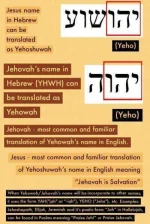
Ang karaniwang salin ng pangalan ng Diyos sa English ay Jehovah (YHWH)

At ang form nito ay "Yeho/Yahu/Yah" kapag idinidugtong sa ilang pangalan gaya ng Yehoshuwah (Jesus),
Yehonatan (Jehonathan)
Yehoshapat (Jehoshapath)
Eliyahu (Elijah)
Yeshayahu (Isaiah)

Kaya naman tama si Jesus nang sabihin niya ang mga salitang ito:
"Dumating ako sa pangalan ng aking Ama." (Juan 5:43)

Para malaman kung bakit ginagamit ng maraming salin ng Bibliya ang pangalang Jehovah?

Pakisuyong i-tap ang link na Ito: You do not have permission to view the full content of this post. Log in or register now.

------

Bakit gumagamit tayo ngayon ng letter J para sa mga pangalan sa Bible imbes na Y?

Dahil sa modernization ng Hebrew alphabet at modernong wika, ang letter "Y" sa Hebreong pangalan ay tina-translate bilang "J" sa English , at hindi lang Ito sa pangalang Jehovah, pati rin sa pangalang Jesus, na ang karaniwang salin ay "Yehoshuwah".

Bakit gumagamit tayo ng "V" nang mas madalas kaysa sa "W", halimbawa, ang pangalan ng Diyos ay nababasa bilang Jehovah imbes na Jehowah sa English?

Pero para malaman kung bakit sa English ay ginamit ang letter "V" bilang transliterasyon ng "W", magbibigay tayo Ng halimbawa: Isalang-alang ang pangalan ng hari sa bibliya na ang pangalan sa Hebreo ay maaring isalin bilang "Dawid". Pero dahil sa modernong wika natin , ginagamit natin ay letrang "V" imbes na "W" kaya binibigkas natin Ito bilang haring "David" at hindi haring "Dawid". Tiyak na mas pamilyar ang mga tao sa David kaysa sa Dawid. Ganoon din sa pangalang Jehovah. Mas pamilyar ang mga tao sa translation na Jehovah. Pero pwede itong bigkasin depende sa ating sariling wika, at dialekto.

Bagaman ginagamit din ng mga Saksi ni Jehova ang pangalan ng Diyos anuman ang bigkas nito depende sa bansa, wika, dialekto at pamilyar sa mga tao. Kaya maaaring basahin ito ng Yahweh o Jehovah depende sa pamilyar sa isang tao. Ang mahalaga ay hindi ang eksaktong bigkas kundi ang mahalaga ay ang katotohanan na ang Diyos ay may sariling pangalan.
FB_IMG_1586123224733.md.webp
Question:
I heard that God's name is supposed to be "Yahweh." Why do people call him "Jehovah" instead? One sect, the "Jehovah's Witnesses," has even used this word in its name.
Answer:
In Hebrew the name of God is spelled YHWH. Since ancient Hebrew had no written vowels, it is uncertain how the name was pronounced originally, but there are records of the name in Greek, which did have written vowels. These records indicate that in all likelihood the name should be pronounced “Yahweh.”
Shortly before the first century A.D., it became common for Jews to avoid saying the divine name for fear of misusing it and breaking the second commandment (“You shall not take the name of the Lord, your God, in vain,” Dt 5:11). Whenever they read Scripture aloud and encountered the divine name, they substituted another Hebrew word, “Adonai” (which means “Lord” or “my Lord”), in its place.
Eventually Hebrew developed written vowels, which appeared as small marks called vowel points and were placed above and below the consonants of a word. In the sixth or seventh century some Jews began to place the vowel points for “Adonai” over the consonants for “Yahweh” to remind the reader of Scripture to say “Adonai” whenever he read “Yahweh.”

About the 13th century the term “Jehovah” appeared when Christian scholars took the consonants of “Yahweh” and pronounced it with the vowels of “Adonai.” This resulted in the sound “Yahowah,” which has a Latinized spelling of “Jehovah.” The first recorded use of this spelling was made by a Spanish Dominican monk, Raymundus Martini, in 1270.
Interestingly, this fact is admitted in much Jehovah’s Witness literature, such as their Aid to Bible Understanding (p. 885). This is surprising because You do not have permission to view the full content of this post. Log in or register now. loathe the Catholic Church and have done everything in their power to strip their church of traces of Catholicism. Despite this, their group’s very name contains a Catholic “invention,” the name “Jehovah.”
Jehovah’s Witnesses blast orthodox Christendom for “hiding the name of God” by replacing “Jehovah” with “the Lord” whenever “Jehovah” appears in Scripture. They charge this is a Jewish “superstition” that dishonors God (which it does not). Yet their own organization has a name that was invented as a result of the same thinking that produced the use of “the Lord.”
 
ano kaya masasabi nila doon sa pangalang lumitaw ngayon na mas tama daw.yong totoo daw pong bigkas ng YHWH ay YaHaWaH at ganyan daw talaga bigkasin ni moises yan.

Dito daw nagkamali ang mga saksi dahil sa modernisasyon ng YHWH

"Dahil sa modernization ng Hebrew alphabet at modernong wika, ang letter "Y" sa Hebreong pangalan ay tina-translate bilang "J" sa English , at hindi lang Ito sa pangalang Jehovah, pati rin sa pangalang Jesus, na ang karaniwang salin ay "Yehoshuwah"."

Kini claim ng mga naniniwala sa pangalang YAHAWAH na ito raw ay ang bigkas noong panahon nila moises(paleo-hebrew).puro daw kasi" a"vowels kung silay gumamit at itong salitang jehovah ay moderno na raw yan kaya produkto yan noong baguhin ang sinaunang wika.kaya para sa kanila mas tama daw ang yahawah.
 
Dito daw nagkamali ang mga saksi dahil sa modernisasyon ng YHWH

"Dahil sa modernization ng Hebrew alphabet at modernong wika, ang letter "Y" sa Hebreong pangalan ay tina-translate bilang "J" sa English , at hindi lang Ito sa pangalang Jehovah, pati rin sa pangalang Jesus, na ang karaniwang salin ay "Yehoshuwah"."

Kini claim ng mga naniniwala sa pangalang YAHAWAH na ito raw ay ang bigkas noong panahon nila moises(paleo-hebrew).puro daw kasi" a"vowels kung silay gumamit at itong salitang jehovah ay moderno na raw yan kaya produkto yan noong baguhin ang sinaunang wika.kaya para sa kanila mas tama daw ang yahawah.

Kahit naman ipangalandakan ng mga tagasunod ng pangalan na yan na tama sila at mali ang nga saksi walang paki ang mga saksi diyan dahil ang may malaking impact sa kanila yong salitang "translated". Anoman ang pagkakasalin ng YHWH sa ibang wika doon sila komporme ma yahweh man yan,ma jehovah man yan o ano pa yan sa wika mo tama yon sa kanila kasi modernized na nga.
 
Status
Not open for further replies.

About this Thread

  • 7
    Replies
  • 816
    Views
  • 5
    Participants
Last reply from:
DoNotDisturb

Online now

Members online
927
Guests online
940
Total visitors
1,867

Forum statistics

Threads
2,277,814
Posts
28,978,958
Members
1,229,078
Latest member
sirapik
Back
Top