 PH
MANILA, Philippines — Business groups are pressing the government to clarify the terms of its trade arrangement with the United States as it warned against relying on a single supplier for agricultural and energy imports.
Management Association of the Philippines president Donald Lim said in a Viber message that the group welcomes stronger trade relations with the US, especially if these lead to lower food and energy costs and greater market access for Philippine businesses.
“However, the reported commitment to source 100 percent of our energy requirements from the US raises important questions,” he stressed.
While the US can be a valuable energy partner, he said that the country should avoid replacing its dependence on one source through reliance on another, citing the importance of diversifying sources.
“Energy security requires diversification, competitive pricing and continued investment in domestic and renewable energy,” he said.
He also said that the full terms of the proposed trade arrangement with the US must be clarified to determine if it is beneficial for both countries.
In particular, he said the following questions need to be answered: what concessions Philippine exporters receive, how increased agricultural imports will affect local farmers and if cheaper energy will translate into lower electricity and operating costs.
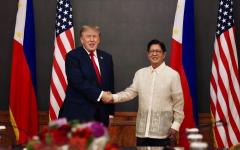
The concern follows conflicting messaging from US President Donald Trump and President Marcos after their meeting in Manila last week.
Trump told reporters at the White House on Saturday that the Philippines will buy 100 percent of its agricultural goods and energy imports from the US.
Meanwhile, Marcos said in China on Friday that the Philippines is looking to buy more agricultural goods and cheaper imported fuel from the US to diversify sources amid supply disruptions and emphasized that the details of the arrangement are still being worked out.
Philippine Exporters Confederation Inc. president Sergio Ortiz-Luis Jr. said the arrangement should not force the country to source from the US if it is not competitive to do so.
“I hope it’s not true. Government cannot just commit because it is not importing. Private sector is the one,” he said. “Malacañang should explain where we are (in the trade arrangement) and ensure that we’re not forced to buy more expensive goods.”
He also said that the US should remove all tariffs, emphasizing the need for both countries to participate in and benefit from trade.
Federation of Philippine Industries chair Elizabeth Lee also emphasized the importance of reciprocity.
“The best route to a healthy trade balance is growing trade in both directions,” she said.
As the country increases its US imports, she said there should also be improved access for Philippine products in the US market.
“That way, both economies grow together and the jobs that depend on our exports are sustained,” she noted.
Just one of several options – Palace
Malacañang explained that the US is only one of several options for sourcing the country’s energy and agricultural needs, stressing that Marcos wants to buy from suppliers offering the lowest prices.
“The more number of sources, the lower the price. The more number of sources, the faster we can address the rise in inflation rate. (We will have) more guaranteed food and energy supply,” Palace press officer Claire Castro said yesterday.
Castro noted that during the Middle East crisis, Marcos ordered Energy Secretary Sharon Garin to ensure an adequate supply of crude products to keep businesses and daily life running.
With a “very strong El Niño” currently underway, the President also directed Agriculture Secretary Francisco Tiu Laurel Jr. to prepare for necessary imports to prevent food shortages.
She assured the public that any transaction entered into by the administration will not negatively affect local products, farmers and fisherfolk.
Meanwhile, she said the Bases Conversion and Development Authority will verify documents allegedly signed via thumbprint by Aetas who did not understand their contents in connection with the Pax Silica initiative.
Castro said BCDA president and CEO Ariel Nepomuceno would have the documents checked to determine whether they are authentic.
Pricing, not geopolitics
For Senate President Sherwin Gatchalian, pricing, not geopolitics must dictate where the Philippines buys its fuel, pushing back against Washington’s pitch for Manila to source its energy exclusively from the US.
In an interview over radio dzBB yesterday, Gatchalian revealed that US Treasury Secretary Scott Bessent actively pressed him during a recent state luncheon for Trump to shift the Philippines’ liquefied natural gas (LNG) purchases from Qatar to the US.
Gatchalian said he told Bessent that while the Philippines has no issue buying American LNG, the distance makes shipping significantly more expensive compared to sourcing from Qatar.
Bessent reportedly floated the possibility of lowering US prices to offset the higher freight costs.
“I told him, it’s a matter of price in the end. If it’s cheaper and more competitive with them, we will buy from them,” Gatchalian said.
Meanwhile, Rep. Antonio Tinio also slammed what he described as a “total surrender” of the Philippines’ energy and food security to the US. — Neil Jayson Servallos, Delon Porcalla
Source: You do not have permission to view the full content of this post. Log in or register now.
Date posted: 2026-11-23T00:00:00+08:00