 PH
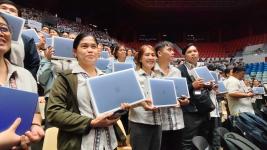
ANTIPOLO CITY, Philippines — The Department of Education (DepEd) distributed 1,441 Apple MacBook Neo laptops to public school teachers on Friday, November 20.
Education Secretary Sonny Angara and local Rizal officials led the turnover ceremony at the Ynares Center, where teachers from 62 schools under the Schools Division Office of Antipolo received the laptops.
The distribution forms part of the DepEd Computerization Program (DCP), which covers more than 230,000 laptops for teachers nationwide, including almost 170,000 MacBook Neo units.
DepEd also procured another 3,646 MacBook Neo devices for administrative personnel. The remaining 62,000 will be Windows-based devices.
The nationwide deployment began earlier this month, including a distribution in Dagupan City on November 9, and is expected to continue until March 2027.
RELATED STORY: MacBook Neo: Why did DepEd partner with Apple?
Training teachers for digital classrooms
Alongside the laptop distribution, DepEd is implementing GuroXL, a professional development program designed to familiarize teachers with digital productivity tools and their applications in classroom instruction.
The initiative is coordinated through DepEd’s National Educators Academy of the Philippines (NEAP), the Information and Communications Technology Service, and the Bureau of Learning Delivery.
During hands-on sessions in Antipolo, teachers practiced setting up their devices, navigating productivity applications, and exploring tools for preparing instructional materials, managing classroom activities, and assessing learners’ progress.
Select teachers also received training from Apple Distinguished Educators before the turnover ceremony.
The training is included in the procurement package at no additional cost to the government.
Teachers who want to pursue further professional development may also obtain Apple Teacher certification.
More instructional videos are also being prepared for online publication in December 2026.
Angara encouraged recipients to familiarize themselves with the laptops’ capabilities rather than limit their use to routine administrative tasks.
“Let’s really take time to listen because they will give you the potential and it will make you more productive. It will save you time, and it will enable you to be a better teacher,” Angara said.
He described the devices as tools that could reduce the time teachers spend on administrative work while allowing them to develop more engaging instructional materials.
Teachers see potential, but connectivity remains a concern
For Joann M. Soria, a master teacher at Sta. Cruz Elementary School, the MacBook Neo offers a welcome change from the laptop she had used for the past decade.
Soria, who teaches English, Filipino, and Science, said the device’s portability was among the first differences she noticed during the introductory training.
“For the past 10 years, I have been using another brand of laptop. So it was heavy, even the charger alone,” she said.
“And then I saw this (MacBook Neo), and it was lightweight. Even the charger is light. I won’t have a hard time carrying it around anymore.”
Beyond portability, Soria expects to use the laptop to prepare digital presentations, compute grades, produce instructional materials, and perform other teaching-related tasks.
Soria, a school paper adviser, looks to also maximize the unit’s potential by conducting online training sessions for student journalists when weather conditions or other circumstances prevent face-to-face activities.
However, Soria acknowledged that internet connectivity could remain a problem despite receiving new equipment.
“Although I haven’t tried it pa naman, when it comes to internet connectivity, that’s usually been the problem, even with our old devices,” she said.
She noted that she had yet to test the laptop under actual school conditions, particularly about connectivity and compatibility with existing equipment.
When asked about technical concerns, including the need for HDMI adapters and other accessories, Angara said schools could address smaller equipment requirements through their increased maintenance and other operating expenses (MOOE) allocations.
“Those are little technical issues that schools can take care of, because schools have an increased MOOE now,” he told reporters.
The education chief maintained that the laptops could improve teachers’ productivity, although internet availability and technical requirements would still need to be addressed at the school level.
Laptop allocation remains limited
Despite the nationwide procurement, not all public school teachers are expected to receive laptops under the current distribution.
Soria said only 66 of the 280 teachers at Sta. Cruz Elementary School were selected as recipients.
She explained that the school followed DepEd’s allocation guidelines, which prioritize teachers who have not before received government-issued laptops.
Some teachers who received devices under earlier distributions were excluded, while those whose previously issued laptops had become unusable could qualify for reconsideration.
“I just hope that soon, 100% of teachers in the Philippines will also receive one,” Soria said.
Angara confirmed that teachers without government-issued laptops would receive priority, followed by schools implementing educational technology programs or working with organizations providing software and training.
“I think the first is if they have not received the laptop before, they’re the top priority,” he said.
The department intends to seek more funding from Congress to expand distribution toward its goal of providing every teacher with a functional laptop.
DepEd defends procurement cost, five-year warranty
DepEd secured the MacBook Neo package at approximately P43,000 per unit, below the device’s suggested Philippine retail price of P49,900.
The procurement includes built-in productivity software, delivery, professional development, and a five-year warranty, compared with the standard one-year retail coverage.
Angara defended the purchase amid questions about its cost, arguing that the additional services and warranty coverage should be considered when assessing its value.
“I don’t think you can question that we got a good value,” said Angara. “The value of what we’re getting from Apple is close to double the actual payment because it comes with upskilling, and it comes with a five-year warranty.”
The secretary also cited complaints from teachers about previously issued laptops, including damaged chargers and devices that were no longer covered by warranties.
He clarified that DepEd was not exclusively procuring Apple products, noting that laptops from other manufacturers were also included in the computerization program.
While the latest distribution expands access to computers among public school teachers, the effectiveness of the rollout will depend on how the devices perform in everyday teaching, the availability of technical support, and whether schools can address persistent connectivity problems.
RELATED STORY: Apple, DepEd partners to send 170,000 Macbook Neo to teachers
Source: You do not have permission to view the full content of this post. Log in or register now.
Date posted: Sat, 21 Nov 2026 19:03:00 PST
