 PH
PH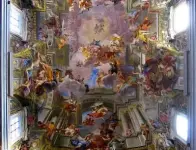
Not every artwork was intended to be experienced straight on.
Certain paintings and decorative works were created for curved walls, ceilings, architectural spaces, or unusual viewing positions.
Artists could distort figures or perspective so that the finished image appeared correct from the intended location.
This is especially important in large-scale architectural painting.
A figure painted on a curved ceiling might look strangely stretched when viewed from the ground in a photograph.
From the original viewing position, however, the distortion could become much less noticeable.
The apparent “mistake” can therefore be evidence that the artwork was designed for a specific architectural environment.
© Smarthistory