 PH
PH
GPT‑5.6 is OpenAI’s new three-tier model family, aimed at higher-quality agentic work—especially coding, research, knowledge work, design, computer use, and defensive cybersecurity—while improving cost efficiency. It launched for general availability on July 9, 2026, across ᑕᕼᗩTGᑭT, Codex, and the API.
The model lineup
Model | Positioning | Best fit | API price per 1M tokens |
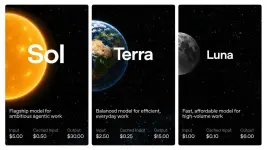
Sol | Flagship, highest capability | Complex coding, deep research, polished deliverables, high-stakes analysis | $5 input / $30 output |
Terra | Balanced everyday model | General work, solid coding, workspaces, cost-conscious quality | $2.50 input / $15 output |
Luna | Fastest and lowest-cost | High-volume tasks, quick drafting, lightweight automation | $1 input / $6 output |
The names are intended as persistent capability tiers, while “5.6” denotes the generation—so future Sol, Terra, and Luna releases can update independently.
What is actually new
maxreasoning: lets the model spend more time exploring, checking, and revising an answer thanxhighreasoning.ultramode: coordinates four agents in parallel by default, prioritizing better and faster results on demanding tasks at a higher token cost.- Programmatic Tool Calling: in the Responses API, the model can write/run lightweight in-memory programs to coordinate tools, filter intermediate data, and adapt a workflow with fewer model round trips.
- Multi-agent API beta: developers can run concurrent subagents and synthesize their work in one request.
- Improved prompt caching: explicit cache breakpoints and a minimum 30-minute cache lifetime; cache reads retain a 90% input-price discount.
Capability highlights
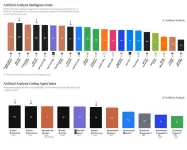
OpenAI positions Sol as its strongest coding model: it reports an 80 score on the Artificial Analysis Coding Agent Index and 91.9% on Terminal-Bench 2.1 in Ultra mode. These are OpenAI-reported benchmark results, so they are useful directional signals but not a substitute for testing it on your own workflows.
For visual and content-production work, the meaningful improvement is design judgment: GPT‑5.6 can generate interfaces from broad direction, inspect the rendered result, catch visual or functional problems, and refine the outcome. OpenAI also claims stronger handling of editable decks, documents, spreadsheets, source templates, typography, spacing, and visual hierarchy.
For knowledge-work agents, OpenAI reports 92.2% on BrowseComp in Sol Ultra mode and 62.6% on OSWorld 2.0 for Sol, indicating a major emphasis on web-like research, computer use, and long multi-step tasks.
Access in ᑕᕼᗩTGᑭT
- Plus, Pro, Business, and Enterprise: GPT‑5.6 Sol in Chat at medium and higher effort settings.
- Pro and Enterprise: access to Sol Pro for the most demanding complex tasks.
- Free and Go: access to Terra through ᑕᕼᗩTGᑭT Work and Codex.
- Plus and above: can select Sol, Terra, or Luna in Work and Codex;
maxis supported. - Ultra: available in ᑕᕼᗩTGᑭT Work for Pro and Enterprise, and in Codex for Plus and higher plans.
Safety implications
GPT‑5.6 is classified by OpenAI as High capability in both cybersecurity and biological/chemical risk, though not at its “Critical” threshold. OpenAI says Sol and Terra can identify vulnerabilities and exploit components, but did not reliably execute autonomous end-to-end attacks against hardened targets in its tests.
The company has applied stronger controls, including model-level safeguards, real-time output checks, monitoring, and access restrictions for sensitive capabilities. It says Sol’s cyber safeguards block roughly ten times more potentially harmful activity than prior safeguards, which may also create occasional friction on legitimate technical prompts.
Practical Take
Sol is best for demanding work where quality matters most: advanced coding, deep research, interactive prototypes, polished documents or presentations, and complex multi-step tasks.
Terra is the likely everyday default. It targets a balance of capability, speed, and cost, making it suitable for general knowledge work, routine coding, content production, and agent workflows.
Luna is designed for speed and volume. It is the practical choice for rapid drafting, classification, summarization, simple automations, and high-throughput tasks where maximum reasoning depth is less important.
The broader shift is that GPT‑5.6 is positioned less as a single-response chatbot and more as an agentic system: it can reason for longer, use and coordinate tools, run parallel subagents, inspect intermediate results, and revise toward an outcome.
Read more about this release here:
You do not have permission to view the full content of this post.
Log in or register now.
Your feedback is highly appreciated

Support my other posts 
- Google just KILLED Photoshop!
- 50 Brilliant Ways to Supercharge Creativity with Nano Banana
- Nano Banana Prompt Gallery
- AI Fashion Studio: AI Virtual Try-On Powered By Nano Banana
- Free Image Upscaler up to 16K Quality!
- Travel the World with Nano Banana
- AI Profile Picture Generator
- AI Snapshot Generator
- ᑕᕼᗩTGᑭT Prompt Packs
- Perplexity at Work
- DumPDF: PDF Editor
- LuxPDF: Open Source PDF Tools
- Gemini Edu ID Card Generator
- Create UNCENS0RED/NSFW AI Characters
- Student ID Card Prompt
- Nano Banana Pro Image And Prompt Gallery
- Create 4K Nano Banana Pro Images
- Create Pro-Grade Infographics
- IHatePDF: Toolkit For Everyday Documents
- Stunning Nano Banana Prompts Gallery
- Create City Map Posters
- Nano Banana 2: ProLevel Image Generation at Flash Speed
- Inside MAI‑Image‑2
- Meet Luma Uni-1
- Microsoft's New MAI Stack
- VEO 3.1 Free on Google Vids
- StreameX: Free Movies, TV Shows and Anime
- 10 Google Gemini Photography Gems
- 12K+ Nano Banana Prompts
- Introducing Google Flow Music
- SplitAnImage Image Splitting Tool
- Introducing ChätGPT Image 2
- 1000+ GPT Image 2 Prompts
- Introducing GPT-5.5
- MeiGen Prompts Gallery
- Stream Movies Using The PlayIMDB Trick
- Structured Image Prompting Custom GPT
- GPT 2 Image Prompt Generator
- MovieNova Free Movie Streaming Site
- NextFlicks - A Strealined Streaming Platform
- Meet Gemini Omni
- Gemini 3.5 Flash - Frontier Intelligence With Action
- Google I/O 2026: Everything Announced
- FREE AI Image Watermark Remover
- Ideogram 4.0 Is Here
- Meta Launches Muse Image
- Introducing GPT-Live