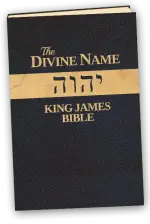
🕯️ Traditions The Divine Name King James Bible

Gentleman007

Forum Expert
dnkjv.webp


Note what the publishers have to say about The Divine Name King James Bible:

"It is a real King James Bible in the sense that we leave all the text as it is in the Authorized King James Bible other than the Divine Name." - Heading: "You do not have permission to view the full content of this post. Log in or register now."

So the DNKJB is claimed to be exactly the same as the Authorized King James Bible except that it has the Divine Name in it. It is a good thing for the publishers to have restored the Divine Name using the DNKJB. However, there were many problems with the original KJV in addition to omitting God's personal name 'Jehovah' from the original Hebrew text.

With the exception of the New World Translation, many translations (including the KJV) were made by those who were influenced by the pagan philosophies and unscriptural traditions that their religious systems had passed down from long ago as well as other influences. Therefore, despite the Divine Name King James Bible restoring the name 'Jehovah' nearly 7,000 times, it still retains a trinitarian bias (Compare John 1:1, John 8:58, Rom. 9:5, Col. 2:9 - just to list a few), along with other unscriptural traditions and influences.
 
1. 17th-century KJV never used “Jehovah” 7,000 times
The 1611 Authorized Version renders the Tetragrammaton (YHWH) almost everywhere as LORD in small caps, following Jewish and Christian practice of the era. Only four verses (Exod 6:3; Ps 83:18; Isa 12:2; 26:4) contain the spelling “Jehovah,” and that tradition remained in all later printings.

2. The form “Jehovah” is a medieval hybrid
Scholars widely note that “Jehovah” arises from combining the consonants YHWH with the vowels of “Adonai.” The English letter J itself did not exist until the late Middle Ages, so no ancient Hebrew or Greek manuscript shows the word “Jehovah”.

3. No Greek New-Testament manuscript contains the Tetragrammaton
All extant NT manuscripts, whether papyri or later uncials, write κύριος (Kyrios, “Lord”)—never the four Hebrew consonants. Thus inserting “Jehovah” into New-Testament verses (which the DNKJB does 128 times) has no manuscript support and conflicts with the textual record.

4. Existing English Bibles that do restore YHWH limit it to the Old Testament
Older versions such as the 1901 American Standard Version or Young’s Literal Translation place “Jehovah” where the Hebrew has YHWH, but they do not insert the name into the Greek NT. DNKJB goes beyond that precedent by introducing it into NT verses based only on cross-references, not on manuscripts.

5. Scholarly reception is highly critical​

Textual critics label DNKJB “an unreliable translation” because it:

  • introduces a form (“Jehovah”) not present in original languages,
  • selectively adds the name in some NT quotations but omits it in others, showing internal inconsistency.

Bottom line​

Historically, the DNKJB departs from both the 1611 KJV and the underlying Hebrew and Greek manuscripts. Its primary alteration—the mass insertion of “Jehovah,” especially into the New Testament—is not supported by any ancient evidence and reflects a theological agenda rather than textual fidelity. Therefore its claim of being “exactly the same as the Authorized KJV, only more accurate” is


not historically factual.
 
1. 17th-century KJV never used “Jehovah” 7,000 times
The 1611 Authorized Version renders the Tetragrammaton (YHWH) almost everywhere as LORD in small caps, following Jewish and Christian practice of the era. Only four verses (Exod 6:3; Ps 83:18; Isa 12:2; 26:4) contain the spelling “Jehovah,” and that tradition remained in all later printings.

2. The form “Jehovah” is a medieval hybrid
Scholars widely note that “Jehovah” arises from combining the consonants YHWH with the vowels of “Adonai.” The English letter J itself did not exist until the late Middle Ages, so no ancient Hebrew or Greek manuscript shows the word “Jehovah”.

3. No Greek New-Testament manuscript contains the Tetragrammaton
All extant NT manuscripts, whether papyri or later uncials, write κύριος (Kyrios, “Lord”)—never the four Hebrew consonants. Thus inserting “Jehovah” into New-Testament verses (which the DNKJB does 128 times) has no manuscript support and conflicts with the textual record.

4. Existing English Bibles that do restore YHWH limit it to the Old Testament
Older versions such as the 1901 American Standard Version or Young’s Literal Translation place “Jehovah” where the Hebrew has YHWH, but they do not insert the name into the Greek NT. DNKJB goes beyond that precedent by introducing it into NT verses based only on cross-references, not on manuscripts.

5. Scholarly reception is highly critical​

Textual critics label DNKJB “an unreliable translation” because it:

  • introduces a form (“Jehovah”) not present in original languages,
  • selectively adds the name in some NT quotations but omits it in others, showing internal inconsistency.

Bottom line​

Historically, the DNKJB departs from both the 1611 KJV and the underlying Hebrew and Greek manuscripts. Its primary alteration—the mass insertion of “Jehovah,” especially into the New Testament—is not supported by any ancient evidence and reflects a theological agenda rather than textual fidelity. Therefore its claim of being “exactly the same as the Authorized KJV, only more accurate” is


not historically factual—sad for you brothers jehovas witnesses..
patingnan nalang to.. pero kung ayaw mo, okay lang din hehe.
https://phcorner.org/threads/hindi-nila-iginalang-ang-pangalan-ng-diyos.2362699/
 

About this Thread

  • 3
    Replies
  • 241
    Views
  • 2
    Participants
Last reply from:
Rectify

Trending Topics

Online now

Members online
1,037
Guests online
1,144
Total visitors
2,181

Forum statistics

Threads
2,269,043
Posts
28,926,066
Members
1,242,223
Latest member
spoknot99
Back
Top