 PH
PHThe rice dish seems viral across demographics, and it’s likely here to stay
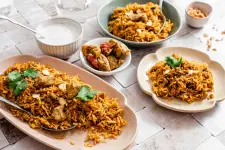
It’s a typical Tuesday at the EDSA MRT and LRT interchange. Dotting the walkway are the semi-legal vendors hawking the usual ephemera: knockoffs of popular toys, grooming and kikay kits, the occasional snake oil potion. But something catches my eye: A stall (really just a monobloc table with a tarpaulin) selling chicken biryani packed in hard plastic containers.
I chat with the lady manning the stall: She’s married to an Indian man and they take turns selling biryani here and also online via Facebook. A tub of her biryani sells for P100 (roughly $1.80), roughly the same price as a meat-and-rice dish in most working-class eateries around Metro Manila.
She shares that daily, her offline stocks run out by noon. I ask her why she thinks biryani has caught on with Filipinos.
“It’s OFW (overseas Filipino worker) relatives bringing the food back home, exposing their families to biryani. I think the spiciness and flavoring of biryani clicks well with Filipino tastebuds, too”
“It’s OFW (overseas Filipino worker) relatives bringing the food back home, exposing their families to biryani. I think the spiciness and flavoring of biryani clicks well with Filipino tastebuds, too,” she smiles in a mix of English and Filipino.
A ‘new’ rice dish for a nation in love with rice dishes
Depending on who you ask, biryani either You do not have permission to view the full content of this post. Log in or register now. from South Asia or the former Persian territories in the Middle East. Even its cooking methods vary. Nonetheless, the dish has become one of the iconic offerings of the greater Middle Eastern and South Asian region.
Common threads include the use of chicken or lamb on flavored basmati long grain rice in ghee (clarified butter), with the You do not have permission to view the full content of this post. Log in or register now. being cloves, cardamom, and cinnamon, often pre-roasted. Fresh herbs and garnishes commonly used are You do not have permission to view the full content of this post. Log in or register now., mint, and lemon rinds.
Selling affordable, pang-masa biryani is a peculiarity that seems to have replicated in the usual liminal spaces taken for granted as we go to and from work, school, and home.
“Biryanis! Biryanis! Biryanis!” I hear through the din of a packed mall food court in Cubao, Quezon City.
Thanks to numerous Indian characters from Holly- and Bollywood films, I could tell from the seller’s voice that his biryanis were legit and would taste fire.
Selling affordable, pang-masa biryani is a peculiarity that seems to have replicated in the usual liminal spaces taken for granted as we go to and from work, school, and home
And lo and behold, it was a Pakistani man also selling complementary dishes like samosas and lassi. The experience was so novel, I couldn’t help but order the full set, and I wasn’t disappointed. I expected a “tinipid” version with small portions and less herbs and spices but it seems our Pakistani friend stuck to his roots.
Weeks later, along a crowded alleyway (it’s actually a two-lane street, but the parked cars have transformed it for better or worse) leading to the tricycle terminal in a low-income Marikina neighborhood, I chance upon a tapsilogan, par for the course in such corners of the metro.
This time around, however, aside from the usual suspects—mami, tapsi, pares—I see biryani on the menu. There are solo, sharing, and party platter options, and diners can choose between chicken or lamb. Prices start at P150 ($2.30) but can shoot for as high as P1,200 ($20).
The challenge in transplanting international cuisine into a new culture lies in balancing traditional flavors with local preferences: Spiciness, bitterness, sweetness, sourness, the knobs here need to be adjusted and this normally sparks debate on whether a dish is “authentic” or not.
Nonetheless, a balance can be struck, and from here, culture not only cross-pollinates and evolves but heritage is also respected. And Filipinos are no stranger to indigenized cuisine, from our versions of starchy Chinese egg noodle dishes to Iberian paellas and stews well into our spin on American fast food.
The challenge in transplanting international cuisine into a new culture lies in balancing traditional flavors with local preferences
It seems biryani, which originated from Indian and Arabic cultures, is taking the same route in Las Islas Filipinas, thanks in large part to migrant Filipino workers returning home.
It seems Filipino cooks across social classes strive as much as possible to stick to biryani’s core principles, importing key ingredients like basmati rice and roasted herbs as needed.
“Our profit margins aren’t much,” the lady at the MRT-LRT exchange says in Taglish, “but at least our recipe is authentic!”