 PH
PHKaplok Kaplok
Established
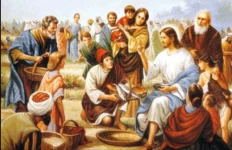
The story of the five loaves and two fishes, traditionally seen as a miracle performed by Jesus, if honestly interpreted, is teaching ideas aligning with communism, emphasizing communal sharing and equality. In this narrative, Jesus feeds 5,000 people with a small amount of food, suggesting that resources, when shared equitably, become sufficient for all. This challenges the capitalist notion of individual accumulation, highlighting that abundance can be achieved through collective generosity and cooperation.
Along with other preaching such as on Matthew 19:21 - about selling possesions and giving to the poor, and Matthew 19:24 - on how it is difficult for the rich to reach the kingdom of God, we will see Jesus' anti-capitalists before "capitalism" was even a defined concept.
Furthermore, Jesus' actions demonstrate leadership that fosters community and cooperation, ensuring everyone is fed equally without regard for status or merit. This embodies the communist ideal of a classless society where resources are distributed based on need. The initial offering of the loaves and fishes symbolizes trust in the power of community, reflecting the belief in people's potential to create a just and equitable society through mutual support.
Ironically, modern Christianity often opposes communism, primarily due to its historical tendency to dictatorial regimes. This is mainly to align with the world's more prominent ideology after the cold war. This opposition overlooks the alignment between Jesus' teachings in this story and the core tenets of communism, which advocate for a fair and just distribution of resources. The narrative of the loaves and fishes, therefore, offers a vision of intellectual dishonesty within the faith, and it's willingness to bend their philosophy, while on the other hand claiming to be the arbiter of the "objective" good and evil.
Along with other preaching such as on Matthew 19:21 - about selling possesions and giving to the poor, and Matthew 19:24 - on how it is difficult for the rich to reach the kingdom of God, we will see Jesus' anti-capitalists before "capitalism" was even a defined concept.
Furthermore, Jesus' actions demonstrate leadership that fosters community and cooperation, ensuring everyone is fed equally without regard for status or merit. This embodies the communist ideal of a classless society where resources are distributed based on need. The initial offering of the loaves and fishes symbolizes trust in the power of community, reflecting the belief in people's potential to create a just and equitable society through mutual support.
Ironically, modern Christianity often opposes communism, primarily due to its historical tendency to dictatorial regimes. This is mainly to align with the world's more prominent ideology after the cold war. This opposition overlooks the alignment between Jesus' teachings in this story and the core tenets of communism, which advocate for a fair and just distribution of resources. The narrative of the loaves and fishes, therefore, offers a vision of intellectual dishonesty within the faith, and it's willingness to bend their philosophy, while on the other hand claiming to be the arbiter of the "objective" good and evil.