 PH
PHGentleman007
Elite
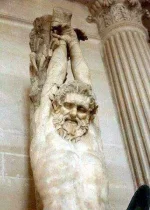
The old E×ρréššion "The Greeks had a word for it" is very literally true. They have, for example, not one but four different words for "love."
There are two words used in the original Greek bible to describe the implement of Jesus' death. Yet nearly every English bible says that Jesus was killed on a "cross", and the verb form says that he was "crucified."
The two Greek words in question are stauros (pronounced Stou-ros or stavros) and xylon (pronounced ksee-lon). Here's what Greek scholars say about those two words:
Strong’s Greek Dictionary:
4716. Stauros
"A stake or post (as set upright), i.e. (specially), a pole or cross (as an instrument of capital punishment) Appears 28 times in the NT."
The Anchor Bible Dictionary defines "Crucifixion" as:
The act of nailing or binding a living victim or sometimes a dead person to a cross or stake (stauros or skolops) or a tree (xylon)"
The New Catholic Encyclopaedia:
"Crucifixion developed from a method of execution by which the victim was fastened to an upright stake either by impaling him on it or by tying him to it with thongs..."
Nelson's Illustrated Bible Dictionary defines "Crucifixion" as:
"The method of torture and execution used by the Romans to put Christ to death. At a crucifixion the victim usually was nailed or tied to a wooden stake and left to die..."
Vine's Expository Dictionary of New Testament Words:
"Stauros denotes, primarily, an upright pale or stake. On such, malefactors were nailed for execution..."
A Dictionary of the Bible, Dealing With Its Language, Literature And Contents, Including the Biblical Theology, in New Testament usage:
"[Stauros] means properly a stake…"
Hastings' Dictionary Of The Bible states:
"The Greek term rendered 'cross' in the English NT is stauros, which has a wider application than we ordinarily give to 'cross,' being used of a single stake or upright beam as well as of a cross composed of two beams."
The Illustrated Bible Dictionary, 1980
"The Greek word for 'cross' (stauros) means primarily an upright stake or beam, and secondarily a stake used as an instrument for punishment and execution. It is used in this latter sense in the New Testament."
The Catholic Encyclopaedia
"The cross originally consisted of a simple vertical pole, sharpened at its upper end."
The Classic Greek Dictionary, Greek-English and English-Greek:
"'stauros': ...an upright pale, stake or pole; in plural, a palisade."
The Companion Bible, Appendix 162:
"In the Greek N.T. two words are used for 'the cross' on which the Lord was put to death: 1. The word stauros; which denotes an upright pale or stake, to which the criminals were nailed for execution. 2. The word xylon, which generally denotes a piece of a dead log of wood, or timber, for fuel or for any other purpose. It is not like dendron, which is used of a living, or green tree, as in Matt.21: 8; Rev.7: 1, 3; 8:7; 9: 4, &c. As this latter word xylon is used interchangeably with stauros it shows us the meaning of each is exactly the same. The verb stauroo means to drive stakes. Our English word 'cross' is the translation of the Latin crux; but the Greek stauros no more means a crux than the word 'stick' means a 'crutch'. Homer uses the word stauros of an ordinary pole or stake, or a simple piece of timber.[footnote, Iliad xxiv.453. Odyssey xiv.11] And this is the meaning and usage of the word throughout the Greek classics. It never means two pieces of timber placed across one another at any angle, but of always one piece alone. Hence the use of the word xylon (No.2 above) in connection with the manner of our Lord's death and rendered 'tree' in Acts 5:30."
Other scriptural evidence:
Is there other evidence within the Bible itself that can help us know how Jesus was killed? As it turns out, there is.
As noted above, at Acts 5:30, Peter declared that Jesus was "hanged upon a tree (xylon)." Acts 10:39 and 13:29 also use the same E×ρréššion, that Jesus was 'hanged upon a tree.' Most Bibles so translate the phrase.
Where else does the Bible use that word xylon?
Matthew 26:55 "Did you come out to arrest me with swords and sticks (xylon)?"
Luke 23:31 "If they do these things when the tree (xylon) is green, what will they do when it withers?"
Acts 16:24 "...they locked their feet into the stocks (xylon)."
Galatians 3:13 "Cursed is every one that hangeth on a tree (xylon)."
1 Peter 2:24 "He carried our sins up to the tree (xylon)."
Revelation 2:7 "...the tree (xylon) of life in the midst of the garden."
Revelation 18:12 "...every vessel made of costliest wood (xylon)..."
Revelation 22:2, 14 "...the tree (xylon) of life..."
Of the 20+ occurrences of stauros in the Greek New Testament, most Bibles consistently render the word "cross." But, not so fast: the 70 Jewish scholars who translated the Hebrew old testament into Greek known as the Septuagint, shortly before Jesus' day, also had access to the word stauros. Did they render it "cross"?
No. At Esther 7:9 we find the story of Haman erecting a 50-cubit-tall stauros on which he planned to hang Mordecai, on which he ended up being hoisted himself. Was this stauros a cross? Bibles variously render the implement there as "pillar, tree, gallows." None render it "cross." Why not? If the Septuagint translators rendered the word stauros, why shouldn't English translators render it "cross"? Why the inconsistency?
The answer is obvious: Haman didn't die on a cross.
Haman was hoisted up to the top of a telephone pole 75 FEET HIGH! The idea of attaching his body to a cross-member that far in the air is ludicrous. And there is simply no reference in the Esther account to a crossbar.
And neither is there any reference to a cross-member in any account of Jesus' execution.
The words "cross" and "crucifixion" comes from the Latin word crux, not the Greek stauros. Did the bible writers use stauros simply because there was no Greek word to describe a crossed piece of wood? Of course not.
If Jesus was killed on an implement the Romans called a "crux", the Bible writers would have inserted the Latin word crux. There are numerous examples where the Bible writers used Latin names for things that weren't native to Judea: Census, Praetorium, flagellum, etc. Furthermore, Greek had words that translated the idea of crossing. Luke 16:26 says: "Those wishing to cross (diabenai) from here to you are not able." Acts 16:9 says "Cross over (diabas) to Macedonia and help us." If neither of those words worked, a writer could have simply made up a word, using elements of dia and xylon to convey the idea. Just as there are examples of Bible writers using Latin words, there are also numerous examples of Bible writers making up new words as the need arose. For example, the Greeks had no word for humility until Paul attached the idea of "low" to the word for "mind" and came up with tapeinophrosune.
Does it matter what you believe on this subject, or is it simply an interesting word puzzle?
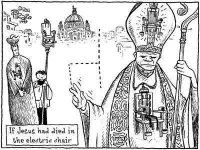
Ultimately, whether Jesus was nailed to a stake, a cross, an X, or was hit by a bus, what matters is this:
- His death ρáíd the ransom to buy back life for those exercising faith.
- Wearing the instrument of his death around your neck is idolatry, and it's insulting.