PH
PHGentleman007
Elite
Everybody who isn’t completely dead from the neck up realizes that a red-suited, white-bearded fat man saying “Ho ho ho,” has absolutely nothing to do with celebrating the birth of the Christ.
It is so brain-dead obvious, in fact, that you seem like a Scrooge for even pointing it out. Why spoil everyone’s fun?
Should you care? Does Christ care? Even the ‘Let’s put Christ back into Christmas’ folks aren’t calling for a ban on Santa, are they? Their message seems to be more about performing charitable works at Christmastime instead of simply perpetuating materialism.
Should Santa be avoided by Christians?
One meme that floats around the internet claims that ‘Santa’ is simply an anagram for ‘Satan.’ I used to think that was a stretch... just because 'santa' and 'satan' have the same letters, that's a coincidence, isn’t it? That’s as weird as twisting ‘St. Nick’ into 'Old Nick' – British slang for Satan. (Remember the movie Little Nicky about Satan’s son?) Can’t be a connection, can there?
Now, I'm not so sure. "Santa" is an American word. It seems to have been made up by Clement Clarke Moore, who wrote the poem we know as 'The night before Christmas' in the early 1800s. He made up 'Santa Claus' out of the Dutch 'sinterklaas’ – Saint Nicholas. New York at that time, aka New Amsterdam, still had a significant Dutch population during his life.
But how did Moore arrive at 'Santa'? Moore was an American professor of Oriental and Greek Literature, as well as Divinity and Biblical Learning, at the General Theological Seminary of the Protestant Episcopal Church, in New York City. “Oriental literature,” in this context refers to the Hebrew Scriptures. Hebrew doesn’t have a word that sounds anything like ‘santa.’ The closest it comes is sha`atah, which Strong’s dictionary defines as “feminine, from an unused root meaning to stamp; a clatter (of hoofs):--stamping. (Only at Jeremiah 47:3)” If you’re curious, Jeremiah 47:3 reads, “At the noise of the stamping of the hoofs of his stallions, at the rushing of his chariots, at the rumbling of their wheels, the fathers look not back to their children.” If you know the poem, you know Moore was familiar with that verse. So maybe it isn’t a stretch at all that he could have been thinking of the Hebrew word ‘sha’atah’ when he invented Santa.
And it is not a stretch at all that he may have mushed that Hebrew word with one of the Latin words related to holy, “Sancta,” as in “sancta sanctorum,” holy of holies.
While Satanists do enjoy tweaking people’s noses with anagrams such as Santa/Satan, there is no evidence that Moore was a Satanist. He simply made up a word, drawing from the Dutch idea and the sound of “Sinterklaas.”
But what was the Dutch idea of Sinterklaas?
They celebrated Saint Nicholas’ day on December 6. That celebration had nothing to do with Christmas. Nicholas had a sidekick, a horned, hairy goat-shaped character called Krampus. In other parts of Europe he was called ‘Black Pete.’ Children were told they would be judged by the pair. If they were good, Nicholas would give them coins or candy. If they were judged as naughty, Krampus or Black Pete would beat them with a bundle of birch switches. If they were really bad, Krampus would throw them in his bag and take them back to hell. That’s right: Krampus was a demon. (Pete was simply a moor – an African Muslim. His threat was to take kids back to Africa.)
What was Moore thinking, calling Santa a ‘jolly old elf’?
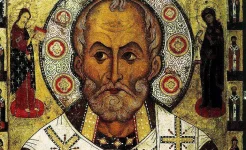
Martin Luther condemned the celebration of St. Nicholas’ day. After all, the belief was based on a legend, with little proof, of a charitable bishop of Myra of the 4th century, who was canonized by the Roman Catholic Church. (As Martin Luther knew, a lot of the Church’s “saints” were never real or, if based on a real person, were grossly embellished.)
According to Greek legend, at the Council of Nicaea in 325, when Arius got up to try explain to the assembled bishops what the Bible says about Jesus – that he was created, that he had a beginning, that he was “the son of God” not ‘God the son,’ bishop Nicholas slugged him in the face. Sure, let’s set him up as the arbiter of who’s naughty and who’s nice. According to the official Catholic creed, however, Nicholas wasn’t there.
Martin Luther realized that removing a pagan celebration and asking people to change their thinking to (gasp!) the truth, was a bridge too far. So as churches everywhere have always done, he instead transmogrified St. Nicholas’ day into a celebration revolving around Kris Kringle. Kris Kringle is simply a mangled form of the old German ‘Krist kindle’ – Christ child. People wouldn’t sit still for it, and in no time, Kris Kringle and Santa Claus became one and the same. It took only a couple hundred years for the Christ child to become a red-suited jolly elf. The goat-shaped demon sidekick was kicked to the side, although he’s still popular in Europe.
But even the Sinterklaas legend isn’t really based on the quasi-true stories of the perhaps real Nicholas of Myra. Long before Christianity began to be preached in Northern Europe the people there worshipped Odin or Woden. (If you think you’ve never heard of him, Wednesday started out as Woden’s Day.) Guess how Odin was depicted? Long white beard, red cape, flying horse, delivering gifts to nice children in December.
If someone asked you to worship Baal, Molech or one of the other pagan gods listed in the Bible, no doubt you would refuse, right? And you would never worship Satan, would you?
If Satan took one of the old pagan gods you rejected, dressed him up in a red suit, white beard, big smile, twinkly eyes – are you still going to reject him?
Who could possibly have arranged a celebration that encourages your kids to direct their petitions to Santa instead of to God? Call the Santa hotline, write Santa a letter? Put out food and drink offerings for him?
Could it be, possibly, in the words of the Church Lady, “SATAN?”