 PH
PH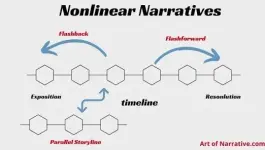
Literary narratives don't have to follow the same order in which events happened.
A writer can begin near the end, jump backward into the past, return to the present, and then reveal information from an even earlier period.
These techniques include flashbacks, flash-forwards, and non-linear narration.
The reader gradually reconstructs the actual timeline.
This can create suspense because the audience may know the outcome before discovering how the characters reached it.
It can also make a familiar event feel completely different when the reader later learns what caused it.
Chronology is therefore only one possible way to organize a story.
Sometimes rearranging time is what makes the story work.
© Purdue Online Writing Lab