 PH
PHPHC-TheGlock
Forum Master
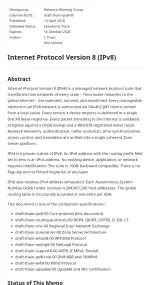
The provided draft outlines Internet Protocol Version 8 (IPv8), a managed network protocol suite designed to resolve IPv4 address exhaustion and management fragmentation. It proposes a 64-bit address format where IPv4 acts as a completely backward-compatible subset, ensuring no forced migration or dual-stack operation is required. Furthermore, IPv8 integrates network telemetry, authentication, name resolution, and access control into a single coherent Zone Server platform to simplify network operations.
Address Format
An IPv8 address uses a 64-bit structure formatted as r.r.r.r.n.n.n.n, where the first half represents a 32-bit Autonomous System Number routing prefix, and the second half acts as the traditional 32-bit host address.
Standard IPv8 Address
Format: 0.0.251.240.192.0.2.1
This example translates to an ASN prefix of 64496 combined with a standard IPv4-style host address of 192.0.2.1.
IPv4 Compatibility
Format: 0.0.0.0.192.0.2.1
If the ASN routing prefix is set to all zeros, the address is processed using standard IPv4 rules, meaning existing devices do not require hardware or software modifications.
Internal Zone Prefix
Format: 127.1.0.0.10.0.0.1
The 127 block in the prefix is permanently reserved for internal zone identifiers that are never routed externally, architecturally preventing address conflicts between different private networks.
You do not have permission to view the full content of this post. Log in or register now.
What do you think about it?
Address Format
An IPv8 address uses a 64-bit structure formatted as r.r.r.r.n.n.n.n, where the first half represents a 32-bit Autonomous System Number routing prefix, and the second half acts as the traditional 32-bit host address.
Standard IPv8 Address
Format: 0.0.251.240.192.0.2.1
This example translates to an ASN prefix of 64496 combined with a standard IPv4-style host address of 192.0.2.1.
IPv4 Compatibility
Format: 0.0.0.0.192.0.2.1
If the ASN routing prefix is set to all zeros, the address is processed using standard IPv4 rules, meaning existing devices do not require hardware or software modifications.
Internal Zone Prefix
Format: 127.1.0.0.10.0.0.1
The 127 block in the prefix is permanently reserved for internal zone identifiers that are never routed externally, architecturally preventing address conflicts between different private networks.
You do not have permission to view the full content of this post. Log in or register now.
What do you think about it?