PH
PHGildarts Tale
Eternal Poster

1. John 1:1 and the missing article (“Theos”)
The claim misunderstands Greek grammar. In Greek, a predicate noun before the verb often drops the article to describe nature, not to make the noun indefinite. Scholars call this Colwell’s Rule.
So “the Word was Theos” does not mean “a god.” It means the Word has the nature of God while still being distinct from the Father mentioned earlier in the verse.
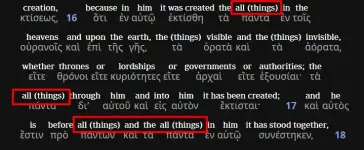
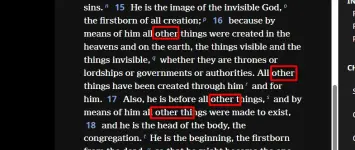
John immediately confirms this in John 1:3: “All things were made through Him.” If everything created came through the Word, the Word cannot be a created being.
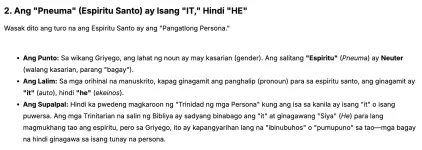
2. The Holy Spirit as “it” because Pneuma is neuter
Greek grammatical gender does not determine personhood.
Examples:
- “Child” (teknon) is neuter but refers to a person.
- “Spirit” (pneuma) is neuter but can still refer to a person.
More importantly, the Bible attributes personal actions to the Spirit:
- He teaches (John 14:26)
- He speaks (Acts 13:2)
- He can be lied to (Acts 5:3–4)
Also, in John 16:13–14, masculine pronouns are used when referring to the Spirit, reinforcing personal agency.
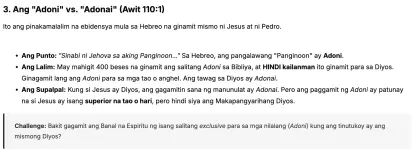
3. Adoni vs Adonai (Psalm 110:1)
This argument ignores how the passage is used in the New Testament.
Psalm 110:1 is quoted repeatedly about Jesus (Matthew 22:41–45, Acts 2:34–36). David calls the Messiah “my Lord.” Jesus’ whole argument is that the Messiah is more than merely David’s descendant.
Also, the New Testament writers apply YHWH passages directly to Jesus:
- Isaiah 45:23 → Philippians 2:10–11 (every knee bows to Jesus)
- Joel 2:32 → Romans 10:13 (calling on the Lord applied to Christ)
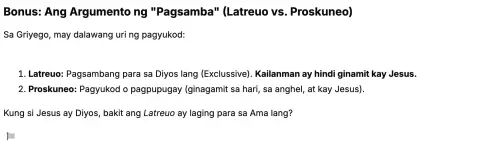
4. Latreuo vs Proskuneo (worship)
The argument is misleading.
- Proskuneo is used for true worship of God in many passages (John 4:24, Revelation 22:9).
- The same word is used for worship directed to Jesus (Matthew 14:33, John 9:38, Hebrews 1:6).
Angels are forbidden to receive worship themselves (Revelation 22:8–9), yet they are commanded to worship Christ.
In short:
These arguments rely on partial grammar claims while ignoring the full biblical context. The New Testament consistently presents Jesus as distinct from the Father yet sharing God’s divine nature, and the Holy Spirit as a personal divine agent, not merely a force.