 PH
PH
D
Deleted member 1561763
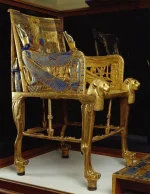
The 'Golden Throne' of Tutankhamun stands as a remarkable piece of art, showcasing intricate craftsmanship and rich detailing. Constructed from wood and adorned with gold, silver, semi-precious stones, and colored glass, the throne has retained its vibrant colors for over three thousand years, a testament to the exceptional skills of ancient Egyptian craftsmen.
The royal chair features projecting lions' heads guarding the seat, while the arms take the form of winged uraei or rearing cobras wearing the double crown of Egypt, protecting the cartouche names of the king. In Egyptian hieroglyphs, the throne is named (Ist) after the mother goddess Isis, often depicted with a throne on her head.
Discovered in 1922 by British Archaeologist Howard Carter beneath a hippopotamus funerary bed in the antechamber of Tutankhamun's tomb, the golden throne symbolizes the connection between the worlds of gods and people, representing majesty, stability, safety, and balance. As kings were considered gods on earth, Tutankhamun likely asserted his divine will while seated on this throne.
The back of the throne depicts Queen Ankhesenamun in a typical Amarna style scene, holding a salve-cup and spreading perfumed oil on her husband's collar, with the sun disc Aten shining above the royal couple. The scene portrays an intimate moment in art history, showing Tutankhamun being regaled with ointment by his wife Ankhesenamun. Both king and queen wear elaborate crowns, collars, and inlaid linen robes.
This historic artifact is housed in the Egyptian Museum, Cairo.
The royal chair features projecting lions' heads guarding the seat, while the arms take the form of winged uraei or rearing cobras wearing the double crown of Egypt, protecting the cartouche names of the king. In Egyptian hieroglyphs, the throne is named (Ist) after the mother goddess Isis, often depicted with a throne on her head.
Discovered in 1922 by British Archaeologist Howard Carter beneath a hippopotamus funerary bed in the antechamber of Tutankhamun's tomb, the golden throne symbolizes the connection between the worlds of gods and people, representing majesty, stability, safety, and balance. As kings were considered gods on earth, Tutankhamun likely asserted his divine will while seated on this throne.
The back of the throne depicts Queen Ankhesenamun in a typical Amarna style scene, holding a salve-cup and spreading perfumed oil on her husband's collar, with the sun disc Aten shining above the royal couple. The scene portrays an intimate moment in art history, showing Tutankhamun being regaled with ointment by his wife Ankhesenamun. Both king and queen wear elaborate crowns, collars, and inlaid linen robes.
This historic artifact is housed in the Egyptian Museum, Cairo.
