 PH
PH
You do not have permission to view the full content of this post. Log in or register now.
-
Welcome to PHCorner Forums! Sign up for free to unlock full access and exclusive privileges, including:
- Asking questions about computer and mobile issues
- Discovering internet tips for your mobile network and computer
You are using an out of date browser. It may not display this or other websites correctly.
You should upgrade or use an alternative browser.
You should upgrade or use an alternative browser.
🔒 Closed Çℎḙḡḡ Questions
- Thread starter DCCS
- Start date
- Status
- Not open for further replies.
mitchieeeko
Journeyman
maraming salamat poooooo

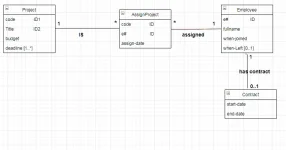
Simplification of the conceptual schema contain only 4 classes

- 1. Project class
- 2. Employee class
- 3. Contract class
- 4. AssignProject class
- 1. There are 1:M relatonship between Project class and AssignProject Class
- 2. There are M:1 relatonship between AssignProject class and Employee class
- 3. There are 1:1 relatonship between Contract class and Employee class.
Attachments
First question answer
Answer :
NOTE: As per the Çℎḙḡḡ guidelines we are allowed to answer only one question at a time . Violating Çℎḙḡḡ guidelines might lead to termination of expert's account . Please post the other question seperately to be answered by other experts . Thank you for understanding .
C++ code:
#include<bits/stdc++.h>
using namespace std;
// Complement of set A
string complementA(string a,string b){
int n = a.size(), m = b.size();
string s = "";
if(n<m){
for(int i=0;i<m;i++){
if(a=='0' && b=='1') s+="1";
else s+="0";
}
}
else{
for(int i=0;i<n;i++){
if(a=='0' && b=='1') s+="1";
else s+="0";
}
}
return s;
}
// Intersection of set A and B
string AandB(string a,string b){
int n = a.size(), m = b.size();
string s = "";
if(n<m){
for(int i=0;i<m;i++){
if(a==b && a=='1') s+="1";
else s+="0";
}
}
else{
for(int i=0;i<n;i++){
if(a==b && a=='1') s+="1";
else s+="0";
}
}
return s;
}
// Union of set A and B
string AUB(string a,string b){
int n = a.size(), m = b.size();
string s = "";
if(n<m){
for(int i=0;i<m;i++){
if(b=='1' || a=='1') s+="1";
else s+="0";
}
}
else{
for(int i=0;i<n;i++){
if(a=='1' || b=='1') s+="1";
else s+="0";
}
}
return s;
}
string A_B(string a,string b){
int n = a.size(), m = b.size();
string s = "";
if(n<m){
for(int i=0;i<m;i++){
if(a=='1' && b=='0') s+="1";
else s+="0";
}
}
else{
for(int i=0;i<n;i++){
if(a=='1' && b=='0') s+="1";
else s+="0";
}
}
return s;
}
// Xor of set A and B
string AxorB(string a, string b){
int n = a.size(), m = b.size();
string s = "";
if(n<m){
for(int i=0;i<m;i++){
if(a != b) s+="1";
else s+="0";
}
}
else{
for(int i=0;i<n;i++){
if(a != b) s+="1";
else s+="0";
}
}
return s;
}
int main(){
// For taking input from file
// Include these line of code if you want to read data from text file rest will remain same
/*
string line;
vector<string> vec;
ifstream myfile ("example.txt");
if (myfile.is_open()){
while ( getline (myfile,line) )
{
vec.push_back(line);
}
myfile.close();
}
vector<int> arr1,arr2;
for(int i=0;i<vec[0].size();i++)
arr1.push_back(stoi(vec[0]));
for(int i=0;i<vec[1].size();i++)
arr2.push_back(stoi(vec[1]));
*/
int arr1[] = {1,2,3,4,5,7};
int arr2[] = {2,4,6,7,9};
string a="",b;
for(int i=0;i<100;i++) a+="0";
b=a;
cout<<"Set A and B are as follows:\n";
for(int i=0;i<sizeof(arr1)/sizeof(arr1[0]);i++){
a[arr1]='1'; // Converting array to bitwise string
cout<<arr1;
}
cout<<endl;
for(int i=0;i<sizeof(arr2)/sizeof(arr2[0]);i++){
b[arr2]='1'; // Converting array to bitwise string
cout<<arr2;
}
cout<<endl;
string ans = AUB(a,b);
cout<<"Union of two sets is: ";
for(int i=0;i<100;i++)
if(ans=='1') cout<<i;
cout<<endl;
cout<<"Xor of two sets is: ";
ans = AxorB(a,b);
for(int i=0;i<100;i++)
if(ans=='1') cout<<i;
cout<<endl;
cout<<"Intersection of two sets is: ";
ans = AandB(a,b);
for(int i=0;i<100;i++)
if(ans=='1') cout<<i;
cout<<endl;
cout<<"Difference of two sets is: ";
ans = A_B(a,b);
for(int i=0;i<100;i++)
if(ans=='1') cout<<i;
cout<<endl;
cout<<"Complement of sets A is: ";
ans = complementA(a,b);
for(int i=0;i<100;i++)
if(ans=='1') cout<<i;
cout<<endl;
return 0;
}
Output:
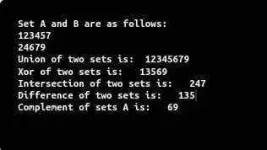
Answer :
NOTE: As per the Çℎḙḡḡ guidelines we are allowed to answer only one question at a time . Violating Çℎḙḡḡ guidelines might lead to termination of expert's account . Please post the other question seperately to be answered by other experts . Thank you for understanding .
C++ code:
#include<bits/stdc++.h>
using namespace std;
// Complement of set A
string complementA(string a,string b){
int n = a.size(), m = b.size();
string s = "";
if(n<m){
for(int i=0;i<m;i++){
if(a=='0' && b=='1') s+="1";
else s+="0";
}
}
else{
for(int i=0;i<n;i++){
if(a=='0' && b=='1') s+="1";
else s+="0";
}
}
return s;
}
// Intersection of set A and B
string AandB(string a,string b){
int n = a.size(), m = b.size();
string s = "";
if(n<m){
for(int i=0;i<m;i++){
if(a==b && a=='1') s+="1";
else s+="0";
}
}
else{
for(int i=0;i<n;i++){
if(a==b && a=='1') s+="1";
else s+="0";
}
}
return s;
}
// Union of set A and B
string AUB(string a,string b){
int n = a.size(), m = b.size();
string s = "";
if(n<m){
for(int i=0;i<m;i++){
if(b=='1' || a=='1') s+="1";
else s+="0";
}
}
else{
for(int i=0;i<n;i++){
if(a=='1' || b=='1') s+="1";
else s+="0";
}
}
return s;
}
string A_B(string a,string b){
int n = a.size(), m = b.size();
string s = "";
if(n<m){
for(int i=0;i<m;i++){
if(a=='1' && b=='0') s+="1";
else s+="0";
}
}
else{
for(int i=0;i<n;i++){
if(a=='1' && b=='0') s+="1";
else s+="0";
}
}
return s;
}
// Xor of set A and B
string AxorB(string a, string b){
int n = a.size(), m = b.size();
string s = "";
if(n<m){
for(int i=0;i<m;i++){
if(a != b) s+="1";
else s+="0";
}
}
else{
for(int i=0;i<n;i++){
if(a != b) s+="1";
else s+="0";
}
}
return s;
}
int main(){
// For taking input from file
// Include these line of code if you want to read data from text file rest will remain same
/*
string line;
vector<string> vec;
ifstream myfile ("example.txt");
if (myfile.is_open()){
while ( getline (myfile,line) )
{
vec.push_back(line);
}
myfile.close();
}
vector<int> arr1,arr2;
for(int i=0;i<vec[0].size();i++)
arr1.push_back(stoi(vec[0]));
for(int i=0;i<vec[1].size();i++)
arr2.push_back(stoi(vec[1]));
*/
int arr1[] = {1,2,3,4,5,7};
int arr2[] = {2,4,6,7,9};
string a="",b;
for(int i=0;i<100;i++) a+="0";
b=a;
cout<<"Set A and B are as follows:\n";
for(int i=0;i<sizeof(arr1)/sizeof(arr1[0]);i++){
a[arr1]='1'; // Converting array to bitwise string
cout<<arr1;
}
cout<<endl;
for(int i=0;i<sizeof(arr2)/sizeof(arr2[0]);i++){
b[arr2]='1'; // Converting array to bitwise string
cout<<arr2;
}
cout<<endl;
string ans = AUB(a,b);
cout<<"Union of two sets is: ";
for(int i=0;i<100;i++)
if(ans=='1') cout<<i;
cout<<endl;
cout<<"Xor of two sets is: ";
ans = AxorB(a,b);
for(int i=0;i<100;i++)
if(ans=='1') cout<<i;
cout<<endl;
cout<<"Intersection of two sets is: ";
ans = AandB(a,b);
for(int i=0;i<100;i++)
if(ans=='1') cout<<i;
cout<<endl;
cout<<"Difference of two sets is: ";
ans = A_B(a,b);
for(int i=0;i<100;i++)
if(ans=='1') cout<<i;
cout<<endl;
cout<<"Complement of sets A is: ";
ans = complementA(a,b);
for(int i=0;i<100;i++)
if(ans=='1') cout<<i;
cout<<endl;
return 0;
}
Output:
2nd question answer
Answer:
Source Code: In C++
#include <algorithm>
#include <iostream>
using namespace std;
int binarySearch(int arr[], int l, int r, int x);
void printUnion(int arr1[], int arr2[], int m, int n)
{
if (m > n) {
int* tempp = arr1;
arr1 = arr2;
arr2 = tempp;
int temp = m;
m = n;
n = temp;
}
sort(arr1, arr1 + m);
for (int i = 0; i < m; i++)
cout << arr1 << " ";
for (int i = 0; i < n; i++)
if (binarySearch(arr1, 0, m - 1, arr2) == -1)
cout << arr2 << " ";
}
// Prints intersection of arr1[0..m-1] and arr2[0..n-1]
void printIntersection(int arr1[], int arr2[], int m, int n)
{
// Before finding intersection, make sure arr1[0..m-1]
// is smaller
if (m > n) {
int* tempp = arr1;
arr1 = arr2;
arr2 = tempp;
int temp = m;
m = n;
n = temp;
}
// Now arr1[] is smaller
// Sort smaller array arr1[0..m-1]
sort(arr1, arr1 + m);
// Search every element of bigger array in smaller
// array and print the element if found
for (int i = 0; i < n; i++)
if (binarySearch(arr1, 0, m - 1, arr2) != -1)
cout << arr2 << " ";
}
// A recursive binary search function. It returns
// location of x in given array arr[l..r] is present,
// otherwise -1
int binarySearch(int arr[], int l, int r, int x)
{
if (r >= l) {
int mid = l + (r - l) / 2;
// If the element is present at the middle itself
if (arr[mid] == x)
return mid;
// If element is smaller than mid, then it can only
// be presen in left subarray
if (arr[mid] > x)
return binarySearch(arr, l, mid - 1, x);
return binarySearch(arr, mid + 1, r, x);
}
// We reach here when element is not present in array
return -1;
}
int main()
{
int arr1[] = { 7, 1, 5, 2, 3, 6 };
int arr2[] = { 3, 8, 6, 20, 7 };
int m = sizeof(arr1) / sizeof(arr1[0]);
int n = sizeof(arr2) / sizeof(arr2[0]);
// Function call
cout << "Union of two arrays is n";
printUnion(arr1, arr2, m, n);
cout << "nIntersection of two arrays is n";
printIntersection(arr1, arr2, m, n);
return 0;
}
Answer:
Source Code: In C++
#include <algorithm>
#include <iostream>
using namespace std;
int binarySearch(int arr[], int l, int r, int x);
void printUnion(int arr1[], int arr2[], int m, int n)
{
if (m > n) {
int* tempp = arr1;
arr1 = arr2;
arr2 = tempp;
int temp = m;
m = n;
n = temp;
}
sort(arr1, arr1 + m);
for (int i = 0; i < m; i++)
cout << arr1 << " ";
for (int i = 0; i < n; i++)
if (binarySearch(arr1, 0, m - 1, arr2) == -1)
cout << arr2 << " ";
}
// Prints intersection of arr1[0..m-1] and arr2[0..n-1]
void printIntersection(int arr1[], int arr2[], int m, int n)
{
// Before finding intersection, make sure arr1[0..m-1]
// is smaller
if (m > n) {
int* tempp = arr1;
arr1 = arr2;
arr2 = tempp;
int temp = m;
m = n;
n = temp;
}
// Now arr1[] is smaller
// Sort smaller array arr1[0..m-1]
sort(arr1, arr1 + m);
// Search every element of bigger array in smaller
// array and print the element if found
for (int i = 0; i < n; i++)
if (binarySearch(arr1, 0, m - 1, arr2) != -1)
cout << arr2 << " ";
}
// A recursive binary search function. It returns
// location of x in given array arr[l..r] is present,
// otherwise -1
int binarySearch(int arr[], int l, int r, int x)
{
if (r >= l) {
int mid = l + (r - l) / 2;
// If the element is present at the middle itself
if (arr[mid] == x)
return mid;
// If element is smaller than mid, then it can only
// be presen in left subarray
if (arr[mid] > x)
return binarySearch(arr, l, mid - 1, x);
return binarySearch(arr, mid + 1, r, x);
}
// We reach here when element is not present in array
return -1;
}
int main()
{
int arr1[] = { 7, 1, 5, 2, 3, 6 };
int arr2[] = { 3, 8, 6, 20, 7 };
int m = sizeof(arr1) / sizeof(arr1[0]);
int n = sizeof(arr2) / sizeof(arr2[0]);
// Function call
cout << "Union of two arrays is n";
printUnion(arr1, arr2, m, n);
cout << "nIntersection of two arrays is n";
printIntersection(arr1, arr2, m, n);
return 0;
}

salamat ng marami paps!
Migelnosour
Enthusiast
Pa unlock din mga bossing, Salamat ng malaki
First: https://www.Çℎḙḡḡ.com/homework-help...ne-hardware-undertook-ambitious-pro-q83113746
Second: https://www.Çℎḙḡḡ.com/homework-help...rvices-organization-initiated-proje-q83106891
Third: https://www.Çℎḙḡḡ.com/homework-help...nization-approximately-5-000-employ-q83106980
First: https://www.Çℎḙḡḡ.com/homework-help...ne-hardware-undertook-ambitious-pro-q83113746
Second: https://www.Çℎḙḡḡ.com/homework-help...rvices-organization-initiated-proje-q83106891
Third: https://www.Çℎḙḡḡ.com/homework-help...nization-approximately-5-000-employ-q83106980
Saul Goodman
Elite
Sana pwede pa
https://www.Çℎḙḡḡ.com/homework-help...pter-2-problem-11p-solution-9780073529363-exc
https://www.Çℎḙḡḡ.com/homework-help...pter-2-problem-11p-solution-9780073529363-exc
Tateyek021
Fanatic
wardsSana pwede pa
https://www.Çℎḙḡḡ.com/homework-help...pter-2-problem-11p-solution-9780073529363-exc
- Status
- Not open for further replies.
About this Thread
-
98Replies
-
570Views
-
22Participants
Last reply from:
Tateyek021
Tateyek021
New Topics
-
CRUNCYROLL ACCS HITZ
- Started by Avii
- Replies: 0
- 🆓 Freemium Access
-
Aiarty Image Enhancer 1 Year License [PC v3.1] #751
- Started by qwerty08
- Replies: 0
- 🆓 Freemium Access
-
[FRESH] Cánvá prø BUSINESS TEAM INVITE LINK | AUTO-JOIN
- Started by Nix69
- Replies: 8
- 🆓 Freemium Access
-
Netflix Standard Cookies(2) #6
- Started by jbl_libra
- Replies: 2
- 🆓 Freemium Access
-
Anydesk Advanced Trial EXP-9/15/26
- Started by IUxplode
- Replies: 4
- 🆓 Freemium Access
-
1x hobomax acc and 1x tidal acc
- Started by Avii
- Replies: 1
- 🆓 Freemium Access
-
Paramount plus [Tested]
- Started by Sarhento
- Replies: 1
- 🆓 Freemium Access
-
MIX MAIL PREMIUM HITZZZZZZZZ
- Started by Avii
- Replies: 0
- 🆓 Freemium Access
-
HOTMAIL PREMIUM HITS
- Started by Avii
- Replies: 0
- 🆓 Freemium Access
-
Tidal+Dj Ext 1 Months
- Started by Kaibasato12345
- Replies: 2
- 🆓 Freemium Access
Trending Topics
Online now
- Members online
- 1,116
- Guests online
- 1,983
- Total visitors
- 3,099