🔒 Closed [CLOSED] [FREE] Need mo ba ng homework help [Çℎḙḡḡ only]?

Status
Not open for further replies.

PanicMortgage22

Honorary Poster
Need mo ba ng homework help [Çℎḙḡḡ only]?
Post mo dito yung Çℎḙḡḡ link, and rereply ko yung answer from Çℎḙḡḡ. May account ako na goods for <1 month and gusto ko lang tumulong hehe.
Free lang po ito, wala pong bayad. Kaya post na! :D

Note: If ever matagal akong magreply, baka tulog lang ako or di nakatambay sa PHcorner hehe.

TS NOTE: Katay na po yung account ko sa Çℎḙḡḡ kaya ipapaclose ko na po yung thread na ito.

For your reference. Salamat po! :D
 
https://www.Çℎḙḡḡ.com/homework-help...ame-atomic-emission-material-analyz-q19166036

lods pa open nito need ko now hahahaha thanks
 
Questiona ball is thrown nearly vertically upward from the cornice of a tall building, leaving the throwers hand with a speed of 48ft/s and just missing the cornice on the way down.
(a) find the position and velocity of the ball 1s and 4s after leaving the throwers hand.
(b) the velocity when the ball is 20ft above its starting point.
(c) the maximum height and the time at which it is reached.

Answer

Use the kinematics equations to describe the motion of the ball. In the x-direction, there is no motion or acceleration.

yf=y0+vy*t+(1/2)*ay*t^2

You're not given the height of the building and the question doesn't ask for any information using that as a necessity, so choose that height as y0=0 for simplicity. vy=48 ft/s ay=-32 ft/s/s

y(1s)=(48)(1)+(1/2)(-32)*(1^2) = 32 ft

y(4s)=(48)(4)+(1/2)(-32)*(4^2) = -64 ft, that is, 64 feet below the initial height of the building since it was our zero-foot reference point.

You can write the velocity equation simply as: vf=vy+ay*t. For part (b) solve for t from the position equation and plug that back into the velocity equation.

20=(48)t+(1/2)(-32)*t^2. Use quadratic formula or a calculator to determine the time. t=0.5s and 2.5s. The SPEED at these points is actually the same! Check it:

v(0.5s)=48+(-32)*(0.5) = 32 ft/s

v(2.5s)=48+(-32)*(2.5) = -32 ft/s

The minus sign shows what direction it is going in...at 0.5s the ball is still going up, but at 2.5s it is going down. The questions asks for the velocity, so I would provide both answers with the appropriate signs.

The maximum height is achieved when v(t)=0.

0=48+(-32)*t gives t=1.5s

y(1.5s)=(48)(1.5)+(1/2)(-32)*(1.5^2)=36ft
 
Pahelp naman po pls
paopen po nito

https://www.Çℎḙḡḡ.com/homework-help...rge-q-moved-around-region-points-po-q67370255
 
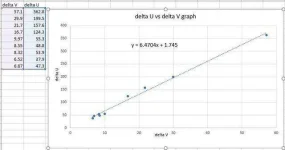
The graph is attached below :
1.webp

From the equation of the trend - line, we find that the slope of the graph :

ca90772d-d8f9-4f7f-b9d7-2e994604840c.gifU / 08afdbcd-4f6b-4be0-be5a-9cacb9784a30.gif ca90772d-d8f9-4f7f-b9d7-2e994604840c.gifV ~ 6.47 kJ / MV.

Hence, Q = 6.47 kJ / MV = 6.47 x 10³ J / 106 V = 6.47 x 10⁻³ C = 6.47 mC.
 
halaaa sorry ngayon ko lang nabasa

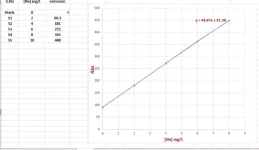
Ans. Step 1. Plot Emission vs Concertation graph

Plot Emission (Y-axis) vs Concertation (X-axis) graph using excel or any other similar software.

Generate the trendline equation for the graph. For this data, we get Y = 44.87X + 91.38 as the trendline equation.

Step 2: Calculating concertation of sample aliquot using trendline equation.

Trendline equation of the graph is “Y = 44.87X + 91.38” in form of “Y = mX + C”

In the graph, Y-axis indicates emission and X-axis depicts concentration. That is, according to the trendline (linear regression) equation Y = 44.87X + 91.38 obtained from the graph, 1 absorbance unit (1 Y = Y) is equal to 44.87 units on X-axis (concentration) plus 91.38.

Given, emission of the sample = 238

Putting Y = 238 in trendline equation-

238 = 44.87X + 91.38

Or, 44.87 X = 238 – 91.38 = 146.62

Or, X = 146.62 / 44.87 = 3.2677

Thus, concentration of sample aliquot (whose emission is taken) = 3.2677 mg/ mL

Step 3: Calculating back to original concentration in plant tissue.


Sample preparation:

4.0264 g sample taken

Final volume made upto = 50.0 mL.

Note the whole 4.0264 g sample is diluted upto 50.0 mL through sample processing.

Note: This dilute sample (sample aliquot) gives emission of 238 whose corresponding [Na] = 3.2677 mg/ mL

Amount of Na in 50.0 mL volume = [Na] of sample aliquot x Total volume of diluted solution

= 3.2677 mg/ mL x 50 mL

= 163.3831 mg

Since the 50 mL solution is made from 4.0264 g bran sample, the total amount of Na in 40.0 mL diluted sample is equal to the amount of Na in 4.0264 g bran.

So, amount of Na in 4.0264 g bran sample = 163.3831 mg

Concentration of Na in bran = Amount of Na / Mass of bran

= 163.3831 mg / 4.0264 g

= 40.58 mg/ g

2.webp
 
Question
How much torque can a cone clutch transmit if the angle of the conical elements is 10 degrees, the mean diameter of the conical clutch sections 200 mm, and an axial force of 550 N is applied? Assume that the coefficient of friction between the clutch elements is 0.45.
Answer

Step 1:
5516-10-3P AID: 1825 | 29/03/2013
E×ρréšš the equation for torque (T) for uniform pressure as below:
5516-10-3P-i1.webp
Here, pressure is p, coefficient of friction between the clutch is f, mean diameter of conical clutch is 5516-10-3P-i2.webp, and cone angle is 5516-10-3P-i3.webp
Substitute 550 N for p, 0.45 for f, 200 mm for 5516-10-3P-i4.webp, and 10 for 5516-10-3P-i5.webp to get:
5516-10-3P-i6.webp
Hence, the torque of a cone clutch is 5516-10-3P-i7.webp
 
Hello po someone help me po maopen yung Çℎḙḡḡ link pls me need ko po talaga
https://www.Çℎḙḡḡ.com/homework-help...r-multimeter-19-voltage-measured-ac-q56276411

tska po ito
https://www.Çℎḙḡḡ.com/homework-help...ing-voltmeter-multimeter-25-voltage-q56675130


thank you po!!!
 
Status
Not open for further replies.

About this Thread

  • 59
    Replies
  • 2K
    Views
  • 25
    Participants
Last reply from:
ZshadowW

Trending Topics

Online now

Members online
1,274
Guests online
1,434
Total visitors
2,708

Forum statistics

Threads
2,272,090
Posts
28,940,146
Members
1,237,989
Latest member
kenneth0528
Back
Top