PH
PHRHIC: The Gate
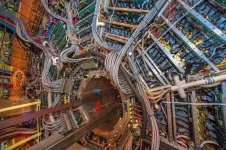
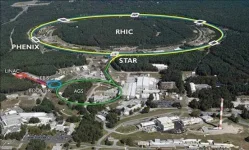
RHIC stands for Relativistic Heavy Ion Collider is the first and one of only two operating heavy-ion colliders, and only spin-polarized proton collider ever built. Located at Brooklyn National Laboratory (BNL) in Upton, New York, and used by an international team of researchers, it is the only operating article collider in the US. By using RHIC to collide ions travelling at relativistic speeds, physicists study the primordial forms of matter that existed in the universe shortly after the Big Bang. By colliding spin-polarized protons, the spin structure of the proton is explored.
RHIC is as of 2019 the second highest-energy heavy-ion collider in the world. As of November 7, 2010, the Large Hadron Collider (LHC) has collided heavy ions of lead at higher energies than RHIC.
In the instant after Big Bang, the only thing in the universe that existed was a hot plasma soup full of subatomic particles. But to study that ancient plasma, you don’t have to travel back in time billions of years to the Big Bang itself – just go out to Long Island, New York, where there’s a gigantic particles collider.
Scientists like Stephen Hawking sometimes say particle colliders are the ‘closest things we have to time machines,’ partly because they can recreate conditions present shortly after the Big Bang.
It holds the key with the potential to unlock countless doors to other dimensions, solving so many mysteries, explaining so many enigmas – the origins of the universe, life, the unseen forces that hold us and bind us and everything else in this existence together, as well as the impossible forces and laws that can tear it all apart. Physicists from around the world flock to BNL to study, in the words of BNL’s official introduction for the RHIC: “What the universe may have looked like in the first few moments after its creation.”
Yes, RHIC is very much a doorway, to enlightenment, and some fear, other dimensions and universe. These concerns were taken so seriously, in fact, that in 1999, prior to the RHIC going operational in 2000, the laboratory’s director John Marburger convened a committee of renowned physicist to address several of its apocalyptic ramifications:
1) “Creation of a black hole that would ‘eat’ ordinary matter, essentially gobbling up the Earth”
2) “Initiation of a transition to a new, more stable universe;”
3) “Formation of a ‘strange let’ that would convert ordinary matter to a new form.”
The aptly named latter item is a hypothetical, thermodynamic, cosmological doomsday particle that would “suck up all matter on Earth, ending life on the planet,” as one Harvard University theoretical physicist PhD candidate explained in a paper tackling the topic. (2)
Ref: www(.)longisland.com
Businessinsider(.)com
Blogs.scientificamerican(.)com
Images from: Atlas Obscura
KhioneNyx
Source of DeepWeb PH
CTTO.
RHIC stands for Relativistic Heavy Ion Collider is the first and one of only two operating heavy-ion colliders, and only spin-polarized proton collider ever built. Located at Brooklyn National Laboratory (BNL) in Upton, New York, and used by an international team of researchers, it is the only operating article collider in the US. By using RHIC to collide ions travelling at relativistic speeds, physicists study the primordial forms of matter that existed in the universe shortly after the Big Bang. By colliding spin-polarized protons, the spin structure of the proton is explored.
RHIC is as of 2019 the second highest-energy heavy-ion collider in the world. As of November 7, 2010, the Large Hadron Collider (LHC) has collided heavy ions of lead at higher energies than RHIC.
In the instant after Big Bang, the only thing in the universe that existed was a hot plasma soup full of subatomic particles. But to study that ancient plasma, you don’t have to travel back in time billions of years to the Big Bang itself – just go out to Long Island, New York, where there’s a gigantic particles collider.
Scientists like Stephen Hawking sometimes say particle colliders are the ‘closest things we have to time machines,’ partly because they can recreate conditions present shortly after the Big Bang.
It holds the key with the potential to unlock countless doors to other dimensions, solving so many mysteries, explaining so many enigmas – the origins of the universe, life, the unseen forces that hold us and bind us and everything else in this existence together, as well as the impossible forces and laws that can tear it all apart. Physicists from around the world flock to BNL to study, in the words of BNL’s official introduction for the RHIC: “What the universe may have looked like in the first few moments after its creation.”
Yes, RHIC is very much a doorway, to enlightenment, and some fear, other dimensions and universe. These concerns were taken so seriously, in fact, that in 1999, prior to the RHIC going operational in 2000, the laboratory’s director John Marburger convened a committee of renowned physicist to address several of its apocalyptic ramifications:
1) “Creation of a black hole that would ‘eat’ ordinary matter, essentially gobbling up the Earth”
2) “Initiation of a transition to a new, more stable universe;”
3) “Formation of a ‘strange let’ that would convert ordinary matter to a new form.”
The aptly named latter item is a hypothetical, thermodynamic, cosmological doomsday particle that would “suck up all matter on Earth, ending life on the planet,” as one Harvard University theoretical physicist PhD candidate explained in a paper tackling the topic. (2)
Ref: www(.)longisland.com
Businessinsider(.)com
Blogs.scientificamerican(.)com
Images from: Atlas Obscura
KhioneNyx
Source of DeepWeb PH
CTTO.