PH
PHThe legality of the "New Majority" bloc's takeover under the 1987 Constitution of the Philippines is heavily disputed, presenting a massive constitutional dilemma with no definitive consensus.
While Malacañang and the Executive branch have officially recognized Acting Senate President Sherwin Gatchalian's leadership, constitutional experts and senators are deeply divided into two camps: [You do not have permission to view the full content of this post. Log in or register now., You do not have permission to view the full content of this post. Log in or register now., You do not have permission to view the full content of this post. Log in or register now., You do not have permission to view the full content of this post. Log in or register now.]
Under the principle of checks and balances, the Executive branch (the President/Malacañang) does not have the power to validate or invalidate the internal organization of the Legislature (the Senate) [1]. Only the Supreme Court of the Philippines has the ultimate judicial power to interpret the Constitution and declare an action null and void if it violates the law [2, 3].
Here is how the law limits Malacañang’s power in this situation, and why the final decision rests elsewhere:
1. Separation of Powers
2. The Supreme Court is the Ultimate Arbiter
While Malacañang and the Executive branch have officially recognized Acting Senate President Sherwin Gatchalian's leadership, constitutional experts and senators are deeply divided into two camps: [You do not have permission to view the full content of this post. Log in or register now., You do not have permission to view the full content of this post. Log in or register now., You do not have permission to view the full content of this post. Log in or register now., You do not have permission to view the full content of this post. Log in or register now.]
Under the principle of checks and balances, the Executive branch (the President/Malacañang) does not have the power to validate or invalidate the internal organization of the Legislature (the Senate) [1]. Only the Supreme Court of the Philippines has the ultimate judicial power to interpret the Constitution and declare an action null and void if it violates the law [2, 3].
Here is how the law limits Malacañang’s power in this situation, and why the final decision rests elsewhere:
1. Separation of Powers
- Co-Equal Branches: The Executive, Legislative, and Judiciary are strictly co-equal [1].
- No Executive Dictation: The President cannot dictate who the Senate President should be [1]. Malacañang's recognition of Senator Gatchalian is a political gesture of pragmatism to keep the government running, but it holds zero weight as a binding legal ruling.
2. The Supreme Court is the Ultimate Arbiter
- If Senator Cayetano's bloc files a petition for Quo Warranto or Certiorari, the Supreme Court will review the case [2].
- If the Court finds that "12 votes" strictly violated the constitutional requirement of a majority of all 24 members, it will declare the New Majority's takeover unconstitutional [4].
- If that happens, Malacañang will be legally forced to retract its recognition and deal with the reinstated Cayetano leadership.

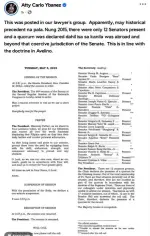


 : IBP
: IBP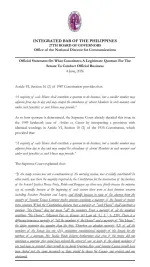
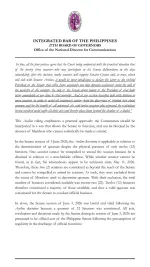
 Samahan lang po sila ng mga abogado, hindi sila ang Supreme Court. Desisyon ba ng korte 'yan para sabihing valid? Magbasa muna tayo kung sino ang may final say sa Constitution bago mag-marites dito, ha? Hintayin natin ang totoong SC ruling bago ka magdiwang.
 Pilit na pilit ang script natin ngayon ah, magkano po ang sahod natin dyan?