 PH
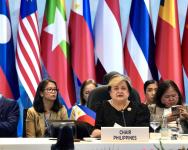
MANILA, Philippines — Southeast Asian leaders meet in Manila on Sunday, November 15, to cap the Philippines' ASEAN year that's been knocked off course by the US-Israeli war with Iran, a conflict that drove up fuel prices globally and made the resulting price squeeze a top issue for the bloc.
Opening the last foreign ministers’ meeting of Manila’s chairship on Saturday, November 14, Foreign Affairs Secretary Theresa Lazaro said the year had brought “unprecedented headwinds,” led by the crisis in the Middle East, and that the Philippines had kept “pivoting our course” in response.
Philippine households continue to be hit hard by the sprawling conflict in the Middle East, which has driven up fuel prices. Inflation accelerated to 7.8% in October, the highest since February 2023, according to the Philippine Statistics Authority.
High prices of goods were also the issue Filipinos most often wanted the country to push as ASEAN host, named by 19% surveyed in a Social Weather Stations poll taken in late March and shared again this week, just above the West Philippine Sea.
ASEAN members imported about half their oil from the Middle East before the war, which began with US and Israeli strikes on Iran in February and effectively shut the Strait of Hormuz.
An ASEAN pact meant to let members share fuel during supply cuts is still not in force though it remains high on the agenda this week. Only four or five of the bloc's 11 members have ratified it as of late October and any sharing under it would be voluntary and on commercial terms.
Asked how the government would measure the success of the Philippines' year as ASEAN chair, Dominic Xavier Imperial, the government's spokesperson for its ASEAN chairship, acknowledged the region was "still feeling the impacts of the Middle East crisis" and that "additional measures" on energy would be forthcoming.
Tangible benefits
Lazaro told her fellow foreign ministers on Saturday that ASEAN’s work “cannot be measured solely by the meetings we convene or the documents that we adopt,” but by whether it can “deliver tangible benefits to our peoples.”
ASEAN leaders’ main economic deliverable is a region-wide digital economy agreement, due to be signed at the summit, that sets common rules for e-commerce, data and digital payments. Lazaro said it would give small businesses “a smoother path... to sell beyond their home markets.”
The year’s setbacks went beyond the war, the DFA chief added, citing “natural calamities that besieged our nations” and “uncertainties that tested the norms of multilateralism.”
“We must also be clear-eyed about the work ahead,” Lazaro said.
President Ferdinand Marcos Jr. in March said he asked fellow leaders whether they saw the need to postpone the bloc’s scheduled May summit due to the energy crisis brought by the Middle East conflict. Eventually, the government scaled down and shortened the summit into a "bare-bones" program lasting a day and a half.
Manila had made “the difficult decision to recalibrate” its hosting, cutting non-essential activities and moving some meetings online, Marcos told the Cebu summit in May.
ASEAN’s limits
ASEAN, often dismissed as a “talk shop,” holds more than a thousand meetings a year across different levels, but many of the statements and work plans produced are never fully carried out, Anoulak Kittikhoun, a former chief executive of the Mekong River Commission, and Joanne Lin, a former ASEAN Secretariat official, wrote in a column for the Lee Kuan Yew School of Public Policy.
"Its current system—comprising more than a thousand meetings annually, overlapping working groups and siloed sectoral processes—often generates activity without delivering meaningful outcomes," they wrote.
Additionally, decisions made by the bloc need the consent of all 11 members, and the bloc does not interfere in members’ internal affairs.
As a result, many ASEAN agreements are non-binding and enforcement is weak or absent, researchers Mark Anthony Barral and Francis Mark Quimba wrote for the state think tank Philippine Institute for Development Studies (PIDS).
"The differing threat perceptions and the varying levels of economic developments also lead to divisions among member states, hindering consensus-building and effective policy implementation," the researchers wrote.
On top of this, the "principle of non-interference ... limit ASEAN’s ability to provide a prompt response on emerging issues, such as the tension in Myanmar," they wrote.
Source: You do not have permission to view the full content of this post. Log in or register now.
Date posted: 2026-11-14T17:28:00+08:00