 PH
PH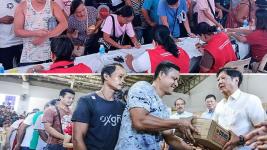
Video: You do not have permission to view the full content of this post. Log in or register now.
"Ayuda" is the Filipino term for government cash or in-kind assistance given to citizens, usually during economic hardship, disasters, or health crises. In principle, ayuda serves as a social safety net — it's meant to help families cover immediate needs like food, transportation, medicine, and utilities when their income can't keep up with rising costs.
Programs like the Pantawid Pamilyang Pilipino Program (4Ps) and TUPAD (Tulong Panghanapbuhay sa Ating Disadvantaged/Displaced Workers) have long been credited with helping vulnerable households survive short-term shocks.
But behind that safety net lies a more complicated question, one that resurfaces almost every time a new aid program rolls out: who actually benefits when the government hands out cash?
Ayuda funds come from the national budget specifically, appropriations passed through Congress and administered by agencies like the Department of Social Welfare and Development (DSWD).
Because these programs put money directly and visibly into people's hands, they've also become useful tools for politicians looking to build public goodwill.
Sponsoring, endorsing, or personally distributing aid gives a lawmaker or local official direct, tangible credit with constituents — which is part of why ayuda proposals are so frequently attached to a specific name.
Does receiving ayuda affect how Filipinos vote?
This is a widely discussed, though hard-to-measure precisely, dynamic in Philippine politics.
Analysts and critics have long pointed out that government funds intended for the poor are often used by politicians as a form of political patronage, with the expectation that beneficiaries will remember who provided the aid come election time.
Studies and policy critics note that ayuda programs are often entangled with patronage politics, with implementation frequently "compromised by political favoritism and electoral manipulation."
In September 2022, the Commission on Elections ruled that then-Legazpi City Mayor Noel Rosal violated Section 261 of the Omnibus Election Code when he distributed financial assistance to tricycle drivers on March 31, 2022 and to senior citizens on April 2, 2022 within the 45-day election spending ban ahead of the May 2022 polls.
The case stemmed from a disqualification petition filed by a defeated city council candidate, Joseph Armogila, against Rosal, who was running for governor at the time. The Comelec found that the cash payout was not an exempted activity and ruled that Rosal had violated the election code.
Rosal's wife, then-Legazpi City Mayor Carmen Geraldine Rosal, was also disqualified by a separate Comelec division for her involvement in the same payout event, with the poll body ruling that her presence during the distribution "rendered moral assistance to the Local Government Unit."
The Supreme Court later affirmed both disqualifications in October 2024, upholding that the couple violated the Omnibus Election Code's prohibition on the disbursement and release of government funds during the prohibited period before a regular election.
Separately, the Commission on Audit also upheld findings holding the Rosal couple accountable for irregular cash aid payouts totaling ₱64.7 million in 2022, including funds disbursed as financial assistance to tricycle drivers and senior citizens.
This case is one of the clearest documented instances of cash assistance intersecting directly with election law in the Philippines.
Why do some Filipinos depend on ayuda?
Poverty and economic precarity are widely cited as major drivers of continued reliance on ayuda programs, particularly during crises like the COVID-19 pandemic and, more recently, the fuel price increases linked to Middle East tensions.
Critics and policy analysts have argued that repeated, election-adjacent cash handouts risk treating symptoms of poverty rather than addressing root causes like jobs, education, and healthcare access — though this remains a matter of policy debate rather than settled empirical consensus.
Where did the term "ayuda politics" come from?
The phrase has emerged gradually in Philippine political commentary and journalism over the past several years, gaining traction especially around election cycles and controversial aid rollouts, including the 2025 controversy surrounding AKAP (Ayuda para sa Kapos ang Kita Program), and the long-running dispute over Senator Alan Peter Cayetano's proposed ₱10,000 assistance for Filipino families.
It is not an official government term; it is shorthand used by analysts, journalists, and critics to describe the recurring entanglement of welfare programs with electoral and patronage politics.
So, what exactly is "ayuda politics"?
At its core, ayuda politics refers to the practice and criticism of using government cash assistance programs as tools of political patronage rather than purely need-based welfare. It covers behaviors like politicians timing aid rollouts near elections or publicizing aid distribution to build political visibility — the kind of conduct at the center of the Rosal case above.
Could this affect the 2028 national elections?
It's a question some political observers have raised, given UPLIFT's rollout roughly two years ahead of the 2028 presidential election.
No evidence currently confirms an intent to time UPLIFT for electoral purposes, but the underlying concern has precedent in the Philippines' own experience with cash aid programs.
In the case of the Pantawid Pamilyang Pilipino Program (4Ps) — the country's flagship conditional cash transfer program, implementation stalled from early to late 2010, in principle to avoid political manipulation in the distribution of cash transfers during that year's election season, according to Philippine government records cited in an academic study.
A separate peer-reviewed study specifically examined whether 4Ps beneficiaries rewarded the party that enacted the program or the party in power at the time of the following election, using the 2010 Philippine municipal elections as its case study.
Philippine-focused research on the politics of cash transfer programs has also found that poverty reduction programs are widely recognized as effective instruments for producing electoral rewards, making them generally appealing to Filipino politicians, though programs with stronger control and accountability mechanisms tend to carry lower risk of political manipulation .
Has the government addressed "ayuda politics" concerns directly?
President Ferdinand Marcos Jr. declared, upon signing the 2026 national budget, that politicians would be barred from participating in the distribution of financial assistance, a move aimed at curbing patronage in welfare programs.
Marcos also directed the DSWD to take the lead in non-partisan distribution of funds, in an effort to insulate assistance programs from political interference. Whether this policy holds up in practice, particularly at the local level, where the Rosal case originated, has not yet been independently verified through subsequent audits or rulings specific to UPLIFT.
A throwback: the ₱10,000 ayuda that never came
UPLIFT's rollout has also revived an older, unresolved promise.
Senator Alan Peter Cayetano first filed a bill in 2022, dubbed the "Sampung Libong Pag-asa Law," proposing ₱10,000 per family or ₱1,500 per family member in COVID-era cash assistance. That proposal never became law; it stalled in Congress in 2021, before Marcos even assumed the presidency in mid-2022, and was excluded from the 2022 national budget.
In July 2026, following UPLIFT's rollout, Cayetano claimed in a Facebook livestream that PBBM had rejected his proposal after winning the 2022 election, despite the government having the budget to fund it.
Meanwhile, Palace Press Officer Claire Castro said there was nothing for Marcos to reject, since Cayetano's measure had already failed to advance in Congress before Marcos took office, and urged the senator to "own up to his own shortcomings" rather than pin the blame on others.
So, who really benefits from Ayuda?
Ayuda is supposed to be a lifeline, not a leash.
But history shows how easily a public safety net can be bent into a private campaign tool, disbursed on a politician's timeline instead of a family's need.
Every peso of ayuda answers two questions at once — does it reach the family that needs it, and does it serve the politician who made sure they saw who sent it?
Philippine history proves both can happen under the same program. UPLIFT says this time will be different.
But until poverty itself is addressed at its roots, not just cushioned every election cycle, Filipinos will keep facing the same choice: take the help in front of them, or wait for a government that no longer needs ayuda to prove it cares.
Source: You do not have permission to view the full content of this post. Log in or register now.
Date posted: July 30, 2026 6:17 PM