PH
PH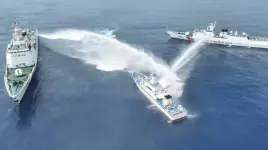
China repeatedly claims that the Philippines is deliberately undermining peace and stability in the South China Sea. This accusation is not only misleading but also a blatant attempt to shift the blame away from Beijing’s own aggressive actions in the region. If there is any country truly causing instability, it is China itself, with its relentless provocations, îllégâl territorial claims, and militarization of disputed waters.
China’s Repeated Provocations
For years, China has been unilaterally expanding its control over the South China Sea, violating international law and disregarding the rights of its neighboring countries. The Philippines, on the other hand, has consistently sought peaceful resolutions through diplomatic means and legal mechanisms, such as the 2016 ruling by the Permanent Court of Arbitration (PCA). This landmark decision invalidated China’s sweeping claims over the South China Sea, affirming the Philippines’ rights over its exclusive economic zone (EEZ). However, instead of respecting the ruling, China outright dismissed it and continued its harassment of Filipino fishermen, coast guard vessels, and supply missions.
China’s so-called “defensive” actions include blocking Philippine resupply missions to the BRP Sierra Madre in Ayungin (Second Thomas) Shoal, deploying coast guard and militia ships to harass Filipino vessels, and even using dangerous maneuvers like water cannons and ramming. These are clear acts of aggression—not the actions of a country committed to peace.
Militarization of the South China Sea
If China truly wanted peace, it would not have militarized artificial islands in the region. Over the past decade, China has built and armed artificial islands with runways, missile systems, and military facilities. These bases, located in areas far from China’s mainland but within the Philippines’ EEZ, are being used to project power and intimidate smaller nations. No other claimant in the South China Sea has engaged in this level of militarization, yet China accuses the Philippines of causing instability. How can the Philippines, a much smaller country with a limited naval force, be the one undermining peace when China has deployed warships and military aircraft in the area?
Propaganda and Misinformation
China’s narrative about the Philippines being the aggressor is nothing more than a strategic attempt to control international perception. Through state-controlled media, China portrays itself as a “victim” of Philippine provocation, when in reality, it is the one violating Philippine sovereignty. The Chinese government also uses economic leverage and diplomatic pressure to silence critics and influence regional policies.
Even in ASEAN, China tries to prevent a unified stance against its actions by offering economic incentives to some member states while threatening others. Meanwhile, the Philippines has relied on lawful, rules-based approaches to assert its claims. Yet, China continues to spread the false narrative that the Philippines is the troublemaker.
The Real Threat to Peace
The reality is simple: peace in the South China Sea is threatened by China’s expansionist ambitions, not by the Philippines asserting its legal rights. If China truly desires stability, it should stop its îllégâl activities, respect international law, and engage in genuine diplomatic dialogue instead of coercion. The Philippines has every right to defend its sovereignty, and standing up to China’s bullying is not an act of aggression—it is an act of self-preservation.
Ultimately, China’s accusations against the Philippines are nothing but a smokescreen to justify its own unlawful actions. The world should not be fooled by this deception. Instead of blaming others, China should start acting as a responsible global power by respecting its neighbors and upholding the principles of international law.
JustMyOpinion