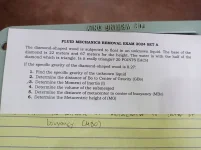
1. To find the specific gravity of the unknown liquid, we can use the formula:
\[ \text{Specific gravity of unknown liquid} = \frac{\text{Weight of wood in air}}{\text{Weight of wood in liquid}} \]
Given that the specific gravity of the wood is 0.27, we know that the weight of the wood in water will be less than its weight in air. Therefore, the weight of the wood in water can be found using the specific gravity formula:
\[ \text{Weight of wood in water} = \text{Specific gravity of wood} \times \text{Weight of wood in air} \]
\[ \text{Weight of wood in water} = 0.27 \times \text{Weight of wood in air} \]
Since the wood is floating, the weight of the wood in water is equal to the weight of the liquid displaced. Therefore, the specific gravity of the unknown liquid can be calculated as:
\[ \text{Specific gravity of unknown liquid} = \frac{\text{Weight of wood in air}}{\text{Weight of wood in air} - \text{Weight of wood in water}} \]
2. To determine the distance of Bo to the Center of Gravity (GBo), we need to consider the geometry of the diamond-shaped wood. The Center of Gravity (CG) of a diamond is at the intersection of its diagonals. Since the diamond is floating in equilibrium, the Center of Buoyancy (Bo) is directly below the CG. Therefore, the distance from Bo to CG (GBo) is half the height of the diamond (33.5 meters).
3. The Moment of Inertia (I) can be calculated using the formula for the moment of inertia of a diamond-shaped object:
\[ I = \frac{bh^3}{12} \]
Where:
- b = base of the diamond = 22 meters
- h = height of the diamond = 67 meters
Substitute the values into the formula to find the Moment of Inertia (I).
4. The volume of the submerged part of the diamond can be calculated using the formula for the volume of a triangular prism:
\[ V = \frac{1}{2} \times \text{Base} \times \text{Height} \times \text{Width} \]
In this case, the width is the thickness of the diamond-shaped wood. Since the diamond is floating in equilibrium, the volume of the submerged part is equal to the volume of the liquid displaced.
5. The distance of the metacenter to the center of buoyancy (MBO) can be determined by understanding the concept of metacentric height. The metacenter is the point where the line of action of the buoyant force intersects the vertical line passing through the Center of Buoyancy (Bo). The distance MBO is a crucial parameter in stability analysis of floating bodies.
6. The Metacentric height (GM) is the distance between the Metacenter and the Center of Gravity of the floating body. It can be calculated as the Moment of Inertia (I) divided by the product of the volume of the submerged part and the distance of MBO. The formula is:
\[ GM = \frac{I}{V \times \text{MBO}} \]
Substitute the calculated values of I, V, and MBO to find the Metacentric height (GM).
 PH
PH