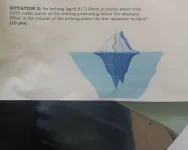
To find the volume of the iceberg above the free seawater surface, we can use the concept of buoyancy and Archimedes' principle.
The buoyant force acting on the iceberg is equal to the weight of the water displaced by the iceberg. The buoyant force can be calculated using the formula:
Buoyant force = Weight of the water displaced = Density of water x Volume of water displaced x Acceleration due to gravity
The weight of the water displaced is equal to the weight of the iceberg that is submerged below the seawater surface. The weight of the submerged part of the iceberg can be calculated using the formula:
Weight of submerged part = Density of iceberg x Volume of submerged part x Acceleration due to gravity
Since the iceberg is floating, the weight of the submerged part is equal to the weight of the iceberg above the water level. Therefore, we can set the weight of the submerged part equal to the buoyant force:
Density of iceberg x Volume of submerged part x Acceleration due to gravity = Density of water x Volume of water displaced x Acceleration due to gravity
Given information:
Density of iceberg (ρi) = 0.917
Volume of submerged part = 8979 m³
Density of water (ρw) = 1000 kg/m³
Acceleration due to gravity (g) = 9.81 m/s²
Now, we can solve for the volume of the iceberg above the free seawater surface:
ρi x Volume of submerged part = ρw x Volume of water displaced
0.917 x 8979 = 1000 x Volume of water displaced
Volume of water displaced = (0.917 x 8979) / 1000 = 8231.923 m³
The total volume of the iceberg is the sum of the volume above and below the seawater surface:
Total volume of iceberg = Volume of submerged part + Volume above water level
Total volume of iceberg = 8979 + 8231.923 = 17210.923 m³
Therefore, the volume of the iceberg above the free seawater surface is 8231.923 cubic meters.
 PH
PH