PH
PHGildarts Tale
Eternal Poster
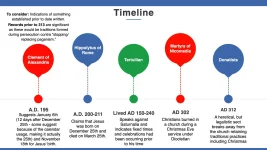
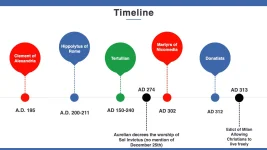
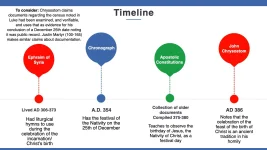
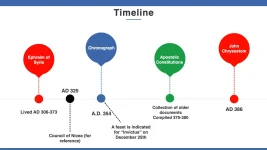
The Christian writer, John Chrysostom (AD 347-407), in his homily, "On that Day of Birth of our Savior Jesus Christ," says some things of interest regarding the date December 25th.
First, he states that December 25th as the date of Christ's birth was known "from the beginning in the Western church."
Second, He points out that Christians in his day were arguing about whether or not the day was accurate.
Thirdly, He proceeds to give three proofs for the December 25th date.
Last, he never mentions any pagan celebration in his exposition on the dating of Christ's birth but instead appeals to scriptures, history, and tradition.
His three proofs are as follows:
1. The time of the census is mentioned in Luke 2:1-7, stating that this census occurred during December.
2. He points out that whoever doubts and wants to know the exact time the census can search the ancient records, which are kept in the public libraries of Rome. He hints that the time of Jesus' birth is easily verifiable.
3. He argues from the text of scriptures, arguing that the timing Zacharias service, Elizabeth's conception, and the visitation to Mary (during Elizabeth's sixth month of *******cy; Luke 1:30-37) would lead to a calculation of December.
He includes that Elizabeth became *******t in the latter part of September (after the Feast of Tabernacles), and Mary became *******t the sixth month later in March. Niner months from that, and we have a December date. This argument of Chrysostom also corroborates with other Christian writers.
(Chrysostom homily can be searched and read online for free)
"One can find scholars who argue that Jesus was born anytime between December to July, but those, we find two predominate theories about his possible birth date. The two main positions are that either Jesus was conceived in December, or he was born in December. Both are possible, but December plays a role in either case...
To summarize, contrary to common opinion, there's good evidence that the traditional view is possible, minimally. We can leave this part of our discussion by saying that the festival is ultimately celebrated on December 25th because of tradition and consensus of the early church."
- Nicholas Cambell
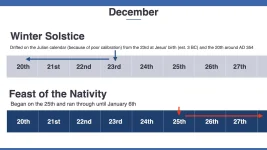
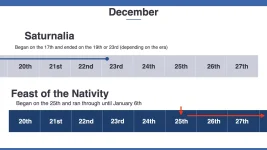
Just going to leave it here.
CTTO
First, he states that December 25th as the date of Christ's birth was known "from the beginning in the Western church."
Second, He points out that Christians in his day were arguing about whether or not the day was accurate.
Thirdly, He proceeds to give three proofs for the December 25th date.
Last, he never mentions any pagan celebration in his exposition on the dating of Christ's birth but instead appeals to scriptures, history, and tradition.
His three proofs are as follows:
1. The time of the census is mentioned in Luke 2:1-7, stating that this census occurred during December.
2. He points out that whoever doubts and wants to know the exact time the census can search the ancient records, which are kept in the public libraries of Rome. He hints that the time of Jesus' birth is easily verifiable.
3. He argues from the text of scriptures, arguing that the timing Zacharias service, Elizabeth's conception, and the visitation to Mary (during Elizabeth's sixth month of *******cy; Luke 1:30-37) would lead to a calculation of December.
He includes that Elizabeth became *******t in the latter part of September (after the Feast of Tabernacles), and Mary became *******t the sixth month later in March. Niner months from that, and we have a December date. This argument of Chrysostom also corroborates with other Christian writers.
(Chrysostom homily can be searched and read online for free)
"One can find scholars who argue that Jesus was born anytime between December to July, but those, we find two predominate theories about his possible birth date. The two main positions are that either Jesus was conceived in December, or he was born in December. Both are possible, but December plays a role in either case...
To summarize, contrary to common opinion, there's good evidence that the traditional view is possible, minimally. We can leave this part of our discussion by saying that the festival is ultimately celebrated on December 25th because of tradition and consensus of the early church."
- Nicholas Cambell
Just going to leave it here.
CTTO


 Handbook of Christian Feasts and Customs, page. 61
 . You can also read in the same book na SINASAWAY ng kanilang mga religious superior ang mga taong magsiselebrate ng paganong okasyon. Kahit na magkapareho ang petsa ay magkaiba po ang paganong selebrasyon (Sol Invictus) at Pasko base na rin mismo sa libro. Kaya po ang inyong claim na PAGANO ang pasko ay isa pong nakapalaking kamalian at klarong walang basehan sa kasaysayan. Mismong ang qinuote nyong libro ang nagdisprove sa inyo.
 ng dahil lang sa hindi ko tinawag na kapatid o kuya ang preacher nila
 baka naman