 PH
PHMasked Rider Black
Forum Guru
tl;dr - Pulitika at pansariling interes ang dahilan kung bakit nag-convert sa Kristiyanismo at tinanggap ni Rajah Humabon sina Magallanes at mga Kastila bilang mga kaalyado.
- Tumanggi si Lapulapu na magbigay ng tribute na “three goats, three pigs, three loads of rice, and three loads of millet” at kilalanin ang Hari ng Espanya.
- Hindi ginamit ng mga Kastila ang mga kanyon sa kanilang barko at mga escopetas o arquebuses (sinaunang baril) sa pagsugod nila sa Mactan.
- Kahit si Antonio Pigafetta na sumama sa Battle of Mactan at nagsulat tungkol dito ay hindi matiyak kung kasama mismo si Lapulapu sa labanan kaya masasabing unhistorical ang popular na imahe ni Lapulapu na bata at may matipunong pangangatawan.
By Van Ybiernas and Xiao Chua
Because of his expedition’s battle-ready impression, Ferdinand Magellan did his best to cast away our ancestors’ fears by limiting their firing to ceremonial purposes. King Carlos’ instruction to Magellan was clear: be friendly to the natives of the territories they visited. Guided by the king’s order, the expedition proceeded to Cebu, an ancient Southeast Asian port. Without any means to pay an anchorage fee, Magellan instead won the paramount ruler of Cebu, Rajah Humabon, by bragging about the might of Spain and that it could help the rajah gain greater influence, at least, in the Visayas. Convinced that Spain was more powerful compared to the conqueror of Calcutta and Malacca—Portugal—Rajah Humabon welcomed Magellan and was even persuaded to accept Christianity. Magellan fed Humabon’s self-esteem with assurances of becoming the lord of as many communities as he pleased and the destruction of those who would reject his lordship.
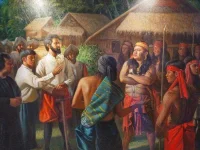
A detail of Jun Impas’ Magellan Meets Humabon’s Allied Chiefs (2021). Photographed by Ian Alfonso.
To test the adherence to Rajah Humabon, a ruler must present Magellan tributes and food supplies. Rulers from the suburbs of Cebu, including Mactan under a chieftain named Zula, came in and brought Magellan what the expedition needed to the best of their ability. Pigafetta identified some of these rulers as Cilaton, Ciguibucan, Cimaningha, Cimatichat, and Cicanbul of Cinghapola, Apanoaan of Mandaui (Mandaue), Theteu of Lalan (Liloan), Tapan of Lalutan, Acibagalen of Cot-cot, and Apanoan of Puzzo. Although unnamed, the rulers of Cilumai and Lubucun also presented tributes to Magellan.
On 26 April 1521, Magellan received the son of Zula with only two goats as presents. That son of Zula reported that his father failed to provide what he promised to Magellan because another chief of Mactan named Çilapulapu (henceforth referred to as Lapulapu) refused to recognize the king of Spain. Lapulapu declined to give Magellan “three goats, three pigs, three loads of rice, and three loads of millet” for the three naos (Spanish ships) of the expedition. Zula also conveyed his request to Magellan to send troops to punish Lapulapu. Midnight of the same day, Magellan and his 60-strong force, together with Rajah Humabon, some princes, and his very own men, riding in several balanghai (ancient Philippine boat), left for Mactan.
The Showdown in Mactan
Magellan and his group anchored in Mactan before dawn on 27 April 1521. Because of the low tide and the terraces of corals, “the boats could not come closer to the beach,” written by Pigafetta who also joined Magellan in fighting Lapulapu. Through the Muslim merchant who already served as their translator, Magellan sent an ultimatum to Lapulapu to subject himself to the authority of Spain to avoid the destruction of Mactan. It was simply ignored by the chief of Mactan. Thus, Magellan and 49 of his men, including Pigafetta, waded in the water for more than a kilometer until they reached the shore. Humabon offered Magellan assistance, only to be told to back off and just watch.
Magellan’s force relied only on two weapons: escopetas (harquebus gun) and a ballesta (crossbow), the latter’s use forbidden then by the Church because of its brutal effects except if used against non-Christians. His decision to leave behind the naos (ships), which were almost eight kilometers away from the Mactan shore, only showed his inability to lead a force. Historian Danilo Gerona described Magellan’s Armada de Maluco as a “floating arsenal… armed with the most powerful artilleries of their time” that could have been utilized for a long-range naval battle.
As they approached the shore, Magellan’s men fired crossbow bolts upon Lapulapu’s 1,500-strong force (as estimated by Pigafetta) arranged in three divisions. However, shots failed to penetrate the shields of our ancestors, thus Magallanes ordered us to keep from firing ballesta.
Continue reading here:
You do not have permission to view the full content of this post. Log in or register now.
- Tumanggi si Lapulapu na magbigay ng tribute na “three goats, three pigs, three loads of rice, and three loads of millet” at kilalanin ang Hari ng Espanya.
- Hindi ginamit ng mga Kastila ang mga kanyon sa kanilang barko at mga escopetas o arquebuses (sinaunang baril) sa pagsugod nila sa Mactan.
- Kahit si Antonio Pigafetta na sumama sa Battle of Mactan at nagsulat tungkol dito ay hindi matiyak kung kasama mismo si Lapulapu sa labanan kaya masasabing unhistorical ang popular na imahe ni Lapulapu na bata at may matipunong pangangatawan.
Battle of Mactan Beyond Textbooks
Posted on 27 April 2021By Van Ybiernas and Xiao Chua
Because of his expedition’s battle-ready impression, Ferdinand Magellan did his best to cast away our ancestors’ fears by limiting their firing to ceremonial purposes. King Carlos’ instruction to Magellan was clear: be friendly to the natives of the territories they visited. Guided by the king’s order, the expedition proceeded to Cebu, an ancient Southeast Asian port. Without any means to pay an anchorage fee, Magellan instead won the paramount ruler of Cebu, Rajah Humabon, by bragging about the might of Spain and that it could help the rajah gain greater influence, at least, in the Visayas. Convinced that Spain was more powerful compared to the conqueror of Calcutta and Malacca—Portugal—Rajah Humabon welcomed Magellan and was even persuaded to accept Christianity. Magellan fed Humabon’s self-esteem with assurances of becoming the lord of as many communities as he pleased and the destruction of those who would reject his lordship.
A detail of Jun Impas’ Magellan Meets Humabon’s Allied Chiefs (2021). Photographed by Ian Alfonso.
To test the adherence to Rajah Humabon, a ruler must present Magellan tributes and food supplies. Rulers from the suburbs of Cebu, including Mactan under a chieftain named Zula, came in and brought Magellan what the expedition needed to the best of their ability. Pigafetta identified some of these rulers as Cilaton, Ciguibucan, Cimaningha, Cimatichat, and Cicanbul of Cinghapola, Apanoaan of Mandaui (Mandaue), Theteu of Lalan (Liloan), Tapan of Lalutan, Acibagalen of Cot-cot, and Apanoan of Puzzo. Although unnamed, the rulers of Cilumai and Lubucun also presented tributes to Magellan.
On 26 April 1521, Magellan received the son of Zula with only two goats as presents. That son of Zula reported that his father failed to provide what he promised to Magellan because another chief of Mactan named Çilapulapu (henceforth referred to as Lapulapu) refused to recognize the king of Spain. Lapulapu declined to give Magellan “three goats, three pigs, three loads of rice, and three loads of millet” for the three naos (Spanish ships) of the expedition. Zula also conveyed his request to Magellan to send troops to punish Lapulapu. Midnight of the same day, Magellan and his 60-strong force, together with Rajah Humabon, some princes, and his very own men, riding in several balanghai (ancient Philippine boat), left for Mactan.
The Showdown in Mactan
Magellan and his group anchored in Mactan before dawn on 27 April 1521. Because of the low tide and the terraces of corals, “the boats could not come closer to the beach,” written by Pigafetta who also joined Magellan in fighting Lapulapu. Through the Muslim merchant who already served as their translator, Magellan sent an ultimatum to Lapulapu to subject himself to the authority of Spain to avoid the destruction of Mactan. It was simply ignored by the chief of Mactan. Thus, Magellan and 49 of his men, including Pigafetta, waded in the water for more than a kilometer until they reached the shore. Humabon offered Magellan assistance, only to be told to back off and just watch.
Magellan’s force relied only on two weapons: escopetas (harquebus gun) and a ballesta (crossbow), the latter’s use forbidden then by the Church because of its brutal effects except if used against non-Christians. His decision to leave behind the naos (ships), which were almost eight kilometers away from the Mactan shore, only showed his inability to lead a force. Historian Danilo Gerona described Magellan’s Armada de Maluco as a “floating arsenal… armed with the most powerful artilleries of their time” that could have been utilized for a long-range naval battle.
As they approached the shore, Magellan’s men fired crossbow bolts upon Lapulapu’s 1,500-strong force (as estimated by Pigafetta) arranged in three divisions. However, shots failed to penetrate the shields of our ancestors, thus Magallanes ordered us to keep from firing ballesta.
Continue reading here:
You do not have permission to view the full content of this post. Log in or register now.