 PH
PH
MARCOS PREDICTED IT RIGHT
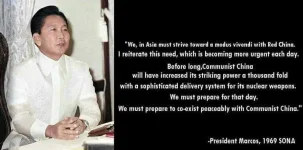
In his 1969 SONA Ferdinand Marcos unveiled his foreign policy:
"We, in Asia must strive toward a modus vivendi with Red China. I reiterate this need, which is becoming more urgent each day. Before long, Communist China will have increased its striking power a thousandfold with a sophisticated delivery system for its nuclear weapons. We must prepare for that day. We must prepare to co-exist peaceably with Communist China."
As communist China is getting stronger, the American economy is getting weak and weaker. -THE FACT THAT WE NEED TO ACCEPT.
In a report of guardian.co.uk:
"Various observers have noted this week that China's economy will be bigger than that of the United States in 2016. This comes from the International Monetary Fund's (IMF's) latest projections
Since 2016 is just a few years away, and it will be the first time in more than a century that the United States will no longer be the world's largest economy, this development will be the object of some discussion – from various perspectives.
First, let's consider the economics. China has been the world's fastest-growing economy for more than three decades, growing 17-fold in real (inflation-adjusted) terms since 1980. It is worth emphasizing that most of this record growth took place (1980-2000) while the rest of the developing world was doing quite badly by implementing neoliberal policy changes – indiscriminate opening to trade and capital flows, increasingly independent central banks, tighter (and often pro-cyclical) fiscal and monetary policies, and the abandonment of previously successful development strategies.
China clearly did not embrace these policy changes, which were promoted from Washington by institutions such as the IMF, World Bank, and later the WTO. (China did not even join the WTO until 2002.) It is true that China's growth acceleration included a rapid expansion of trade and foreign investment. But these were heavily managed by the state, to make sure that they fitted in with the government's development goals – quite the opposite of what happened in most other developing countries. China's goals included producing for export markets, promoting higher levels of technology (with the goal of transferring technology from foreign enterprises to the domestic economy), hiring local residents for managerial and technical jobs, and not allowing foreign investments to compete with certain domestic industries.
China's economy is still very much state-led, with the government controlling most of the financial system, the exchange rate, and about 44% of the assets of major industrial enterprises. That is why China was able to plow through the world recession with GDP growth of 9.8%, despite losing about 3.7 percentage points of GDP due to falling net exports.
Now for the politics and international implications. First, much of the discussion of China's rise is written from a Washington perspective – that is, from the perspective of an empire. From this view, China's rise is a "threat". Since this view sees the supremacy of Washington and its allies as good for the world, China's rise is also seen as a threat to the world. It is assumed that China will become an empire like the United States, but will not be so "benevolent" as the United States is.
This view is not supported by the facts. To take just current and recent history, it is the United States that invaded Iraq, leading to an estimated million deaths, is occupying Afghanistan, bombing Pakistan and Libya, and threatening Iran. The United States' and its allies' control over many developing countries' economic policies through the IMF, World Bank, and other institutions has also caused a lot of damage over the past few decades.
It is always possible that China, once it becomes a rich country – and this is many years away – could develop imperial ambitions. But so far, its leadership seems to see China as a developing country seeking to become a high-income country, and doesn't see a role for empire-building in this process. "Hide brilliance, cherish obscurity," Chinese leader Deng Xiaoping once said.
A few months ago, press reports, using an exchange rate measure of GDP, announced that China had become the world's "second-largest economy" just this year. But by a purchasing power parity (PPP) measure, which adjusts for the difference in many prices between China and the US, China had become the second-largest economy years ago. A technical matter: if we measure China's economy in dollars at current exchange rates, it reached $5.9tn in 2010, as compared with $14.7tn for the US. By a purchasing power parity measure, its economy reached $10.1tn in 2010. It is that measure that the IMF projects to grow to $18.98tn in 2016, putting the US in second place at $18.81tn.
Fortunately, a new cold war with China is not in the cards for now. But the size of China's economy is another good reason to make sure that it doesn't happen."
Last week China tests new s†éálth fighter.
Ross Babbage, of Australia's Kokoda Foundation, and Greg Waldron, of Flightglobal magazine in Singapore, said the plane, known as the J-31, appeared to be a smaller version of the J-20 prototype that was tested last year in Chengdu.
Both planes feature s†éálth design features but their true capabilities in terms of sensors, radar-absorbing coatings, and other factors remain unknown. It is not known when, or if, either plane will go into production.
"I think it's a fairly straightforward evolution to develop advanced fighters at this time, but you can't read too much into it in terms of capabilities," Waldron said. He said the smaller and nimbler J-31 appeared intended for a fighter-interceptor role similar to the US Joint Strike Fighter, and the heavier J-20 could target airfields, warships, and other ground targets.
The technical barriers and development costs for such aircraft are enormous and the US has struggled for years to deliver on their potential. Babbage said another challenge for China was developing engines reliable and capable enough for such cutting-edge aircraft.
China remains overwhelmingly reliant on Russia for engines for its latest J-10, J-11, and J-15 models, the last two of which were developed from Russian Sukhoi fighter-bombers. "The demands in the engine area are very substantial," Babbage said.
Despite that, the ability to develop two prototype s†éálth fighters at the same time demonstrates an impressive capability on the part of the Chinese industry, he said. "It's a very interesting development. It shows how rapidly they're moving ahead."
ADDITIONAL INFORMATION:
What will America do if China attacks Filipino forces?
Under the US Constitution, the US president as commander in chief may commit US armed forces into action overseas although the US president is obliged to notify the US Congress within 48 hours of such action, as provided for under the US War Powers Resolution of 1973. The same resolution requires that such commitment of US armed forces could not go beyond 60 days, with a further 30-day withdrawal period, without US congressional authorization. This means that a US congressional authorization is needed only if the engagement of US armed forces abroad would go beyond 60 days.

