 PH
PHThe Curious Case of Caloocan
Whenever we share maps of Metro Manila, people notice that there are “two” Caloocan Cities. To clarify this matter, here’s a simple explanation.
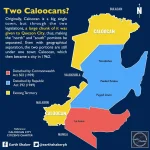
There is only one (1) Caloocan City in Metro Manila, though it has two disconnected parts: The northern and southern, but why?
During the time of the Americans, Caloocan is a large town located just northeast of Manila. It consists of several barrios/sitios.
During the Commonwealth period, to give way for the establishment of Quezon City, several barrios/sitios was redesignated under Quezon City through Commonwealth Act 502 (1939). These are: Balingasa, Kaingin, Kangkong, La Loma, Malamig, Matalahib, Masambong, San Isidro, San Jose, Santol and Tatalon.
In 1949, the boundaries of Quezon City was redefined, making Caloocan lose several barrios/sitios again: Baesa, Bagbag, Bahay-Toro, Banlat, Novaliches, Pasong Tamo, San Bartolome and Talipapa. After this, the north and south portions of Caloocan was separated.
Today, the people in the northern Caloocan City still need to go to the southern one to access City Hall services, but before getting there, they still need to pass the cities of Quezon City or Valenzuela.
REFERENCE: CALOOCAN CITY CITIZEN’S CHARTER (Link: You do not have permission to view the full content of this post. Log in or register now.)
Whenever we share maps of Metro Manila, people notice that there are “two” Caloocan Cities. To clarify this matter, here’s a simple explanation.
There is only one (1) Caloocan City in Metro Manila, though it has two disconnected parts: The northern and southern, but why?
During the time of the Americans, Caloocan is a large town located just northeast of Manila. It consists of several barrios/sitios.
During the Commonwealth period, to give way for the establishment of Quezon City, several barrios/sitios was redesignated under Quezon City through Commonwealth Act 502 (1939). These are: Balingasa, Kaingin, Kangkong, La Loma, Malamig, Matalahib, Masambong, San Isidro, San Jose, Santol and Tatalon.
In 1949, the boundaries of Quezon City was redefined, making Caloocan lose several barrios/sitios again: Baesa, Bagbag, Bahay-Toro, Banlat, Novaliches, Pasong Tamo, San Bartolome and Talipapa. After this, the north and south portions of Caloocan was separated.
Today, the people in the northern Caloocan City still need to go to the southern one to access City Hall services, but before getting there, they still need to pass the cities of Quezon City or Valenzuela.
REFERENCE: CALOOCAN CITY CITIZEN’S CHARTER (Link: You do not have permission to view the full content of this post. Log in or register now.)