 PH
PH1. Saturn is the least dense planet in the Solar System
Saturn has a density of 0.687 grams/cubic centimeter. Just for comparison, water is 1 g/cm3 and the Earth is 5.52. Since Saturn is less dense than water, it would actually float like an apple if you could find a pool large enough. Of course, why you’d want to ruin a pool with all that hydrogen, helium and ices…
2. Saturn is a flattened ball
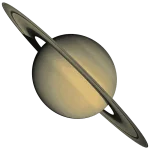
Saturn spins so quickly on its axis that the planet flattens itself out into an oblate spheroid. Seriously, you see this by eye when you look at a picture of Saturn; it looks like someone squished the planet a little. Of course, it’s the rapid spinning that’s squishing it, causing the equator to bulge out.
While the distance from the center to the poles is 54,000 km, the distance from the center to the equator is 60,300 km. In other words, locations on the equator are approximately 6,300 km more distant from the center than the poles.
We have a similar phenomenon here on Earth, where points on the equator are more distant from the center of the Earth, but on Saturn, it’s much more extreme.

Cassini’s drawings of Saturn
3. The first astronomers thought the rings were moons.
When Galileo first turned his rudimentary telescope on Saturn in 1610, he could see Saturn and its rings, but he didn’t know what he was looking at. He though that the rings might actually be two large moons stuck to either side of Saturn – ears maybe?
It wasn’t until 1655 that the Dutch astronomer Christian Huygens used a better telescope to observe Saturn. He had the resolution to realize that the moons on either side of Saturn were actually rings: “a thin, flat ring, nowhere touching, and inclined to the ecliptic.” Huygens was also the first person to discover Saturn’s largest moon, Titan.
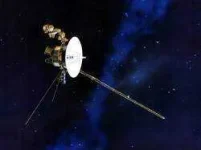
Voyager 2. Credit: NASA
4. Saturn has only been visited 4 times by spacecraft
Only 4 spacecraft sent from Earth have ever visited Saturn, and three of these were just brief flybys. The first was Pioneer 11, in 1979, which flew within 20,000 km of Saturn. Next came Voyager 1 in 1980, and then Voyager 2 in 1981. It wasn’t until Cassini’s arrival in 2004 that a spacecraft actually went into orbit around Saturn and captured photographs of the planet and its rings and moons.
Unfortunately, there are no future plans to send any more spacecraft to Saturn. A few missions have been proposed, including such radical concepts as a sailboat that could traverse the liquid methane lakes on Titan.
5. Saturn has 62 moons
Jupiter has 67 discovered moons, but Saturn is a close second with 62. Some of these are large, like Titan, the second largest moon in the Solar System. But most are tiny – just a few km across, and they have no official names. In fact, the last few were discovered by NASA’s Cassini orbiter just a few years ago. More will probably be discovered in the coming years.
6. The length of a day on Saturn was a mystery until recently
Determining the rotation speed of Saturn was actually very difficult to do, because the planet doesn’t have a solid surface. Unlike Mercury, you can’t just watch to see how long it takes for a specific crater to rotate back into view; astronomers needed to come up with a clever solution: the magnetic field.
To determine the rotational speed of Saturn, astronomers had to measure the rotation of the planet’s magnetic field. By one measurement, Saturn takes 10 hours and 14 minutes to turn on its orbit, but when Cassini approached Saturn, it clocked the rotation at 10 hours and 45 minutes. Astronomers now agree on an average day of 10 hours, 32 minutes and 35 seconds.
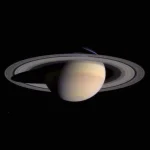
Saturn. NASA/JPL/Caltech
7. Saturn’s rings could be old, or they could be young.
It’s possible that Saturn’s rings have been around since the beginning of the Solar System – around 4.54 billion years ago. Or maybe they’re relatively brand new compared to the age of Saturn. Astronomers still don’t fully understand the origin of Saturn’s rings.
They might have formed recently, when a 300-km ice moon was torn apart by Saturn’s gravity, forming a ring around the planet.
It’s also possible that they’re the left over material when Saturn formed in the solar nebula. The material in the rings might have gotten jostled by Saturn’s gravity, and never could pull together into a cohesive Moon.
But astronomers have also found that the ring material looks just too clean to have formed so long ago, and could be as young as 100 million years old. It’s all just a big mystery.
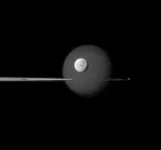
Credit: NASA/JPL-Caltech/Space Science Institute
8. Sometimes the rings disappear
Well, they don’t actually disappear, but they look like they’re going away. Saturn’s axis is tilted, just like Earth. From our point of view, we see Saturn’s changing position as it takes its 30 year journey around the Sun. Sometimes, the rings are fully open, and we see them in all their glory, but other times we see the rings edge on – it looks like they’ve disappeared. This happened in 2008-2009, and will happen again in 2024-2025.
9. You can see Saturn with your own eyes
Saturn appears as one of the 5 planets visible with the unaided eye. If Saturn is in the sky at night, you can head outside and see it. To see the rings and the ball of the planet itself, you’ll want to peer through a telescope. But you can amaze your friends and family by pointing out that bright star in the sky, and let them know they’re looking at Saturn.
10. There could be life near Saturn
Not life on Saturn; the planet is way too hostile to support life. But there could be life on one of Saturn’s moons: Enceladus.
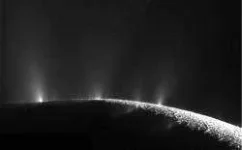
Water vapour geysers on Enceladus. Credit: NASA/JPL
NASA’s Cassini spacecraft recently discovered ice geysers blasting out of Enceladus’ southern pole. This means that some process is keep the moon warm enough that water can remain a liquid underneath the surface. And wherever we find liquid water on Earth, we find life.
Saturn has a density of 0.687 grams/cubic centimeter. Just for comparison, water is 1 g/cm3 and the Earth is 5.52. Since Saturn is less dense than water, it would actually float like an apple if you could find a pool large enough. Of course, why you’d want to ruin a pool with all that hydrogen, helium and ices…
2. Saturn is a flattened ball
Saturn spins so quickly on its axis that the planet flattens itself out into an oblate spheroid. Seriously, you see this by eye when you look at a picture of Saturn; it looks like someone squished the planet a little. Of course, it’s the rapid spinning that’s squishing it, causing the equator to bulge out.
While the distance from the center to the poles is 54,000 km, the distance from the center to the equator is 60,300 km. In other words, locations on the equator are approximately 6,300 km more distant from the center than the poles.
We have a similar phenomenon here on Earth, where points on the equator are more distant from the center of the Earth, but on Saturn, it’s much more extreme.
Cassini’s drawings of Saturn
3. The first astronomers thought the rings were moons.
When Galileo first turned his rudimentary telescope on Saturn in 1610, he could see Saturn and its rings, but he didn’t know what he was looking at. He though that the rings might actually be two large moons stuck to either side of Saturn – ears maybe?
It wasn’t until 1655 that the Dutch astronomer Christian Huygens used a better telescope to observe Saturn. He had the resolution to realize that the moons on either side of Saturn were actually rings: “a thin, flat ring, nowhere touching, and inclined to the ecliptic.” Huygens was also the first person to discover Saturn’s largest moon, Titan.
Voyager 2. Credit: NASA
4. Saturn has only been visited 4 times by spacecraft
Only 4 spacecraft sent from Earth have ever visited Saturn, and three of these were just brief flybys. The first was Pioneer 11, in 1979, which flew within 20,000 km of Saturn. Next came Voyager 1 in 1980, and then Voyager 2 in 1981. It wasn’t until Cassini’s arrival in 2004 that a spacecraft actually went into orbit around Saturn and captured photographs of the planet and its rings and moons.
Unfortunately, there are no future plans to send any more spacecraft to Saturn. A few missions have been proposed, including such radical concepts as a sailboat that could traverse the liquid methane lakes on Titan.
5. Saturn has 62 moons
Jupiter has 67 discovered moons, but Saturn is a close second with 62. Some of these are large, like Titan, the second largest moon in the Solar System. But most are tiny – just a few km across, and they have no official names. In fact, the last few were discovered by NASA’s Cassini orbiter just a few years ago. More will probably be discovered in the coming years.
6. The length of a day on Saturn was a mystery until recently
Determining the rotation speed of Saturn was actually very difficult to do, because the planet doesn’t have a solid surface. Unlike Mercury, you can’t just watch to see how long it takes for a specific crater to rotate back into view; astronomers needed to come up with a clever solution: the magnetic field.
To determine the rotational speed of Saturn, astronomers had to measure the rotation of the planet’s magnetic field. By one measurement, Saturn takes 10 hours and 14 minutes to turn on its orbit, but when Cassini approached Saturn, it clocked the rotation at 10 hours and 45 minutes. Astronomers now agree on an average day of 10 hours, 32 minutes and 35 seconds.
Saturn. NASA/JPL/Caltech
7. Saturn’s rings could be old, or they could be young.
It’s possible that Saturn’s rings have been around since the beginning of the Solar System – around 4.54 billion years ago. Or maybe they’re relatively brand new compared to the age of Saturn. Astronomers still don’t fully understand the origin of Saturn’s rings.
They might have formed recently, when a 300-km ice moon was torn apart by Saturn’s gravity, forming a ring around the planet.
It’s also possible that they’re the left over material when Saturn formed in the solar nebula. The material in the rings might have gotten jostled by Saturn’s gravity, and never could pull together into a cohesive Moon.
But astronomers have also found that the ring material looks just too clean to have formed so long ago, and could be as young as 100 million years old. It’s all just a big mystery.
Credit: NASA/JPL-Caltech/Space Science Institute
8. Sometimes the rings disappear
Well, they don’t actually disappear, but they look like they’re going away. Saturn’s axis is tilted, just like Earth. From our point of view, we see Saturn’s changing position as it takes its 30 year journey around the Sun. Sometimes, the rings are fully open, and we see them in all their glory, but other times we see the rings edge on – it looks like they’ve disappeared. This happened in 2008-2009, and will happen again in 2024-2025.
9. You can see Saturn with your own eyes
Saturn appears as one of the 5 planets visible with the unaided eye. If Saturn is in the sky at night, you can head outside and see it. To see the rings and the ball of the planet itself, you’ll want to peer through a telescope. But you can amaze your friends and family by pointing out that bright star in the sky, and let them know they’re looking at Saturn.
10. There could be life near Saturn
Not life on Saturn; the planet is way too hostile to support life. But there could be life on one of Saturn’s moons: Enceladus.
Water vapour geysers on Enceladus. Credit: NASA/JPL
NASA’s Cassini spacecraft recently discovered ice geysers blasting out of Enceladus’ southern pole. This means that some process is keep the moon warm enough that water can remain a liquid underneath the surface. And wherever we find liquid water on Earth, we find life.
