 PH
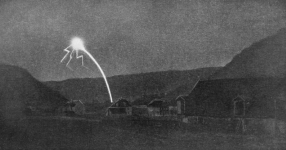
Did you know that a factory foreman reported seeing a ball of light "about the size of 20 suns" during the 1911 Ebingen earthquake (drawing pictured)?
An earthquake light, also known as earthquake lightning or an earthquake flash, is a reported luminous phenomenon that is said to be associated with tectonic stress or seismic activity. Reports describe flashes, glows, luminous orbs, sheet-like lights, streamers, and other transient lights observed before, during, or after earthquakes and at varying distances from earthquake sites. Experts differ on whether the reports describe a single real phenomenon, multiple unrelated phenomena, or misidentified natural and artificial light sources, and there is no consensus on a confirmed geological mechanism.
Fact from Wikipedia Did you know? (You do not have permission to view the full content of this post. Log in or register now.). Context excerpt adapted from Wikipedia: Earthquake light (You do not have permission to view the full content of this post. Log in or register now.). Text: CC BY-SA 4.0 (You do not have permission to view the full content of this post. Log in or register now.). See the source article for references.
Image: Originally observed and drawn by Friedrich Konzelmann and published in Schmidt, A.; Mack, K. (1912). "Das Süddeutsche Erdbeben vom 16 November 1911. Abschnitt VII: Lichterscheinung." Württembergische Jahrbücher für Statistik und Landeskunde, 1912 part 1, pages 131–139. — Public domain (You do not have permission to view the full content of this post. Log in or register now.) · You do not have permission to view the full content of this post. Log in or register now.
Source: You do not have permission to view the full content of this post. Log in or register now.