 PH
PremiumCourses
Honorary Poster
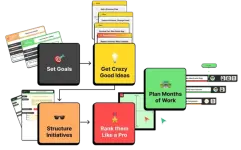
Andre Cruz's The SuperFast Roadmap is a practical guide and template for creating clear, collaborative business roadmaps. It introduces a straightforward process for turning a business goal into a prioritized plan of initiatives and actions arranged across a realistic timeline. The resource is designed to make roadmapping accessible even to people who have never created one before, with an emphasis on simplicity, team participation, and easy ongoing updates.
Course Overview
A business roadmap is a high-level plan that outlines the steps required to achieve a particular goal within a defined period. It helps teams understand what they are working toward, which initiatives deserve attention, and how planned activities fit together over time.
The SuperFast Roadmap presents this process as a simple, repeatable workflow rather than a complicated planning exercise. Its central idea is that an effective roadmap should be easy to create, understand, share, and maintain.
Instead of beginning with a long list of tasks or selecting projects without a clear direction, the process starts by identifying the goal. Team members then contribute ideas and potential initiatives, which are evaluated and prioritized before being placed on a timeline.
The result is intended to give managers and teams a shared view of their priorities while making it easier to adjust plans as business needs change.
The Roadmapping Process
The framework follows a sequence of connected steps that guide participants from an initial business objective to a roadmap that can be shared with the wider team.
1. Define the Goal
Every roadmap begins with a clear goal. This provides direction for the planning process and helps the team understand what the proposed initiatives are intended to accomplish.
A well-defined objective also creates a reference point for evaluating ideas. Without a common goal, roadmapping can become a collection of unrelated projects rather than a coordinated plan.
2. Involve the Team and Collect Ideas
Once the goal is established, the next step is to involve the people who will contribute to achieving it. Team members share ideas, potential initiatives, and possible ways to move toward the objective.
This collaborative stage helps bring different perspectives into the planning process. It also gives participants an opportunity to discuss priorities and contribute to decisions rather than simply receiving a finished plan.
3. Prioritize Initiatives Objectively
Not every idea can be included in a roadmap. The framework therefore emphasizes evaluating initiatives and deciding which ones deserve priority.
Objective prioritization helps teams compare potential activities according to their relevance to the goal. It also provides a more structured basis for discussions when different stakeholders have competing suggestions.
4. Build a Realistic Timeline
After selecting the most relevant initiatives, the team places them on a timeline. The schedule should be ambitious enough to encourage progress while remaining achievable given available resources and business constraints.
A timeline makes the roadmap easier to interpret because it shows how planned activities relate to one another over the selected period.
5. Share and Maintain the Roadmap
The final step is to make the roadmap accessible to everyone who needs it. Sharing the plan creates a common reference for the team and helps maintain alignment around agreed priorities.
A roadmap is not intended to remain unchanged indefinitely. As circumstances, priorities, or business requirements evolve, the plan should be reviewed and refreshed when necessary.
Focus on Valuable Customer Problems
One of the main principles behind The SuperFast Roadmap is that planning should begin with the problems that matter most to customers.
Before adding initiatives to a timeline, teams need to consider which customer problem would create the greatest value if solved. This encourages a more purposeful approach to prioritization and helps prevent roadmaps from becoming lists of activities that have little connection to customer needs.
The framework also highlights the importance of making the planning process engaging. Team participation and open discussion can improve the quality of ideas and make people more willing to contribute to maintaining the roadmap.
When participants understand the purpose of the plan and have a role in shaping it, keeping the roadmap current can become a shared responsibility rather than an administrative task assigned to one manager.
Choosing a Simple Roadmapping Tool
The resource emphasizes that the most suitable roadmapping tool is one that team members can understand without extensive training. A complicated platform can create unnecessary friction, particularly when people need to make frequent updates or collaborate across different responsibilities.
The suggested tool requirements focus on practical usability:
- Easy Sharing: Team members should be able to access the roadmap without a complicated distribution process.
- Team Comments: Participants should be able to discuss initiatives and contribute feedback directly.
- Quick Editing: Users should be able to update, move, delete, or clone roadmap items without unnecessary steps.
- Real-Time Collaboration: Everyone should be able to work from the same shared board, reducing the risk of conflicting versions.
- Minimal Learning Curve: The interface should be intuitive enough for team members to understand its basic operation in less than five minutes.
Reducing Planning Friction and Improving Collaboration
A shared roadmap can help reduce misunderstandings about business priorities, project ownership, and planned activities. When the team works from the same plan, discussions can focus more directly on goals and decisions rather than disagreements about what has been agreed.
The SuperFast approach also aims to make regular updates easier. Being able to move, revise, or remove initiatives quickly helps keep the roadmap relevant as new information becomes available.
The resource identifies several potential advantages of a simpler roadmapping process:
- Fewer disagreements and less friction during planning discussions.
- Greater team involvement in developing and maintaining priorities.
- A clearer view of how initiatives contribute to business goals.
- More straightforward updates when plans need to change.
- Less dependence on expensive tools, external consultants, or time-consuming planning processes.
- A shared reference that managers and team members can understand.
Who Can Benefit from The SuperFast Roadmap?
The resource is relevant to managers, startup founders, business owners, product teams, and professionals responsible for coordinating initiatives across a team.
It may be particularly useful for:
- Managers who need a clearer way to communicate business priorities.
- Startup founders organizing initiatives around growth objectives.
- Teams creating their first formal business roadmap.
- Product and project professionals coordinating multiple activities.
- Organizations looking to improve collaboration during planning.
- Teams that find traditional roadmapping tools too complicated or time-consuming.
Download Information
Course Name: Andre Cruz - The SuperFast Roadmap Free Download
Instructor: Andre Cruz
Category: Business Management / Strategy / Project Planning
Content Type: Roadmapping Guide and Template
Language: English
Format: .MP4
FileSize: 3.41 MB | 1 part
Course Page:
Code:
https://superfaststartup.com/pages/the-superfast-roadmap-overviewDOWNLOAD LINKS
Links are Interchangeable - No Password - Single ExtractionRapidgator
You do not have permission to view the full content of this post. Log in or register now.
ClicknUpload
You do not have permission to view the full content of this post. Log in or register now.
DDownload
You do not have permission to view the full content of this post. Log in or register now.
FreeDL
You do not have permission to view the full content of this post. Log in or register now.