 PH
PremiumCourses
Journeyman
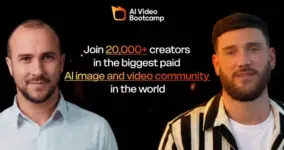
Daniel Riley - AI Video Bootcamp is an educational program focused on creating AI-generated videos, developing consistent virtual characters, and producing content for marketing and social media. The bootcamp covers AI influencers, user-generated content (UGC) advertisements, AI twins, character consistency, and advanced prompting techniques. It is presented as a learning resource for both beginners and experienced creators, with guided instruction, community feedback, and regular updates on AI tools.
Course Overview
AI Video Bootcamp focuses on the practical use of artificial intelligence in video creation and digital content production. Its stated goal is to help creators move from experimenting with AI tools to developing repeatable workflows for producing videos, building virtual personalities, and creating advertising content.
The program brings together several related areas of AI-assisted production. These include designing AI influencers, creating an AI version of oneself, maintaining a character's appearance across multiple scenes, and using prompting techniques to guide generated content. It also addresses the commercial side of content creation, particularly AI-generated advertisements and UGC-style videos intended for brands.
According to the supplied description, the bootcamp combines a guided roadmap with personal one-to-one feedback, community participation, challenges, giveaways, and weekly updates. The format is intended to make learning manageable for people working around existing schedules.
The source also emphasizes accessibility for people without technical experience. Although the program refers to expert-level prompting and advanced creative goals, it is explicitly marketed to complete beginners as well as established creators.
Creating and Monetizing AI Influencers
One of the bootcamp's main topics is the creation of AI influencers and the use of virtual personalities in digital content. An AI influencer is a computer-generated character designed to appear in videos, images, or other media as a recognizable online personality.
Creators may develop these characters for social media content, brand storytelling, promotional campaigns, or other digital publishing activities. Building a recognizable identity involves more than generating an attractive image: the character's appearance, presentation, and role need to remain coherent across different pieces of content.
The program specifically identifies AI influencer creation and monetization as learning objectives. It also promotes the development of AI-generated UGC advertisements, connecting virtual character creation with commercial content production.
The supplied material does not specify particular monetization platforms, revenue models, pricing strategies, or guaranteed earnings. Instead, it presents monetization as an intended application of the creative skills covered in the bootcamp.
Producing AI-Generated UGC Ads
User-generated content (UGC) ads are advertising materials designed to resemble content created by individual users or creators. They commonly use conversational presentation, product demonstrations, personal-style narration, and social-media-oriented formats.
The bootcamp highlights AI-assisted production of advertisements that brands may pay creators to produce. This focus connects video-generation techniques with the practical requirements of marketing content.
Relevant areas of application include:
- Developing concepts for short-form advertising videos.
- Creating virtual presenters or characters for promotional content.
- Using prompts to guide the appearance and style of generated scenes.
- Maintaining a recognizable visual identity across related assets.
- Developing content intended for brand campaigns and social media.
For creators exploring commercial AI video production, the subject connects visual experimentation with a more defined content objective: producing material that communicates a product or service in a format suitable for a marketing campaign.
Building an AI Twin or Digital Clone
Another stated focus is building an AI Twin or Clone. In AI-assisted content production, this generally refers to creating a digital representation of a person that can be used in generated visual or video content.
Depending on the tools involved, a digital twin workflow may involve reference images, visual identity controls, generated scenes, or other methods for reproducing a recognizable appearance. The exact process varies by platform and technology.
The bootcamp lists AI twin creation as a core learning objective, suggesting that learners can explore ways to develop a digital version of themselves for content production. Such workflows may be relevant to creators who want to experiment with virtual presentations or develop additional video assets without recording every scene in the conventional way.
The supplied description does not identify the specific software, voice-cloning methods, avatar systems, or technical steps used in the training. Those details should therefore not be assumed.
When creating digital representations of real people, permission and appropriate use of personal likenesses remain important considerations, particularly when content is published commercially.
Mastering Character Consistency
Maintaining character consistency is one of the bootcamp's explicitly stated priorities. Generative AI systems can produce variations in facial features, clothing, proportions, and other visual details when creating images or scenes from separate prompts.
These inconsistencies can make a sequence difficult to use as a coherent video. A character that looks different from one shot to the next may weaken continuity and make the finished content appear artificial.
The bootcamp identifies consistent character generation as a skill learners are expected to develop. This topic is particularly relevant to AI influencer projects, recurring virtual presenters, serialized content, and advertisements that use the same character across multiple scenes.
In general, character consistency can involve maintaining suitable references, using carefully structured prompts, and controlling visual attributes throughout a generation workflow. The precise techniques taught by this particular program are not detailed in the supplied source.
The emphasis on this subject reflects a practical challenge in AI video creation: generating individual attractive images is not the same as maintaining a stable character throughout a complete sequence.
Expert-Level Prompting for AI Video
The program also highlights AI prompting techniques as a major part of its curriculum. Prompts provide instructions that guide generative systems toward a desired visual result, subject, composition, style, or scene.
For video-related work, prompt design may influence the character's appearance, the environment, the action taking place, and the overall visual direction. More structured instructions can help creators communicate their intended result more precisely, although outputs still depend on the capabilities and limitations of the tools being used.
The bootcamp lists expert-level prompting among its advertised learning objectives. This sits alongside character consistency and AI advertisement creation, making prompting relevant to both the creative and commercial aspects of the program.
The source does not provide sample prompts, a named prompting framework, or a list of supported AI models. Its specific teaching methods and software demonstrations cannot be established from the supplied description alone.
A Guided Roadmap for Beginners and Experienced Creators
AI video production involves several interconnected decisions, from choosing a creative direction to selecting tools and refining generated results. The bootcamp advertises a guided learning roadmap intended to help participants understand where to begin and how to approach the subject.
The program is presented as suitable for people with different experience levels:
- Complete beginners: People exploring AI video creation without previous technical experience.
- Content creators: Individuals looking to incorporate AI-generated characters and videos into their existing workflows.
- Social media creators: People interested in developing repeatable content formats.
- Aspiring AI advertising creators: Learners interested in producing promotional content for potential brand clients.
- Experienced creators: Video and digital media practitioners who want to explore AI-assisted production methods.
Personal Feedback and Creator Community
Beyond the technical subject matter, the bootcamp promotes personal feedback and community participation as parts of the learning experience.
The advertised features include:
- One-to-one feedback: Personal feedback intended to help participants review their work and improve their approach.
- Creator community: A community advertised as having more than 25,000 helpful creators providing feedback daily.
- Challenges and giveaways: Community activities designed to encourage participation.
- Weekly updates: Updates intended to keep the material aligned with developments in AI tools.
These features are relevant to a field where AI generation tools and creative workflows change frequently. Feedback can provide an opportunity to discuss results, while community interaction may help participants compare approaches and learn about different production techniques.
The source does not specify the exact frequency of individual feedback sessions, the terms of community access, or the details of the challenges and giveaways.
Keeping Up with AI Video Tools
The bootcamp identifies staying up to date with AI tools as another part of its offering. This is relevant because generative video technology continues to develop, with platforms introducing new capabilities and changing their interfaces, generation methods, and usage conditions.
A creator's workflow may depend on the tools available for character creation, video generation, editing, and other production tasks. Learning how to approach these tools systematically can be useful when experimenting with new creative possibilities.
The advertised weekly updates are intended to support ongoing learning. However, the supplied material does not identify specific applications, subscription requirements, supported models, or the exact scope of these updates.
What the Bootcamp Aims to Address
The promotional description identifies several common frustrations that the program is designed to address:
- Uncertainty about where to begin with AI video production.
- Generated visuals that look artificial or overly polished.
- Characters whose appearances change between scenes.
- Spending substantial time generating content without producing usable material.
As with any generative AI workflow, results depend on the tools used, the quality of the instructions, and the amount of refinement required. The program's stated objectives should not be interpreted as a guarantee that every output will look realistic or that participants will secure paying clients.
Download Information
Course Name: Daniel Riley - AI Video Bootcamp
Instructor: Daniel Riley
Category: Artificial Intelligence, AI Video Creation, Digital Marketing
Content Type: Online AI Video Training Program
Language: English
Format: .MP4 + PDF
FileSize: 9.21 GB | 3 part
Course Page:
Code:
https://www.skool.com/aivideobootcamp/aboutDOWNLOAD LINKS
Links are Interchangeable - No Password - Single ExtractionRapidgator
You do not have permission to view the full content of this post. Log in or register now.
FreeDL
You do not have permission to view the full content of this post. Log in or register now.
You do not have permission to view the full content of this post. Log in or register now.
You do not have permission to view the full content of this post. Log in or register now.