 PH
PH0dayreleaser
Established
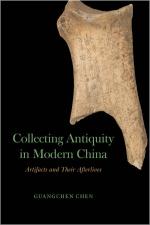
Collecting Antiquity in Modern China Artifacts and Their Afterlives | 16.51 MB
Title: Collecting Antiquity in Modern China Artifacts and Their Afterlives
Author: Guangchen Chen
Category: Ethnic Studies, Literary Theory & Criticism, General Art, Far Eastern, Art
Language: English | 384 Pages | ISBN: 9780226848570
Description:
A look at twentieth-century Chinese writers and intellectuals who used the material remains of the past to unsettle the present. In this book, Guangchen Chen argues that discerning collectors used antiquities to upend dominant discourses on history and cultural memory in twentieth-century China. Examining four categories of ancient artifacts-"carving" (oracle bones), "rubbing" (imprints of inscriptions and books), "brushing" (calligraphy), and "weaving" (textiles and costumes)-Chen explains how their modern (re)emergences changed our understanding of the relationship between tradition and modernity, textuality and materiality, and the very meaning of "Chineseness." Chen considers intellectuals such as Wang Yirong, Liu E, Luo Zhenyu, Wang Guowei, and Chen Mengjia, who played a pivotal role in the oracle bones' modern reception. He also looks to major literary figures including Lu Xun, whose engagements with textual remnants of the past inspired his critique of Chinese culture; Guo Moruo, whose work on the calligraphic masterpiece Lantingxu contributed to the cultural-political climate that sparked the Cultural Revolution; Shi Zhecun, whose interest in inscriptions on ancient stelae helped him to hold fast to intellectual integrity in the face of political pressure; and Shen Congwen, whose obsession with ancient textiles saved him from committing suicide after his writing fell out of favor. These antiquarians used their collections as a strategy to synchronize historical time and to challenge two dominant yet contrasting ideologies in modern China: a regressive idealization of antiquity and an unquestioning trust in linear progress. During this turbulent period, long-lost artifacts came to function as omens, warnings, and revelations from another time, generating new meanings that were uniquely relevant to the present.DOWNLOAD:
You do not have permission to view the full content of this post. Log in or register now.
You do not have permission to view the full content of this post. Log in or register now.
You do not have permission to view the full content of this post. Log in or register now.
You do not have permission to view the full content of this post. Log in or register now.