 PH
PH0xD4veZ10N
Leecher
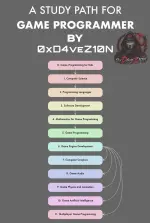
 GAME PROGRAMMING BOOKS & STUDY PATH
Category: Game DevelopmentLevel: Beginner → Advanced
Type: Study Resources / Ebooks
Maintainer: 0xD4veZ10N
 ABOUT THIS COLLECTION
Want to become a Game Programmer but don't know where to start?This thread contains a collection of game programming books and ebooks that can be used as a self-study library.
Rather than jumping randomly between tutorials, this collection is organized into different stages so you can gradually build your knowledge.
You don't need to read every book. Choose the resources that match your current level and goals.Learn → Practice → Build → Debug → Repeat
 GAME PROGRAMMING BOOK COLLECTION
Open Game Programming Books Collection [BEGINNER]
0. Game Programming for Beginners
For people who are completely new to programming.Topics:
- Programming fundamentals
- Variables & data types
- Conditions
- Loops
- Functions
- Basic logic
- Problem solving
- Introduction to game development
- Pong
- Snake
- Tic-Tac-Toe
- Breakout
1. Computer Science
Build a foundation in how computers and software work.Topics:
- Algorithms
- Data structures
- Computer architecture
- Memory
- Operating systems
- Computational thinking
- Problem solving
2. Programming Languages
Learn at least one programming language properly.Common choices:
- C++
- C#
- C
- Python
- Lua
3. Software Development
Learn how to create software that can grow beyond a small experiment.Topics:
- Object-oriented programming
- Design patterns
- Debugging
- Testing
- Version control
- Git
- Code organization
- Software architecture
 [INTERMEDIATE]
4. Mathematics for Game Programming
Mathematics becomes increasingly important as your games become more complex.Topics:
- Algebra
- Geometry
- Trigonometry
- Vectors
- Matrices
- Coordinate systems
- Transformations
- Quaternions
- Probability
- Basic calculus
- Movement
- Rotation
- Cameras
- Physics
- Graphics
5. Game Programming
Start learning the systems that make games actually work.Topics:
- Game loops
- Input systems
- Game states
- Collision detection
- Player controllers
- Cameras
- Animation
- UI
- Audio
- Save/load systems
- Entity systems
- 2D Platformer
- Top-down Shooter
- RPG Prototype
- Tower Defense
- Inventory System
- Dialogue System
6. Game Engine Development
Learn how game engines organize and manage game systems.Topics:
- Scenes
- Entities
- Components
- Assets
- Rendering
- Physics
- Audio
- Animation
- Input
- Scripting
- UI
- Serialization
Unity • Unreal Engine • Godot
Don't only learn how to use an engine. Try to understand what is happening underneath it.
 [ADVANCED]
7. Computer Graphics
For developers interested in rendering and visual technology.Topics:
- Rendering pipelines
- Rasterization
- 2D/3D graphics
- Shaders
- Lighting
- Materials
- Textures
- GPU programming
- OpenGL
- DirectX
- Vulkan
- Software Renderer
- 3D Renderer
- Ray Tracer
- Shader Experiments
- Custom Rendering Pipeline
8. Game Audio
Learn how sound and music are integrated into games.Topics:
- Digital audio
- Sound effects
- Music systems
- 3D positional audio
- Audio mixing
- DSP fundamentals
- Interactive music
- Audio middleware
9. Game Physics & Animation
Understand movement, physical interactions, and character animation.Physics:
- Collision detection
- Rigid bodies
- Forces
- Dynamics
- Constraints
- Spatial partitioning
- Keyframe animation
- Skeletal animation
- Inverse kinematics
- Animation blending
- Animation state machines
- Procedural animation
10. Game Artificial Intelligence
Learn how to create intelligent NPCs and enemies.Topics:
- Finite state machines
- Behavior trees
- Pathfinding
- Navigation
- Steering behaviors
- Decision systems
- Utility AI
- Procedural AI
- Enemy AI
- NPC Navigation
- Companion AI
- Tactical AI
- Procedural Behavior
11. Multiplayer Game Programming
For developers interested in online and multiplayer games.Topics:
- Client/server architecture
- Networking fundamentals
- Replication
- Synchronization
- Prediction
- Interpolation
- Lag compensation
- Multiplayer architecture
- Matchmaking
- Dedicated servers
- Multiplayer Pong
- Networked FPS Prototype
- Multiplayer Lobby
- Co-op Prototype
- Client/Server Framework
 HOW TO USE THIS COLLECTION
You do not need to complete every section in order.Use the categories to identify what you need to learn next.
Beginner
Programming → Computer Science → Software DevelopmentIntermediate
Mathematics → Game Programming → Game EnginesAdvanced
Choose your specialization:Graphics | Audio | Physics | Animation | AI | Networking
 DON'T JUST READ
Books give you knowledge.Projects give you experience.
Debugging gives you understanding.
Try to follow this cycle:
READ → CODE → BUILD → BREAK → DEBUG → IMPROVE
If a book teaches collision detection, build a collision system.
If it teaches AI, create an enemy.
If it teaches rendering, experiment with rendering.
If it teaches networking, make two clients communicate.
The goal isn't to finish the most books.
The goal is to become capable of building things yourself.
 POSSIBLE CAREER PATHS
Depending on what you enjoy, you can specialize in:- Gameplay Programmer
 Engine Programmer
 Graphics Programmer
 AI Programmer
 Network Programmer
 Physics Programmer
 Tools Programmer
 Technical Artist
 RESOURCE
Game Programming Books & Ebooks You do not have permission to view the full content of this post.
Log in or register now.Collection will be expanded with additional resources over time.
 FINAL NOTE
You don't need to read everything.You don't need to learn every programming language.
You don't need to build a AAA game as your first project.
Start small.
Learn something → build something → break something → fix it → learn something new.
Eventually, tutorials become references rather than instructions.
That's when you know you're making progress.
PROGENIC
Seed • Share • EvolveGame Programming Books & Study Path
Maintained by 0xD4veZ10N