 PH
PH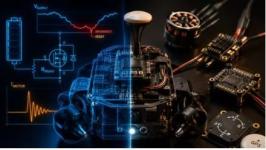
Electronics for Robotics 2026: Motor Drivers, ESCs & Sensors
Published 9/2026
MP4 | Video: h264, 1920x1080 | Audio: AAC, 44.1 KHz, 2 Ch
Language: English | Duration: 9h 2m | Size: 9.88 GB
Motor drivers, brushless ESCs, flight controllers and sensors, simulated in free ngspice. No hardware or kit needed.
What you'll learn
Read a motor driver or ESC datasheet and size it correctly: on-resistance, gate charge and thermal limits, and why absolute maximums are not operating points.
Explain how an H-bridge and a brushless ESC actually switch current, including shoot-through, dead time, PWM ripple and sensorless commutation timing.
Diagnose the five electrical failures that look like software bugs: supply sag, brownout, thermal runaway, sensor interference and intermittent connections.
Architect a full robot power and signal chain: battery, drivers, ESCs, flight controller, companion compute, IMU, GPS and sonar, buses and grounding.
Requirements
No hardware, kit or soldering required. No prior electronics needed beyond basic algebra. All simulations use free open-source ngspice, and every netlist is included.
Description
This course contains the use of artificial intelligence.
Your robot browns out halfway through a turn. One motor runs hotter than the others. The compass suddenly reads thirty degrees off, but only when the motors spin up.
You check the code, and the code is fine.
These are not software problems. They are electrical problems showing up as software symptoms, and most robotics courses barely teach you how to diagnose them.
This course covers theelectronics layer of a robot, from the battery and motor drivers to ESCs, flight controllers, companion computers, and sensors. The goal is not to memorize components, but to understand the physical mechanisms behind them.
No hardware required
Every waveform, current spike, voltage sag, and time constant comes from circuit simulations usingngspice, which is free and open source.
Every netlist is included, so you can change values, rerun experiments, observe failures, and test your own hypotheses.
For example, we test the common advice of adding a large capacitor when a microcontroller resets during a motor stall.
A4700 µF capacitor can save the processor during a 0.5 ms disturbance. At 2 ms, it fails. By 10 ms, increasing capacitance barely matters.
The lesson is that capacitors help with short transients. Sustained motor stalls require a stronger power source, current limiting, or better system design.
What you will learn
-Power systems: cells, internal resistance, voltage sag, brownouts, and shared grounds
-Transistors: on-resistance, gate charge, switching losses, and thermal behaviour
-H-bridges and motor drivers: shoot-through, dead time, PWM frequency, and current ripple
-Brushless motors and ESCs: commutation, back-EMF, sensorless startup, and DShot
-Current and position sensing: measuring the system and closing control loops
-Flight controllers and companion computers: what each should handle and why
-Robot sensors: IMU bias and noise, GPS fix quality, and acoustic ranging
-Communication and integration: buses, EMI, grounding, and wiring the complete robot
By the end of the course, you should be able to look at a robot behaving strangely and reason about whether the real problem is software, power, sensing, communication, or the electronics underneath it.
Who this course is for
Robotics engineers and CS graduates who can write a controller but have never been taught what the electronics beneath it are actually doing.
Drone, rover and underwater vehicle builders whose projects brown out, overheat or read the wrong heading, and who want to know why rather than guess.
Students and self-taught makers who want real electronics depth without buying an Arduino kit, a bench supply or an oscilloscope.
]You do not have permission to view the full content of this post. Log in or register now.
You do not have permission to view the full content of this post. Log in or register now.
You do not have permission to view the full content of this post. Log in or register now.
You do not have permission to view the full content of this post. Log in or register now.
You do not have permission to view the full content of this post. Log in or register now.
You do not have permission to view the full content of this post. Log in or register now.
You do not have permission to view the full content of this post. Log in or register now.
You do not have permission to view the full content of this post. Log in or register now.
You do not have permission to view the full content of this post. Log in or register now.
You do not have permission to view the full content of this post. Log in or register now.
You do not have permission to view the full content of this post. Log in or register now.