 PH
PH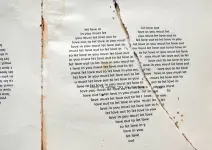
In visual poetry, the arrangement of words, letters, images, and empty spaces can become part of the poem.
The words don't necessarily have to form conventional lines.
A poet can scatter text across a page, overlap it with images, or manipulate its shape.
The visual arrangement can communicate ideas that ordinary sentences cannot.
This creates a fascinating overlap between literature and visual art.
The reader isn't just following language—they're also looking at a composition.
In some cases, the page itself becomes part of the poem's meaning.
© J. Paul Getty Museum