 PH
PH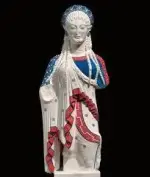
The clean white appearance of Greek sculpture has heavily influenced modern ideas about classical art.
But many ancient sculptures were originally painted in bright colors.
Researchers call this decoration polychromy.
Pigments could be used for clothing, hair, skin, jewelry, patterns, and other details.
Thousands of years of weathering, burial, cleaning, and deterioration removed much of that color.
Scientific analysis can sometimes detect microscopic pigment traces that survive on the stone.
Researchers and museums have even created reconstructions showing how dramatically different certain statues may originally have appeared.
The white marble aesthetic many people associate with ancient Greece is therefore partly the result of what happened to the artworks after antiquity.
© The Metropolitan Museum of Art