 PH
PH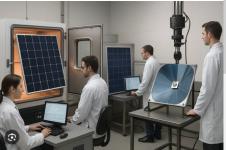
Solar Pv Module Testing: Iec 61215-1 & Iec 61215-2 Explained
Published 7/2026
Created by Purankumar Gajera
MP4 | Video: h264, 3840x2160 | Audio: AAC, 44.1 KHz, 2 Ch
Level: All Levels | Genre: eLearning | Language: English | Duration: 11 Lectures ( 4h 30m ) | Size: 10.5 GB
What you'll learn
 Understand the complete requirements of IEC 61215-1 and IEC 61215-2 for the design qualification and type approval of terrestrial photovoltaic (PV) modules. Learn the purpose, test procedures, laboratory setup, and acceptance criteria for every Module Quality Test (MQT 01 to MQT 22) specified in the IEC 61215 series Explain the qualification requirements for different PV technologies, including Crystalline Silicon, Cadmium Telluride (CdTe), Amorphous Silicon (a-Si), and CIG Understand how photovoltaic modules are evaluated for long-term reliability, safety, durability, and international certification according to IEC standards.
Requirements
 No prior knowledge of IEC 61215 is required. This course is designed to guide learners from the fundamentals to advanced concepts.
Description
"This course contains the use of artificial intelligence."
As the global demand for renewable energy continues to grow, photovoltaic (PV) modules are expected to deliver reliable performance for decades under challenging environmental conditions. To ensure their safety, durability, and long-term performance, PV modules must comply with internationally recognized qualification standards.IEC 61215-1 and IEC 61215-2 are the world's most widely accepted standards for thedesign qualification, type approval, and reliability testing of terrestrial photovoltaic modules.
This comprehensive course is designed to help engineers, testing professionals, manufacturers, certification bodies, researchers, and students gain a practical understanding of these important IEC standards. Whether you are new to photovoltaic module testing or looking to strengthen your expertise, this course explains every concept insimple, easy-to-understand language with practical engineering examples.
You will begin by learning the qualification philosophy and requirements ofIEC 61215-1, including the scope of the standard, design qualification principles, sample selection, test sequences, pass criteria, and technology-specific requirements forCrystalline Silicon (c-Si), Cadmium Telluride (CdTe), Amorphous Silicon (a-Si), and Copper Indium Gallium Selenide (CIGS) photovoltaic modules.
The course then exploresIEC 61215-2, which provides the detailed laboratory procedures for everyModule Quality Test (MQT) used to evaluate photovoltaic modules. Each test is explained step by step, including its purpose, required equipment, test setup, procedure, measurements, acceptance criteria, and engineering significance.
In this course, you will learn
 Fundamentals of IEC 61215-1 and IEC 61215-2 Design qualification and type approval requirements for PV modules Qualification philosophy, test sequences, and sample selection Technology-specific requirements for different PV module technologies Module Quality Tests (MQT 01 to MQT 22) Visual Inspection and Power Measurement Insulation, Wet Leakage Current, and Electrical Safety Tests Temperature Coefficient Measurement Nominal Operating Module Temperature (NMOT) Test Performance at STC and Low Irradiance Hot-Spot Endurance Testing UV Preconditioning Thermal Cycling Test Humidity-Freeze Test Damp Heat Test Robustness of Terminations Static Mechanical Load Test Hail Impact Test Bypass Diode Thermal Test Module Stabilization Procedures Cyclic Dynamic Mechanical Load Test Potential-Induced Degradation (PID) Test Bending Test for Flexible PV Modules Test report interpretation and qualification criteria Practical applications of IEC 61215 in testing laboratories, manufacturing, and certification
Throughout the course, complex technical requirements are explained in a structured and practical manner, making the standard accessible to both beginners and experienced professionals. By the end of the course, you will understand not onlywhat each qualification test requires, but alsowhy it is performed andhow the results are evaluated.
Who should take this course?
This course is ideal for
Solar PV Design Engineers Testing and Laboratory Engineers QA/QC Engineers Certification and Compliance Engineers PV Module Manufacturers Renewable Energy Professionals EPC Engineers and Project Engineers Research and Development Engineers Engineering Students and Researchers Anyone interested in solar photovoltaic module testing and international IEC standardsWhether you work insolar manufacturing, product testing, certification, quality assurance, research, or renewable energy projects, this course will provide valuable technical knowledge that you can immediately apply in your professional career.
Enroll today and master IEC 61215-1 & IEC 61215-2 to build your expertise in photovoltaic module qualification, reliability testing, and international certification.
Who this course is for
 This course is designed for anyone who wants to develop a strong understanding of IEC 61215-1 and IEC 61215-2 and the international requirements for photovoltaic (PV) module design qualification and testing.
Homepage
l
You do not have permission to view the full content of this post. Log in or register now.
l
You do not have permission to view the full content of this post. Log in or register now.
You do not have permission to view the full content of this post. Log in or register now.
You do not have permission to view the full content of this post. Log in or register now.
You do not have permission to view the full content of this post. Log in or register now.
You do not have permission to view the full content of this post. Log in or register now.
You do not have permission to view the full content of this post. Log in or register now.
You do not have permission to view the full content of this post. Log in or register now.
You do not have permission to view the full content of this post. Log in or register now.
You do not have permission to view the full content of this post. Log in or register now.
You do not have permission to view the full content of this post. Log in or register now.
You do not have permission to view the full content of this post. Log in or register now.
