 PH
PH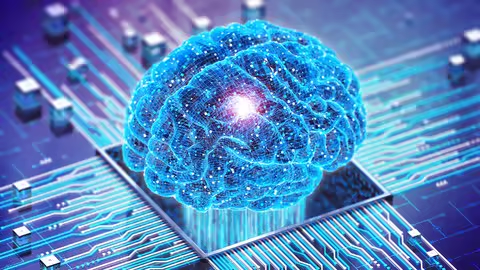
Udemy - Automotive Engineering; Vehicle Control Unit
Published 5/2025
MP4 | Video: h264, 1920x1080 | Audio: AAC, 44.1 KHz
Language: English | Size: 1.89 GB | Duration: 1h 57m
Fundamentals og Vehicle Control unit ; Brain of EV
What you'll learn
Importance of Vehicle Control UNit
Career Opportunities in Vehicle Control Unit
Future trends in Vehicle Control Unit
Components of VCU
Requirements
Basic Automobile Software development knowledge and Automotive Students
Description
1. Introduction to Vehicle Control Unit (VCU)The Vehicle Control Unit (VCU) is a critical electronic control unit (ECU) in electric vehicles (EVs) that acts as the central brain, managing and coordinating various subsystems to ensure optimal performance, safety, and efficiency. It plays a pivotal role in integrating powertrain control, battery management, thermal management, and other vehicle functions.The VCU performs several essential functions, including:2.1. Powertrain ControlManages the electric motor(s) for acceleration, deceleration, and regenerative braking.Controls torque distribution in multi-motor EVs (e.g., AWD systems).Ensures smooth power delivery by coordinating with the Motor Control Unit (MCU).2.2. Battery Management CoordinationCommunicates with the Battery Management System (BMS) to monitor battery state-of-charge (SoC), state-of-health (SoH), and temperature.Optimizes energy usage to maximize driving range.Enforces safety protocols to prevent overcharging or deep discharging.2.3. Regenerative Braking ControlAdjusts regenerative braking levels based on driving conditions.Balances friction and regenerative braking for optimal energy recovery.2.4. Thermal ManagementMonitors and controls cooling systems for the battery, motor, and power electronics.Prevents overheating and ensures efficient operation.2.5. Vehicle Dynamics & Stability ControlWorks with Electronic Stability Control (ESC) and Anti-lock Braking System (ABS) to enhance safety.Adjusts motor torque to prevent wheel slip (traction control).2.6. Charging ControlManages AC/DC charging processes.Communicates with charging stations via CCS, CHAdeMO, or Tesla protocols.2.7. Driver Input InterpretationProcesses inputs from the accelerator pedal, brake pedal, and driving modes (Eco, Sport, etc.).Adjusts vehicle response accordingly.2.8. Diagnostics & Fault HandlingMonitors system health and triggers warnings for malfunctions (e.g., motor failure, battery issues).Implements fail-safe modes to ensure driver safety.
Overview
Section 1: Introduction
Lecture 1 Introduction
Lecture 2 Lecture 2
Lecture 3 Lecture 3
Lecture 4 Lecture 4
Lecture 5 Lecture 5
Section 2: Section 2
Lecture 6 Lecture 6
Lecture 7 Lecture 7
Lecture 8 Lecture 8
Lecture 9 Lecture 9
Lecture 10 Lecture 10
EV Enthusiasts
Screenshot
Homepage
Code:
https://www.udemy.com/course/automotive-engineering-vehicle-control-unit/
RapidGator
You do not have permission to view the full content of this post. Log in or register now.
You do not have permission to view the full content of this post. Log in or register now.
Fikper
You do not have permission to view the full content of this post. Log in or register now.
You do not have permission to view the full content of this post. Log in or register now.
No Password - Links are Interchangeable