PH
PHWSODownload
Established
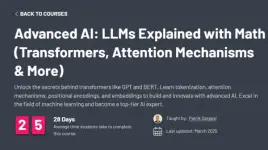
Released 3/2025
MP4 | Free Download Video: h264, 1920x1080 | Audio: AAC, 44.1 KHz, 2 Ch
Genre: eLearning | Language: English | Duration: 32 Lessons ( 4h 55m ) | Size: 688 MB
Dive deep into the mathematics powering transformers like GPT and BERT. Master attention mechanisms, positional encodings, and embeddings to understand the tech behind cutting-edge AI and language models.
What you'll learn
How tokenization transforms text into model-readable data
The inner workings of attention mechanisms in transformers
How positional encodings preserve sequence data in AI models
The role of matrices in encoding and processing language
Building dense word representations with multi-dimensional embeddings
Differences between bidirectional and masked language models
Practical applications of dot products and vector mathematics in AI
How transformers process, understand, and generate human-like text
What Are Transformers?
So many millennia ago the AutoBots and Decepticons fought over Cybertron...
Oh wait, sorry. Wrong Transformers.
The Transformer architecture is a foundational model in modern artificial intelligence, particularly in natural language processing (NLP). Introduced in the seminal paper "Attention Is All You Need" by Vaswani et al. in 2017, it is one of the most important technological breakthroughs that gave rise to the Large Language Models you know today like ᑕᕼᗩTGᑭT and Claude.
What makes Transformers special is that instead of reading word-by-word like old systems (called recurrent models), the Transformer looks at the whole sentence all at once. It uses something called attention to figure out which words are important to focus on for each task. For example, if you're translating "She opened the box because it was her birthday," the word "it" might need special attention to understand it refers to "the box."
Why Learn The Transformer Architecture?
1. They Power Modern AI Applications Transformers are the backbone of many AI systems today. Models like GPT, BERT (used in search engines like Google), and DALL·E (image generation) are all based on Transformers. If you're interested in these technologies, understanding Transformers gives you insight into how they work.
2. They Represent AI's Cutting Edge Transformers revolutionized AI, shifting from older methods like RNNs (Recurrent Neural Networks) to a whole new way of processing information. Learning them helps you understand why this shift happened and how it unlocked a new level of AI capability.
3. They're Widely Used in Research and Industry Whether you want to work in academia, build AI products, or explore mechanistic interpretability (which you've E×ρréššed interest in), Transformers are often the core technology. Understanding them can open doors to exciting projects and careers.
6. They're Fun and Intellectually Challenging The concept of self-attention and how Transformers handle context is elegant and powerful. Learning about them can feel like solving a fascinating puzzle. It's rewarding to see how they "think" and to realize why they're so effective.
Why This Transformers Course?
Well, because it teaches you advanced, dense material in a clear and enjoyable way - which is no easy feat!
But of course we're biased. So here's a breakdown of what's covered in this Advanced AI course so that you can make up your own mind
Introduction to Tokenization
Learn how transformers convert raw text into a processable format using techniques like the WordPiece algorithm. Discover the importance of tokenization in enabling language understanding.
Foundations of Transformer Architectures
Understand the roles of key, query, and value matrices in encoding information and facilitating the flow of data through a model.
Mechanics of Attention Mechanisms
Dive into multi-head attention, attention masks, and how they allow models to focus on relevant data for better context comprehension.
Positional Encodings
Explore how models maintain the sequence of words in inputs using cosine and sine functions for embedding positional data.
Bidirectional and Masked Language Models
Study the distinctions and applications of bidirectional transformers and masked models in language tasks.
Vector Mathematics and Embeddings
Master vectors, dot products, and multi-dimensional embeddings to create dense word representations critical for AI tasks.
Applications of Attention and Encoding
Learn how attention mechanisms and positional encoding come together to process and generate coherent text.
Capstone Knowledge for AI Innovation
Consolidate your understanding of transformer algorithms to develop and innovate with state-of-the-art AI tools.
Homepage:
Code:
https://zerotomastery.io/courses/advanced-ai-transformers-explained/DOWNLOAD LINKS
Fileaxa
You do not have permission to view the full content of this post. Log in or register now.
TakeFile
You do not have permission to view the full content of this post. Log in or register now.
Rapidgator
You do not have permission to view the full content of this post. Log in or register now.
Fikper
You do not have permission to view the full content of this post. Log in or register now.