 PH
PHProfessora Akira
☯️ SôulNinetãiL☯️
If the sky is clear we're lucky enough to witness this rare & mesmerizing celestial phenomenon
according to astronomer this rare event will be visible after sunset in western sky of course with clear & pollution-free skies.
-ccto-
in plain sight:Venus,Mars,Jupiter & Saturn
Venus & Saturn - shining bright in southwest sky
Jupiter- southeast sky above Orions constellation
Mars- glowing red in the eastern sky
with binoculars/ telescope:Uranus & Neptune
mercury will be harder to observe because of its proximity to the sun
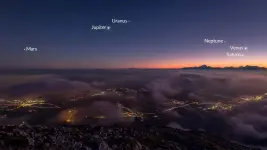
The planetary alignment take place today January 21, 2025. In the evening, just after sunset, six planets — Mars, Jupiter, Uranus, Neptune, Venus, and Saturn — will align in the sky. Four of these planets (Mars, Jupiter, Venus, and Saturn) will be easily visible to the nåkëd eye. You'll need a telescope or high-powered binoculars to see Neptune and Uranus.
Reddish Mars (mag -1.3) will shine on the eastern horizon, in the constellation Gemini.
Bright Jupiter (mag -2.6) will be positioned a little higher, in the constellation Taurus. If the sky is dark enough, you will be able to enjoy the beautiful Pleiades, Hyades and yellow Aldebaran that surround the planet and complete the picture. You can easily identify all these objects with the help of the Sky Tonight app.
Get high-powered binoculars to see Uranus (mag 5.7). It will be in the constellation Aries, near the border with Taurus.
The next three planets will be located closer to the western horizon. Neptune (mag 7.9) will be in the constellation Pisces, but you’ll need at least a pair of powerful binoculars to spot it. Yellowish Saturn (mag 0.6) and the "evening star" Venus (mag -4.7) will be easily visible. They will shine close together in the constellation Aquarius.
To make sure you located the planets correctly, download "Sky Tonight," a free stargazing app that makes it easy to identify any celestial object in the sky. To find out the name of an object above you, just launch the app and point your device at the sky – you will see the names of the planets and be able to learn more about each one.
Tips:
To see the alignment in all its beauty, find a place with a dark sky without light pollution and with a clear view of the horizon (without obstacles such as trees or tall buildings).
Exerpt from:Starwarspace/DvgNews
according to astronomer this rare event will be visible after sunset in western sky of course with clear & pollution-free skies.
-ccto-
in plain sight:Venus,Mars,Jupiter & Saturn
Venus & Saturn - shining bright in southwest sky
Jupiter- southeast sky above Orions constellation
Mars- glowing red in the eastern sky
with binoculars/ telescope:Uranus & Neptune
mercury will be harder to observe because of its proximity to the sun
The planetary alignment take place today January 21, 2025. In the evening, just after sunset, six planets — Mars, Jupiter, Uranus, Neptune, Venus, and Saturn — will align in the sky. Four of these planets (Mars, Jupiter, Venus, and Saturn) will be easily visible to the nåkëd eye. You'll need a telescope or high-powered binoculars to see Neptune and Uranus.
Reddish Mars (mag -1.3) will shine on the eastern horizon, in the constellation Gemini.
Bright Jupiter (mag -2.6) will be positioned a little higher, in the constellation Taurus. If the sky is dark enough, you will be able to enjoy the beautiful Pleiades, Hyades and yellow Aldebaran that surround the planet and complete the picture. You can easily identify all these objects with the help of the Sky Tonight app.
Get high-powered binoculars to see Uranus (mag 5.7). It will be in the constellation Aries, near the border with Taurus.
The next three planets will be located closer to the western horizon. Neptune (mag 7.9) will be in the constellation Pisces, but you’ll need at least a pair of powerful binoculars to spot it. Yellowish Saturn (mag 0.6) and the "evening star" Venus (mag -4.7) will be easily visible. They will shine close together in the constellation Aquarius.
To make sure you located the planets correctly, download "Sky Tonight," a free stargazing app that makes it easy to identify any celestial object in the sky. To find out the name of an object above you, just launch the app and point your device at the sky – you will see the names of the planets and be able to learn more about each one.
Tips:
To see the alignment in all its beauty, find a place with a dark sky without light pollution and with a clear view of the horizon (without obstacles such as trees or tall buildings).
Exerpt from:Starwarspace/DvgNews


