PH
PHUTANG NI JUAN. As of the last press release by the National Treasury the country’s total debt stood at something like ₱16.37 trillion.
The BoTr in its latest reported data had the government amortization for its debt in the month of October this year almost tripled compared to the same month of last year—evidence of intensified borrowing.
Compared to P77.760 billion in October of 2023 the government ρáíd a whopping P216.850 billion for the same month this year.
From ₱77+B to ₱216+B. That’s a lot.
In usapang personal na utang, when your amortization nearly tripled it follows you borrowed almost 3x what you borrowed in comparison to a previous period.
But no it wasn’t just 3x as much.
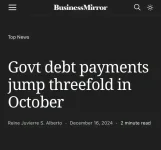
Glaring evidence of this massive borrowing by the BBM administration in the past year alone was explained by the Business Mirror article,
“Broken down, amortization, or the repayment of loan principal over time, shot up by 759.89 percent year-on-year to P161.462 billion from P18.777 billion.”
The other components of the ₱216+B were for Treasury Bonds and T-Bills, etc.
Ibig sabihin mula noong Oktubre 2023 hanggang nitong Oktubre 2024 (year-on-year) ang hulog natin sa ating pambansang utang ay halos multiplied 8x—that’s eight times in just one year!
Runaway debt is alarming. I know this because I’ve experienced it and am sure many of you did too.
How much more when the country runs on debt—spending money we haven’t earned. Worse, we’re not even sure if we can earn it.
From available data, I estimate our national debt will be or close to ₱17 trillion by the end of 2024.
The 2025 Budget will be running a deficit meaning we will be in a deficit spending mode. Simply put, uutangin natin ang pangtapal sa ating budget dahil kulang ang ating ‘income’. We will be spending beyond our means.
During the 2025 budget deliberations it was noted that estimated revenues for 2025 will only be about ₱4.8 trillion against the proposed, now Bicam approved ₱6.3+ trillion.
A deficit of around ₱1.5 trillion. Saan kukunin ang kakulangan na yan? Of course uutangin yan.
We will be spending more than ₱120 billion per month next year using money we don’t have on top of the previous debt we still have to pay.
Uutang tayo pambayad sa utang. Sounds familiar? You don’t need to be a genius to figure out this is not sustainable.
Admittedly, there are two types of debts, a bad debt and a good debt. A bad debt is, well, bad. It’s like buying an iPhone on credit that you have trouble paying in the future.
A good debt on the other hand is also called a leverage. You borrow and use it to invest in assets that generate income that is hopefully more than the interest you pay on your debt.
But in the case of the BBM administration I see no particular significant investments that can generate viable economic returns.
Nothing. In fact, big ticket infrastructure projects have been defunded this year and in 2025. Even human capital investments are next to nothing.
What we have is Ayuda spending. Too much dole-outs you can never find proof in any country that it is effective in uplifting the social standing of the citizenry, rather it runs the risk of turning people into lazy bums instead of providing economic opportunities for them to be empowered to fend for themselves.
Debt to GDP and Interest payment ratios are even more alarmingly high by 2025.
By the end of 2025 my estimate for our nation’s debt will be ₱20 trillion. As of 2023 the Philippine GDP was valued at ₱26+ trillion. Assuming it grew 6% this year, that would put it at ₱28 trillion in 2025.
If my approximation holds true, by end 2025 our Debt-To-GDP ratio will be a risky 71%. While some highly developed economies have debt-to-gdp ratios of more than 100%, emerging economies are careful not to go over 60% as this will put pressure on development spending since most of the government budget will be used to service debt.
Consider:
At ₱17 trillion debt with average interest rates at 3.5%, the country needs to shell out close to ₱600 billion a year just for interest payments.
At ₱28 trillion GDP in 2025, ₱600 billion is roughly 2.14% of total GDP. So, even if the economy grows by 6% next year the reality would only be less than 4% since over 2% of that will be used to pay for interest payments.
Disclaimer: I’m not an economist, I’m only using my common sense.
Ctto: POV NI KUYA EB
The BoTr in its latest reported data had the government amortization for its debt in the month of October this year almost tripled compared to the same month of last year—evidence of intensified borrowing.
Compared to P77.760 billion in October of 2023 the government ρáíd a whopping P216.850 billion for the same month this year.
From ₱77+B to ₱216+B. That’s a lot.
In usapang personal na utang, when your amortization nearly tripled it follows you borrowed almost 3x what you borrowed in comparison to a previous period.
But no it wasn’t just 3x as much.
Glaring evidence of this massive borrowing by the BBM administration in the past year alone was explained by the Business Mirror article,
“Broken down, amortization, or the repayment of loan principal over time, shot up by 759.89 percent year-on-year to P161.462 billion from P18.777 billion.”
The other components of the ₱216+B were for Treasury Bonds and T-Bills, etc.
Ibig sabihin mula noong Oktubre 2023 hanggang nitong Oktubre 2024 (year-on-year) ang hulog natin sa ating pambansang utang ay halos multiplied 8x—that’s eight times in just one year!
Runaway debt is alarming. I know this because I’ve experienced it and am sure many of you did too.
How much more when the country runs on debt—spending money we haven’t earned. Worse, we’re not even sure if we can earn it.
From available data, I estimate our national debt will be or close to ₱17 trillion by the end of 2024.
The 2025 Budget will be running a deficit meaning we will be in a deficit spending mode. Simply put, uutangin natin ang pangtapal sa ating budget dahil kulang ang ating ‘income’. We will be spending beyond our means.
During the 2025 budget deliberations it was noted that estimated revenues for 2025 will only be about ₱4.8 trillion against the proposed, now Bicam approved ₱6.3+ trillion.
A deficit of around ₱1.5 trillion. Saan kukunin ang kakulangan na yan? Of course uutangin yan.
We will be spending more than ₱120 billion per month next year using money we don’t have on top of the previous debt we still have to pay.
Uutang tayo pambayad sa utang. Sounds familiar? You don’t need to be a genius to figure out this is not sustainable.
Admittedly, there are two types of debts, a bad debt and a good debt. A bad debt is, well, bad. It’s like buying an iPhone on credit that you have trouble paying in the future.
A good debt on the other hand is also called a leverage. You borrow and use it to invest in assets that generate income that is hopefully more than the interest you pay on your debt.
But in the case of the BBM administration I see no particular significant investments that can generate viable economic returns.
Nothing. In fact, big ticket infrastructure projects have been defunded this year and in 2025. Even human capital investments are next to nothing.
What we have is Ayuda spending. Too much dole-outs you can never find proof in any country that it is effective in uplifting the social standing of the citizenry, rather it runs the risk of turning people into lazy bums instead of providing economic opportunities for them to be empowered to fend for themselves.
Debt to GDP and Interest payment ratios are even more alarmingly high by 2025.
By the end of 2025 my estimate for our nation’s debt will be ₱20 trillion. As of 2023 the Philippine GDP was valued at ₱26+ trillion. Assuming it grew 6% this year, that would put it at ₱28 trillion in 2025.
If my approximation holds true, by end 2025 our Debt-To-GDP ratio will be a risky 71%. While some highly developed economies have debt-to-gdp ratios of more than 100%, emerging economies are careful not to go over 60% as this will put pressure on development spending since most of the government budget will be used to service debt.
Consider:
At ₱17 trillion debt with average interest rates at 3.5%, the country needs to shell out close to ₱600 billion a year just for interest payments.
At ₱28 trillion GDP in 2025, ₱600 billion is roughly 2.14% of total GDP. So, even if the economy grows by 6% next year the reality would only be less than 4% since over 2% of that will be used to pay for interest payments.
Disclaimer: I’m not an economist, I’m only using my common sense.
Ctto: POV NI KUYA EB