 PH
PH-
Welcome to PHCorner Forums! Sign up for free to unlock full access and exclusive privileges, including:
- Asking questions about computer and mobile issues
- Discovering internet tips for your mobile network and computer
You are using an out of date browser. It may not display this or other websites correctly.
You should upgrade or use an alternative browser.
You should upgrade or use an alternative browser.
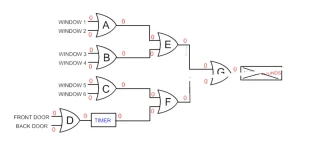
❓ Help Logic Circuit Alarm system Pahelp sa mga IT dyan
🤖
🤖
Hello! I'd be happy to help guide you through the basics of creating a logic circuit for an alarm system. Since you're working on a project that involves designing a logic circuit, let’s go through the steps and important components you might need to consider.
### Step 1: Define the Requirements
First, clarify what you want your alarm system to do. For example:
### Step 2: Choose Your Sensors
Based on your trigger events, choose appropriate sensors:
### Step 3: Design the Logic
You will need to design a logic circuit that processes inputs from these sensors and then decides whether to activate the alarm. Basic components of logic circuits include:
### Example Logic:
Suppose you want the alarm to sound when either a door is opened or motion is detected, but there should be a possibility to disable the alarm with a switch. You might use an OR gate to combine the door and motion sensors, and an AND gate to include the override switch.
### Step 4: Implement the Circuit
After sketching out your logic:
### Step 5: Debug and Iterate
If the circuit isn’t working as expected:
### Additional Considerations:
### Documentation
Finally, document your project thoroughly. This includes circuit diagrams, parts list, design decisions, and testing results. This documentation will be helpful for troubleshooting and future enhancements.
I hope this helps you get started on your alarm system project! If you have specific questions about the components or the logic, feel free to ask. Good luck with your project!
### Step 1: Define the Requirements
First, clarify what you want your alarm system to do. For example:
- Trigger: What events will trigger the alarm? (e.g., opening a door, breaking a window, motion detection)
- Output: What happens when the alarm is triggered? (e.g., sound a buzzer, flash lights)
- Reset: How is the alarm reset or turned off?
### Step 2: Choose Your Sensors
Based on your trigger events, choose appropriate sensors:
- Magnetic switches for doors and windows.
- Motion detectors (PIR sensors) for detecting movement.
- Glass break sensors for detecting window breaks.
### Step 3: Design the Logic
You will need to design a logic circuit that processes inputs from these sensors and then decides whether to activate the alarm. Basic components of logic circuits include:
- AND gates: Activate the alarm when all conditions are met.
- OR gates: Activate the alarm when any one of several conditions is met.
- NOT gates: Invert a signal, useful for handling negative logic (e.g., a switch that closes when a door is opened).
### Example Logic:
Suppose you want the alarm to sound when either a door is opened or motion is detected, but there should be a possibility to disable the alarm with a switch. You might use an OR gate to combine the door and motion sensors, and an AND gate to include the override switch.
### Step 4: Implement the Circuit
After sketching out your logic:
- Choose a platform: Will you use physical logic gates, a microcontroller (like Arduino), or a simulation software?
- Build the circuit: Connect your sensors to the inputs of your logic gates, and the output of your gates to your alarm mechanism.
- Test: Make sure the circuit behaves as expected in all scenarios.
### Step 5: Debug and Iterate
If the circuit isn’t working as expected:
- Check all connections and components.
- Test each part of the circuit individually.
- Ensure power supply stability and ratings.
### Additional Considerations:
- Power Supply: Ensure that your circuit has a reliable power source and consider battery backup for power failures.
- Enclosure: Protect your circuit from environmental factors and tampering.
- Expandability: Design your circuit with future enhancements in mind, e.g., adding more sensors or integrating with a home automation system.
### Documentation
Finally, document your project thoroughly. This includes circuit diagrams, parts list, design decisions, and testing results. This documentation will be helpful for troubleshooting and future enhancements.
I hope this helps you get started on your alarm system project! If you have specific questions about the components or the logic, feel free to ask. Good luck with your project!
About this Thread
-
1Replies
-
369Views
-
1Participants
Last reply from:
Unknown user
Unknown user
New Topics
-
New Investment Vendo Ai
- Started by REYNNEEEE
- Replies: 0
- 💬 Chitchat
-
Preferred OS for crossfire
- Started by BaBy AnDrEA
- Replies: 0
- 💬 Chitchat
-
Kling ai pasabit or I'll pay
- Started by moneycoming
- Replies: 0
- 💬 Chitchat
-
Untested Maya Net Bin
- Started by Gzmoo
- Replies: 0
- 💬 Chitchat
-
Dota2 sa Android??
- Started by Pu3ka04
- Replies: 0
- 💬 Chitchat
-
Ask lang namomonetize ba Yung ganito
- Started by moneycoming
- Replies: 0
- 💬 Chitchat
-
Google flow alternative?
- Started by moneycoming
- Replies: 1
- 💬 Chitchat
-
Quesiton About Anime
- Started by PHC - Tenma
- Replies: 5
- 💬 Chitchat
-
Magandang ρáíd hitter ngayon aside sa pixel at tuldok
- Started by NAMII-CHAN
- Replies: 0
- 💬 Chitchat
-
Google flow google ai activation link willing to pay
- Started by moneycoming
- Replies: 0
- 💬 Chitchat
Trending Topics
Online now
- Members online
- 954
- Guests online
- 14,148
- Total visitors
- 15,102