 PH
PH𝐔𝐍𝐃𝐄𝐑𝐒𝐓𝐀𝐍𝐃𝐈𝐍𝐆 𝐓𝐇𝐄 𝟏𝟗𝟎𝟎 𝐓𝐑𝐄𝐀𝐓𝐘 𝐎𝐅 𝐖𝐀𝐒𝐇𝐈𝐍𝐆𝐓𝐎𝐍 𝐁𝐄𝐓𝐖𝐄𝐄𝐍 𝐓𝐇𝐄 𝐔𝐍𝐈𝐓𝐄𝐃 𝐒𝐓𝐀𝐓𝐄𝐒 𝐀𝐍𝐃 𝐒𝐏𝐀𝐈𝐍
The 1900 Treaty of Washington between the United States and Spain, a supplement to the 1898 Treaty of Paris, is being used without deep appreciation of the words used in the treaty.
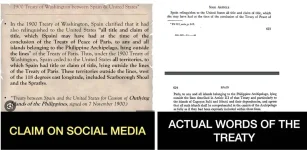
The attached photos provide a side-by-side comparison of the claim on social media, and the actual words of the treaty.
The actual treaty can be downloaded from the U.S. archives:
You do not have permission to view the full content of this post. Log in or register now.
From this comparison, the following observations can be deduced.
1. The social media claim disregard the FACT that the Republic of the Philippines is not a party to the 1898 Treaty of Paris and 1900 Treaty of Washington. Thus, the interpretation of the Republic of the Philippines on the interpretations of these treaties do not matter at all. These treaties were between Spain and the United States. Only Spain and the United States have the standing to interpret these treaties contracted between them.
2. The social media claim is VERY MISLEADING as it did NOT pay attention to the construction of the 1900 Treaty of Washington between the United States and Spain.
The social media claim disregarded that the sole provision in that 1900 treaty of Washington has two parts.
The first part is a general part, which is introduced by the verb MAY. May means possibility. This part refers to “titles and claim of title” which Spain, “may have had a the time of the conclusion of the Treaty of Peace of Paris, to any and all islands belonging to the Philippine archipelago, lying outside” the Treaty of Paris lines indicated in the 1898 Treaty of Paris. This part of the 1900 Treaty of Washington is the LEX GENERALIS.
The second part is the specific part. This part specifically indicated the islands that Spain has ceded to the United States, and they are: Cagayan Sulù and Sibutú and their dependencies.” This part of the 1900 Treaty of Washington is the LEX SPECIALIS.
In interpreting treaties, which are one of the sources of international law, the principle to be followed is lex specialis derogate legi generali, which means that when two laws govern the same factual situation, the specific law overrides the general law.
3. The social media claim has interpreted the 1900 Treaty of Washington assumes that Spain has sovereignty over all the islands OUTSIDE the 1898 Treaty of Paris limits. This is an incorrect assumption. MAY is not the same as HAS. May has to be interpreted to mean as IF IN CASE SPAIN HAS SOVEREIGNTY over those islands, they are deemed ceded to the United States under the 1900 Treaty of Washington. Thus, in order for the LEX GENERALIS part of the treaty article to be interpreted in the affirmative, it has first to be determined if Spain indeed had sovereignty over those islands, which in the social media claim refer to as Scarborough Shoal and the Spratlys.
4. The lex generalis part of the 1900 Treaty of Washington provides SWEEPING terms; tut this is delimited by the word MAY. The social media claim has totally disregarded this part.
The Island of Dos Palmas arbitration case between the Netherlands and the United States (1928) is relevant in this regard. The Island of Dos Palmas case is about the territorial dispute between the United States and the Netherlands over the Island of Palmas (or Miangas). The dispute is whether Island of Palmas was Spanish or Dutch territory. Island of Palmas is located south of Mindanao island.
The case can be read in the U.N. archives:
You do not have permission to view the full content of this post. Log in or register now.
The United States claimed that it was Spanish territory, and therefore, included in the territories ceded by Spain in the 1898 Treaty of Paris. The Netherlands disputed this, and denied that Spain had sovereignty over the Island of Palmas.
In fact, the Island of Palmas is WITHIN the Treaty of Paris limits. However, Island of Palmas arbitration court did not find this authoritative in determining who had sovereignty of Miangas.
The arbitration court has a word on the sweeping terms of the 1898 Treaty of Paris:
“Whilst there existed a divergence of views as to the extension of the cession to certain Spanish islands outside the treaty limits, it would seem that the cessionary Power never envisaged that the cession, in spite of the sweeping terms of Article III, should comprise territories on which Spain had not a valid title, though falling within the limits traced by the Treaty. It is evident that whatever may be the right construction of a treaty, it cannot be interpreted as disposing of the rights of independent third Powers.” (p. 842).
The central question of the arbitration court was whether Island of Dos Palmas was for Spain to give. The arbitration court quoted the position of the United States in its letter to the Spanish Minister in Washington D.C. in 1900: “If valid title belonged to Spain, it passed; if Spain had no valid title, she convey none.” (p. 842. Island Dos Palmas Case).
The arbitration court awarded the Island of Palmas to the Netherlands, despite the fact that it was within the 1898 Treaty of Paris limits. The sweeping terms of the treaty cannot disregard the claims of other independent states.
5. The social media claim has this logic: Spain has sovereignty over Scarborough Shoal and Spratlys, which Spain then ceded to the United States under the 1900 Treaty of Washington, and the Philipipnes inherited this.
This logic can only be valid if Spain has actual sovereignty over Scarborough Shoal and Spratlys. So before the Philippines can assert it inherited the claim, the United States first have to prove that it inherited Spanish sovereignty over Scarborough Shoal and Spratlys. The United States has not made any such assertions. In fact, the actions of the United States in the 2012 Scarborough Shoal stand-off between the Philippines and China are detrimental: the United States advised the Philippines to withdraw from Scarborough Shoal! If the United States inherited Spanish sovereignty over the shoal, and thus the Philippines subsequently inherited it, Washington D.C. should have not advised the Philippines to leave it at all. With regards to the Spratlys, the United States did not stake a claim over the Spratlys. In fact, the United States did not even object to the French annexation of the Spratly’s in 1933. China and Japan objected. If the United States have inherited Spanish sovereignty over the Spratlys, the United States should have made that claim in the 1951 San Francisco Treaty, which negotiated to whom the Spratly’s would belong after Japan was defeated in World War II.
What is clear was when Japan occupied the Spratly’s in 1933, it put the Spratly’s under the jurisdiction of the Island of Taiwan. Japan withdrew in 1943. China, which was still under the Kuomintang, occupied Itu Aba in 1946, the largest island in the Spratlys. In 1952, Japan entered into a separate treaty with China (under the Kuomintang). China interprets the treaty as Japan ceding the Spratly’s to China.
Until 1971, the Kuomintang (which was exiled in Taiwan after their defeat in the civil war versus the Communist Party of China) was considered the legitimate government of China as a whole. However, in October 25, 1971, the UN General Assembly de-recognized the Kuomintang and recognised the Communist Party of China. The People’s Republic of China (under the Communist Party of China) INHERITED all the territorial titles, claims, and actions of the Republic of China (under the Kuomintang). This is the reason why Taiwan and Beijing have the same claim: They are claiming it for China, as a whole.
6. So to summarise the logic of the Spratly claims:
Vietnam inherits the claims of France. Vietnam then accompanies this with historical arguments that even before the French claim they have had administered the Spratly’s.
The People’s Republic of China inherits the claims of the Republic of China, which they inherit from previous Chinese imperial governments, which is then accompanied by historical arguments of China’s previous discovery, use, and administration of the islands prior to the emergence of the modern state system.
As per the social media claim: The Philippines inherits the inheritance of the United States from Spain. This is, however, VERY INCONSISTENT, with the official assertion of the Philippines when it first joined the Spratly disputes in the 70s! The official Philippines position was the Spratly's were res nullius, which means legally belonging to no one, and thus Marcos Sr proceeded to occupy them.
This is how complex the issue is. A complexity that Filipinos are NOT being sufficiently informed about. The only way out of this complexity is to shelve sovereignty disputes, pursue joint development, which will subsequently create NEW FACTS based on mutual stewardship of the South China Sea. This is the pragmatic and long-term solution.
The 1900 Treaty of Washington between the United States and Spain, a supplement to the 1898 Treaty of Paris, is being used without deep appreciation of the words used in the treaty.
The attached photos provide a side-by-side comparison of the claim on social media, and the actual words of the treaty.
The actual treaty can be downloaded from the U.S. archives:
You do not have permission to view the full content of this post. Log in or register now.
From this comparison, the following observations can be deduced.
1. The social media claim disregard the FACT that the Republic of the Philippines is not a party to the 1898 Treaty of Paris and 1900 Treaty of Washington. Thus, the interpretation of the Republic of the Philippines on the interpretations of these treaties do not matter at all. These treaties were between Spain and the United States. Only Spain and the United States have the standing to interpret these treaties contracted between them.
2. The social media claim is VERY MISLEADING as it did NOT pay attention to the construction of the 1900 Treaty of Washington between the United States and Spain.
The social media claim disregarded that the sole provision in that 1900 treaty of Washington has two parts.
The first part is a general part, which is introduced by the verb MAY. May means possibility. This part refers to “titles and claim of title” which Spain, “may have had a the time of the conclusion of the Treaty of Peace of Paris, to any and all islands belonging to the Philippine archipelago, lying outside” the Treaty of Paris lines indicated in the 1898 Treaty of Paris. This part of the 1900 Treaty of Washington is the LEX GENERALIS.
The second part is the specific part. This part specifically indicated the islands that Spain has ceded to the United States, and they are: Cagayan Sulù and Sibutú and their dependencies.” This part of the 1900 Treaty of Washington is the LEX SPECIALIS.
In interpreting treaties, which are one of the sources of international law, the principle to be followed is lex specialis derogate legi generali, which means that when two laws govern the same factual situation, the specific law overrides the general law.
3. The social media claim has interpreted the 1900 Treaty of Washington assumes that Spain has sovereignty over all the islands OUTSIDE the 1898 Treaty of Paris limits. This is an incorrect assumption. MAY is not the same as HAS. May has to be interpreted to mean as IF IN CASE SPAIN HAS SOVEREIGNTY over those islands, they are deemed ceded to the United States under the 1900 Treaty of Washington. Thus, in order for the LEX GENERALIS part of the treaty article to be interpreted in the affirmative, it has first to be determined if Spain indeed had sovereignty over those islands, which in the social media claim refer to as Scarborough Shoal and the Spratlys.
4. The lex generalis part of the 1900 Treaty of Washington provides SWEEPING terms; tut this is delimited by the word MAY. The social media claim has totally disregarded this part.
The Island of Dos Palmas arbitration case between the Netherlands and the United States (1928) is relevant in this regard. The Island of Dos Palmas case is about the territorial dispute between the United States and the Netherlands over the Island of Palmas (or Miangas). The dispute is whether Island of Palmas was Spanish or Dutch territory. Island of Palmas is located south of Mindanao island.
The case can be read in the U.N. archives:
You do not have permission to view the full content of this post. Log in or register now.
The United States claimed that it was Spanish territory, and therefore, included in the territories ceded by Spain in the 1898 Treaty of Paris. The Netherlands disputed this, and denied that Spain had sovereignty over the Island of Palmas.
In fact, the Island of Palmas is WITHIN the Treaty of Paris limits. However, Island of Palmas arbitration court did not find this authoritative in determining who had sovereignty of Miangas.
The arbitration court has a word on the sweeping terms of the 1898 Treaty of Paris:
“Whilst there existed a divergence of views as to the extension of the cession to certain Spanish islands outside the treaty limits, it would seem that the cessionary Power never envisaged that the cession, in spite of the sweeping terms of Article III, should comprise territories on which Spain had not a valid title, though falling within the limits traced by the Treaty. It is evident that whatever may be the right construction of a treaty, it cannot be interpreted as disposing of the rights of independent third Powers.” (p. 842).
The central question of the arbitration court was whether Island of Dos Palmas was for Spain to give. The arbitration court quoted the position of the United States in its letter to the Spanish Minister in Washington D.C. in 1900: “If valid title belonged to Spain, it passed; if Spain had no valid title, she convey none.” (p. 842. Island Dos Palmas Case).
The arbitration court awarded the Island of Palmas to the Netherlands, despite the fact that it was within the 1898 Treaty of Paris limits. The sweeping terms of the treaty cannot disregard the claims of other independent states.
5. The social media claim has this logic: Spain has sovereignty over Scarborough Shoal and Spratlys, which Spain then ceded to the United States under the 1900 Treaty of Washington, and the Philipipnes inherited this.
This logic can only be valid if Spain has actual sovereignty over Scarborough Shoal and Spratlys. So before the Philippines can assert it inherited the claim, the United States first have to prove that it inherited Spanish sovereignty over Scarborough Shoal and Spratlys. The United States has not made any such assertions. In fact, the actions of the United States in the 2012 Scarborough Shoal stand-off between the Philippines and China are detrimental: the United States advised the Philippines to withdraw from Scarborough Shoal! If the United States inherited Spanish sovereignty over the shoal, and thus the Philippines subsequently inherited it, Washington D.C. should have not advised the Philippines to leave it at all. With regards to the Spratlys, the United States did not stake a claim over the Spratlys. In fact, the United States did not even object to the French annexation of the Spratly’s in 1933. China and Japan objected. If the United States have inherited Spanish sovereignty over the Spratlys, the United States should have made that claim in the 1951 San Francisco Treaty, which negotiated to whom the Spratly’s would belong after Japan was defeated in World War II.
What is clear was when Japan occupied the Spratly’s in 1933, it put the Spratly’s under the jurisdiction of the Island of Taiwan. Japan withdrew in 1943. China, which was still under the Kuomintang, occupied Itu Aba in 1946, the largest island in the Spratlys. In 1952, Japan entered into a separate treaty with China (under the Kuomintang). China interprets the treaty as Japan ceding the Spratly’s to China.
Until 1971, the Kuomintang (which was exiled in Taiwan after their defeat in the civil war versus the Communist Party of China) was considered the legitimate government of China as a whole. However, in October 25, 1971, the UN General Assembly de-recognized the Kuomintang and recognised the Communist Party of China. The People’s Republic of China (under the Communist Party of China) INHERITED all the territorial titles, claims, and actions of the Republic of China (under the Kuomintang). This is the reason why Taiwan and Beijing have the same claim: They are claiming it for China, as a whole.
6. So to summarise the logic of the Spratly claims:
Vietnam inherits the claims of France. Vietnam then accompanies this with historical arguments that even before the French claim they have had administered the Spratly’s.
The People’s Republic of China inherits the claims of the Republic of China, which they inherit from previous Chinese imperial governments, which is then accompanied by historical arguments of China’s previous discovery, use, and administration of the islands prior to the emergence of the modern state system.
As per the social media claim: The Philippines inherits the inheritance of the United States from Spain. This is, however, VERY INCONSISTENT, with the official assertion of the Philippines when it first joined the Spratly disputes in the 70s! The official Philippines position was the Spratly's were res nullius, which means legally belonging to no one, and thus Marcos Sr proceeded to occupy them.
This is how complex the issue is. A complexity that Filipinos are NOT being sufficiently informed about. The only way out of this complexity is to shelve sovereignty disputes, pursue joint development, which will subsequently create NEW FACTS based on mutual stewardship of the South China Sea. This is the pragmatic and long-term solution.