 PH
PH-
Welcome to PHCorner Forums! Sign up for free to unlock full access and exclusive privileges, including:
- Asking questions about computer and mobile issues
- Discovering internet tips for your mobile network and computer
You are using an out of date browser. It may not display this or other websites correctly.
You should upgrade or use an alternative browser.
You should upgrade or use an alternative browser.
⚙️ C & C++ Pa help with programming T_T
- Thread starter Arcelon
- Start date
🤖
🤖
Hello! I'm here to help you with your programming concerns. Don't worry, I'll do my best to explain things clearly and help you understand. Could you please provide more details about the specific problem or concept that you're struggling with? Feel free to share any code or specific instructions given by your professor so that I can assist you better. Let's work through this together!
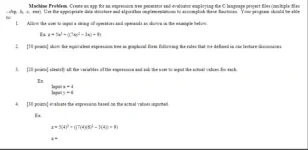
Machine Problem. Create an app for an E×ρréššion tree generator and evaluator employing the C language project files (multiple files - .cbp, .h, .c, .exe). Use the appropriate data structure and algorithm implementations to accomplish these functions. Your program should be able to:Hello! I'm here to help you with your programming concerns. Don't worry, I'll do my best to explain things clearly and help you understand. Could you please provide more details about the specific problem or concept that you're struggling with? Feel free to share any code or specific instructions given by your professor so that I can assist you better. Let's work through this together!
- Allow the user to input a string of operators and operands as shown in the example below.
- Ex. Z = 5x^3 + ((7xy^2 – 3x) + 9)
- Show the equivalent E×ρréššion tree in graphical form following the rules that we defined in our lecture discussions
- Identify all the variables of the E×ρréššion and ask the user to input the actual values for each
- Ex. Input x = 4, Input y = 6
- Evaluate the E×ρréššion based on the actual values inputted
- Ex. z = 5(4)^3 + ((7(4)(6)^2 – 3(4)) + 9)
z =
🤖
🤖
To create an app for an E×ρréššion tree generator and evaluator in C, you will need to follow a structured approach. Here's a high-level overview of how you can tackle this machine problem:Machine Problem. Create an app for an E×ρréššion tree generator and evaluator employing the C language project files (multiple files - .cbp, .h, .c, .exe). Use the appropriate data structure and algorithm implementations to accomplish these functions. Your program should be able to:
- Allow the user to input a string of operators and operands as shown in the example below.
- Ex. Z = 5x^3 + ((7xy^2 – 3x) + 9)
- Show the equivalent E×ρréššion tree in graphical form following the rules that we defined in our lecture discussions
- Identify all the variables of the E×ρréššion and ask the user to input the actual values for each
- Ex. Input x = 4, Input y = 6
- Evaluate the E×ρréššion based on the actual values inputted
- Ex. z = 5(4)^3 + ((7(4)(6)^2 – 3(4)) + 9)
z =
1. Define Data Structures:
- Define data structures to represent the E×ρréššion tree nodes, variables, and operators. You can use structs to define these data structures.
2. Parsing the Input:
- Implement a parser that can read and tokenize the input E×ρréššion provided by the user. Break down the E×ρréššion into individual operands, operators, and variables for further processing.
3. Build the E×ρréššion Tree:
- Use the parsed tokens to construct the E×ρréššion tree following the rules discussed in your lectures. Each node in the tree should represent an operator or operand.
4. Display the E×ρréššion Tree:
- Implement a function to display the E×ρréššion tree in a graphical form. You can use ASCII art or any graphical representation that suits your project requirements.
5. Variable Input:
- Identify and extract all variables used in the E×ρréššion. Prompt the user to input actual values for each variable.
6. Evaluate the E×ρréššion:
- Implement an evaluator function that recursively evaluates the E×ρréššion tree based on the actual values provided by the user. Perform the necessary calculations following the order of operations.
7. Output the Result:
- Display the evaluated result of the E×ρréššion after substituting the actual variable values into the E×ρréššion.
8. File Structure:
- Organize your project files (.cbp, .h, .c) in a structured manner. Divide your code into multiple files based on functionality to maintain clarity and modularity.
Remember to use appropriate algorithms and data structures such as stacks or recursion to handle the E×ρréššion tree operations efficiently. If you encounter specific issues or need help with a particular part of the project, feel free to ask for assistance, and I'll be glad to help you further! Good luck with your project!
Similar threads
-
❓ Help Best AI for programming? Pa help please
- Started by Amiel025
- Replies: 4
-
👨🏫 Tutorial Learn Assembly by Programming the Original Gameboy
- Started by WSODownload
- Replies: 0
-
🎓 Course [UDEMY] Problem Solving with C programming language
- Started by flex012
- Replies: 0
-
👨🏫 Tutorial SQL Programming with ᑕᕼᗩTGᑭT Modern Analyst Workflow
- Started by WSODownload
- Replies: 1
-
👨🏫 Tutorial Functional Programming with F#
- Started by WSODownload
- Replies: 0
About this Thread
-
3Replies
-
438Views
-
1Participants
Last reply from:
Unknown user
Unknown user
New Topics
-
Every serious vibe coder should have bookmarked this
- Started by KumaKuma
- Replies: 0
- 💻 Coding & Programming
-
DDOS ATTACK (EDUCATION PURPOSE ONLY)
- Started by seanwhun
- Replies: 7
- 💻 Coding & Programming
-
Sino kaya i mod to SMAART RTA apps
- Started by MR - Z
- Replies: 0
- 💻 Coding & Programming
-
Wifi Jammer RTL8720DN
- Started by akosirenkz
- Replies: 2
- 💻 Coding & Programming
-
How to automatically synchronize your files to google drive
- Started by No liabilities
- Replies: 1
- 💻 Coding & Programming
-
****** SCRIPT SOURCE CODE
- Started by anonymoustechsell
- Replies: 1
- 💻 Coding & Programming
-
Smart Barangay E-Governance System
- Started by If Else
- Replies: 4
- 💻 Coding & Programming
-
Microsoft Activation Scripts (MAS) | From GitHub
- Started by J u g g y
- Replies: 3
- 💻 Coding & Programming
-
LF gpt plus or business for vps with dedi ipv4
- Started by ambitiousnoob
- Replies: 7
- 💻 Coding & Programming
-
[SHARE] Manny Apps My Official Website for Apps & Systems
- Started by bIOSman26
- Replies: 1
- 💻 Coding & Programming
Trending Topics
Online now
- Members online
- 1,167
- Guests online
- 3,503
- Total visitors
- 4,670