 PH
PH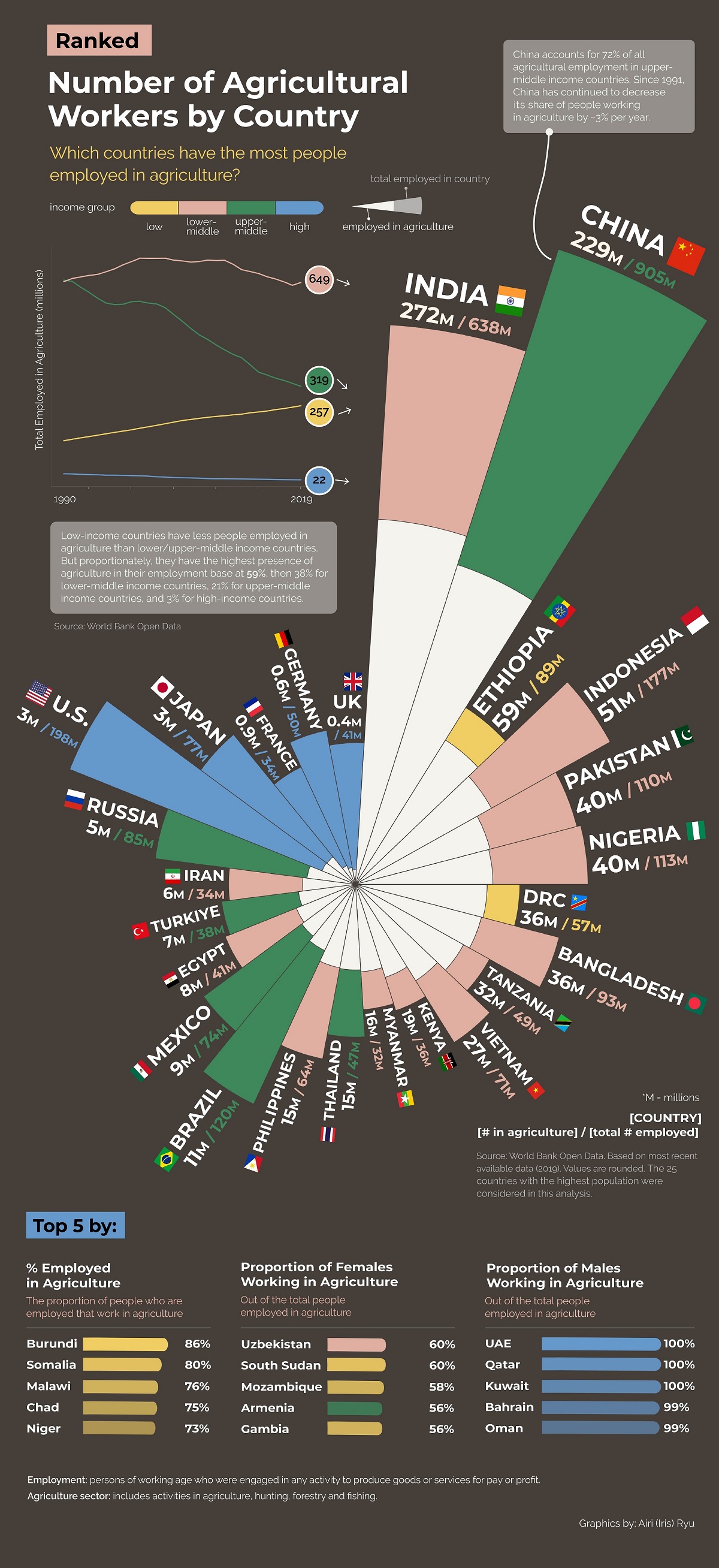
Agriculture has long been the foundation of human civilization, supporting billions of people worldwide with food and a means of subsistence.
Agriculture employed a projected 27% of the world's workers as of 2021, although contributing only 4% of the world economy's gross domestic product (GDP).
The World Bank's 2019 employment and population statistics are used in the figure above to rank the distribution of agricultural employees in the world's most populous nations.
Asia and Africa Have the Most Agricultural Workers
Asia and Africa Have the Most Agricultural Workers
India and China, the two most populated nations, are at the top of the list with 272 million and 229 million agricultural workers, respectively:
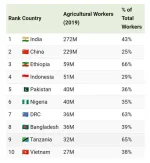
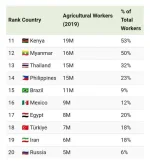
Despite having fewer agricultural employees, Africa has a much higher proportion of the world's agricultural workforce. Among the most populous nations, Tanzania (65%) and Ethiopia (66%) had the largest proportions of agricultural workers, followed closely by other low- and lower-middle-income African nations.
In fact, according to McKinsey, more than 60% of all people in sub-Saharan Africa are smallholder farmers, and the sector accounts for around 23% of the region's GDP.
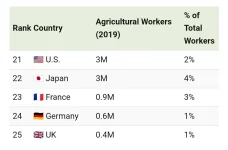
In contrast, high-income nations employ substantially less people in agriculture. An estimated 3 million people work in agriculture in the U.S. and Japan, which represents only 3% and 4% of the overall working populations, respectively.
Women make up 37% of all agricultural laborers on average, with the majority being found in just 20 nations in Africa and Asia.
Evolution of Agricultural Jobs Over Time
The number of agricultural employees has decreased over the past century as a result of technical advancements, urban migration, changes in land usage, and economic diversification.Nevertheless, they continue to make up 25% of the world's workforce, and despite agriculture's mechanization, labor is still required to keep up with demand.
For instance, a study published in Bioscience stated that in order to meet the food needs of the global population by 2050, agricultural productivity will need to rise by at least 25%.
Source: Visual Capitalist