 PH
PHarsenal1205
Rarely opens PHC
Mecum Auctions
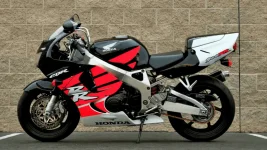
Side profile shot of a 1999 Honda CBR900RR Fireblade
The You do not have permission to view the full content of this post. Log in or register now. It started life as the CBR900RR, a lightweight rocket, and grew into the CBR1000RR, still a lightweight rocket but with much stiffer competition from its rival Japanese manufacturers, as well as European manufacturers such as BMW and Ducati. Horsepower outputs of the ‘Blade have grown relentlessly over the years, as has technology, in an effort to keep up with those rivals, but one thing is certain: the Honda Fireblade, in all its iterations, is one of the most iconic motorcycles of the modern era.
Origin Of The Fireblade
Honda
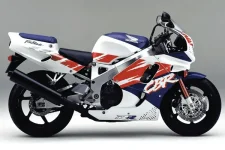
1992 Honda CBR900RR Fireblade facing right against a white background
You do not have permission to view the full content of this post. Log in or register now. and, much later, in 1992, with the startlingly original CBR900RR Fireblade, which was no more powerful than other large displacement sports bikes of the time, but, crucially, it was much more compact and lighter. If Honda reinvented the sports bike with that first Fireblade, it soon lost ground to its rivals, certainly in terms of power output. For many years the Fireblade played second fiddle to its rivals - in the eyes of the wider public, that is - as power outputs in the 1000cc class escalated and Honda steadfastly refused to play Keep Up With The Joneses, preferring to refine its concept gradually and concentrate on dynamics over raw power. Ironically, when Honda first entered GP racing in the 1960s, the emphasis of the engineers was on outright power. Their thinking was along the lines of ‘to go faster we need more power’, which they duly delivered whilst ignoring the fact that the spindly steel tube frames just weren’t up to handling it! Not for nothing was Mike Hailwood’s 1967 Honda 500cc GP bike nicknamed ‘The Bronco’.
RELATED:You do not have permission to view the full content of this post. Log in or register now.
It Was More Than Just Outright Performance Since Its Inception
Honda
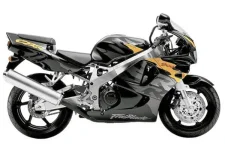
1998 Honda CBR900RR Fireblade facing right against a white background
Of course, Honda soon learned that the chassis was just as important as the engine. The whole tenet of the Fireblade from inception was one of power, certainly, but allied to lightweight and a compact but extremely stiff chassis giving excellent handling. Kings of the performance heap back in the late 1980s were the You do not have permission to view the full content of this post. Log in or register now. and the Suzuki GSX-R1100. Both of these bikes produced around 140 – 150 horses, but the problem was that they were a bit porky, weighing in at 240 – 250 kilos and some testers claimed slightly suspect handling. Then the You do not have permission to view the full content of this post. Log in or register now. came along in 1992. It made fewer horses than the Yamaha and Suzuki but weighed in at up to 50 kilos less (for a wet weight of 205 kilos) than both of them and had a much sweeter handling chassis. In fact, it only weighed two kilos more than the CBR600F2! It was, in short, perfection in two-wheeled form.
Honda
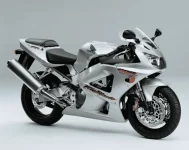
2001 Honda CBR900RR Fireblade in silver, facing right
The first CBR900RR Fireblade had an 893cc, in-line four-cylinder engine which produced 111 horses. For the second generation, capacity and power stayed the same, but there were revisions to the chassis and bodywork. Up to 919cc and 123 horses for version three, then 929cc and 150 horses, thanks to fuel injection. Finally, it reached 954cc and 154 horses in 2002, 10 years after its debut. All through this period of constant and gradual evolution, the Honda CBR900RR was still the motorcycle by which all others judged their progress and success.
RELATED:You do not have permission to view the full content of this post. Log in or register now.
Honda Upped The Ante With The CBR1000RR
Honda
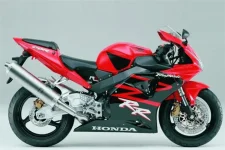
2002 Honda CBR91000RR Fireblade in red, facing right
Now the engine was over 950cc, You do not have permission to view the full content of this post. Log in or register now.. This was a completely new engine and not merely a stretched 900cc unit. Pretty much from that day to 2017, the 998/999cc engine produced 172-177 horses, although there were many more generations (in total, 12 generations from 1992 up to 2017), each significantly re-engineered over the previous model, but retaining basically the same essence as the first model back in 1992; lightweight, compact design, good power married to a brilliant chassis and possessing sharp handling and excellent brakes.
RELATED:You do not have permission to view the full content of this post. Log in or register now.
Honda Had A Winner But Couldn't Achieve Good Volume
Honda
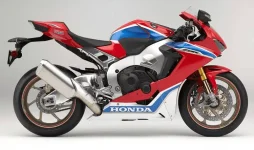
2017 Honda CBR91000RR Fireblade in red and blue, facing right
The CBR1000RR was awarded You do not have permission to view the full content of this post. Log in or register now. and this is significant; those in the know knew what Honda was doing and appreciated it. Unfortunately, they weren’t the ones buying the bikes.
The public voted with their feet and wallets and, despite having no idea what to do with so much horsepower, decided that more of it was a great idea and bought Kawasakis, Yamahas, or Suzukis. The Honda was still the sweetest handling and most user-friendly superbike out there but nothing sells like horsepower.
RELATED:You do not have permission to view the full content of this post. Log in or register now.
Honda Finally Caves In To Peer Pressure
Honda
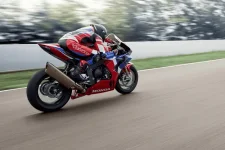
Action shot of a 2020 Honda CBR1000RR-R SP
The only problem with the ‘Blade was that where it led, others naturally followed and, often, did a better (or rather, more powerful) job, hence the constant development of the ‘Blade. Up to a point that worked, until the fateful day that Honda realized that power above all else was the deciding factor in the allure of a superbike. The 13th generation of the ‘Blade, introduced in 2017, had a power output of 189bhp which is surely enough for any rider but, with rivals pushing the 200bhp mark, Honda was seen to be lagging behind yet again. Never mind that the new ‘Blade was one of the sweetest handling and most user-friendly superbikes out there, those bar-room braggers needed POWER!
For three years, Honda resisted the temptation to join the ‘200 Club’ until early 2020 when the 14th generation was launched. Honda finally offered the CBR1000RR Fireblade with 214 horsepower, which is commonly known as a Lot of Power! The best thing, however, was that Honda refused to abandon the core principle behind the ‘Blade in this pursuit of power: that it should first and foremost be the chassis that is important for, without control, power is nothing! You do not have permission to view the full content of this post. Log in or register now. The 2022 Fireblade is insanely compact but remains telepathically intuitive to ride and is still the most accessible of all the lire superbikes. The question now is: where next?
FROM: TOP SPEED
For more auto and motorcycle news, follow arsenal1205.