 PH
PHartichoke211
Eternal Poster

Pa sagot po, maraming salamat
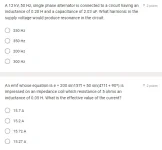
A 12 kV, 50 Hz, single phase alternator is connected to a circuit having an inductance of 0.20 H and a capacitance of 2.03 uF. What harmonic in the supply voltage would produce resonance in the circuit.Walang anuman po, handa po akong tumugon sa mga katanungan ninyo. Ano po ang katanungan ninyo?
A non-sinusoidal voltage consists of a fundamental and a third harmonic. If the effective value of the composite wave and the fundamental are 240 volts and 230 volts, what is the effective value of the third harmonic?Walang anuman po, handa po akong tumugon sa mga katanungan ninyo. Ano po ang katanungan ninyo?
Ang formula para sa pag-compute ng effective value ng isang non-sinusoidal waveform ay:A non-sinusoidal voltage consists of a fundamental and a third harmonic. If the effective value of the composite wave and the fundamental are 240 volts and 230 volts, what is the effective value of the third harmonic?
68.55 volts
58 volts
162 volts
170 volts
ito po
A 12 kV, 50 Hz, single phase alternator is connected to a circuit having an inductance of 0.20 H and a capacitance of 2.03 uF. What harmonic in the supply voltage would produce resonance in the circuit.Walang anuman po, handa po akong tumugon sa mga katanungan ninyo. Ano po ang katanungan ninyo?