 PH
PHAll of us have tried learning something new: a photo editing software, a foreign language, or a brand new industry that you’re about to enter into.
If you’re like most people, then you’ve probably given up learning this skill before you reached mastery. For whatever reason, you weren’t picking up the skill as fast as you expected, got bored of the subject, or maybe you just didn’t have enough time.
There’s dozens of mistakes that all of us make when we’re learning something for the first time. In this post, we’re going to share with you the top 5 mistakes that you should avoid when learning something new.
1. No clear end goal
Put an average joe next to a person with impressive achievements, and it’s likely that the latter had clear, specific goals that they reviewed on a regular basis.
Without a clear end goal of what you want to achieve, it’s easy to lose motivation or give up when the difficult times inevitably arises.
Let’s review the difference between a bad goal, good goal, and a great goal.
Bad goal: I want to become learn a new language so I can travel to Europe by next year.
Good goal: I want to learn how to speak Spanish so I can travel to Spain by next summer.
Great goal: I will have a 15-minute conversation in Spanish with a native Spanish person over coffee in a cafe in Madrid on July 2016.
Notice the difference between the first and last goal? The great goal had certainty, specificity, and a measurable deadline for when the goal will be completed. Too many of us set general, broad goals which makes it impossible for us to visualize and focus on.
2. Putting the cart before the horse
This is a mistake that I’m sure we can all admit to. When we’re not aware of all the steps involved in learning a new skill, it’s easy to underestimate the complexity of the process involved. How many times have you judged a skill or task from the outside, only to realize how difficult it is once you’ve tried it yourself?
While there are shortcuts and ways to shorten the learning curve in anything, there is a progression that we need to follow if we want to have lasting results. For example, you can’t go from knowing zero Spanish to becoming a fluent speaker, without reaching conversation fluency first. And you can’t reach conversation fluency without understanding the basics of grammar, vocabulary, and sentence structures. Nor can you build a $100M business, if you haven’t even built a $100K business yet.
3. Having unrealistic expectations
As an avid optimist, I’m certainly guilty of this. As Tony Robbins says, “Once you have mastered time, you will understand how true it is that most people overestimate what they can accomplish in a year— and underestimate what they can achieve in a decade!”
In the rapidly changing world we live in, it’s easy to be impatient. It seems like if we’re not making 10x progress all the time, then we’re going backwards. Everywhere we look, there are “5 steps to do X”, or “how to do X in 30 days” when the truth is, all great things take time.
While having big goals is important, such as I’m going to learn Spanish in 1 month, it can actually do us harm if we don’t truly believe that we can get there.
The rule of thumb is: the size of our goals should make us uncomfortable, and slightly out of reach.
4. Using the wrong strategy
The right strategy can save 100’s of hours of hard work.
“Give me six hours to chop down a tree and I will spend the first four sharpening the axe.” -Abraham Lincoln
Learning smart is just as important as the repetitions you put in, and we should make it a habit to take a step back to observe what the most effective strategy is moving forward.
You can also apply the Pareto’s Law to understand if you’re using the right strategy, by asking: “Is this the best 20% of my time, energy, and method I can use that will deliver 80% of my desired results?
For example, if you want to improve your public speaking skills, you may want to focus on just attending your local Toastmasters community and getting real-life practice. Or if you want to learn how to speak a foreign language, you may want to just work with a professional native speaking teacher online, instead of learning from Duolingo or books.
5. Trying to do it alone
When we’re learning something new, all of us experience what’s called a training curve.
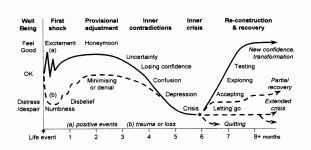
The training curve is the upward and downward slope of emotions that we face, from excitement to depression. When we decide to learn everything alone, without seeking outside help of a professional, we’re making it that much harder on ourselves. People that don’t have an accountability partner, mentor, or coach, are much more likely to quit at moments of difficulty versus someone that has support and pathway to follow.
In almost any aspect of our lives, we should have a coach that we work with, whether it’s a fitness trainer, financial advisor, business mentor, or sports coach. This is the best kept secret amongst the best performers and the fastest learners in the world.
If you want to get your finances in shape, hire an accountant or financial advisor. If you want to get in shape, hire a personal trainer. If you want to learn a new language, find a professional language teacher.
Life is too short to go at it alone. You’ll be pleasantly surprised how much help there is in the world, as long as you know where to look.
If you’re like most people, then you’ve probably given up learning this skill before you reached mastery. For whatever reason, you weren’t picking up the skill as fast as you expected, got bored of the subject, or maybe you just didn’t have enough time.
There’s dozens of mistakes that all of us make when we’re learning something for the first time. In this post, we’re going to share with you the top 5 mistakes that you should avoid when learning something new.
1. No clear end goal
Put an average joe next to a person with impressive achievements, and it’s likely that the latter had clear, specific goals that they reviewed on a regular basis.
Without a clear end goal of what you want to achieve, it’s easy to lose motivation or give up when the difficult times inevitably arises.
Let’s review the difference between a bad goal, good goal, and a great goal.
Bad goal: I want to become learn a new language so I can travel to Europe by next year.
Good goal: I want to learn how to speak Spanish so I can travel to Spain by next summer.
Great goal: I will have a 15-minute conversation in Spanish with a native Spanish person over coffee in a cafe in Madrid on July 2016.
Notice the difference between the first and last goal? The great goal had certainty, specificity, and a measurable deadline for when the goal will be completed. Too many of us set general, broad goals which makes it impossible for us to visualize and focus on.
2. Putting the cart before the horse
This is a mistake that I’m sure we can all admit to. When we’re not aware of all the steps involved in learning a new skill, it’s easy to underestimate the complexity of the process involved. How many times have you judged a skill or task from the outside, only to realize how difficult it is once you’ve tried it yourself?
While there are shortcuts and ways to shorten the learning curve in anything, there is a progression that we need to follow if we want to have lasting results. For example, you can’t go from knowing zero Spanish to becoming a fluent speaker, without reaching conversation fluency first. And you can’t reach conversation fluency without understanding the basics of grammar, vocabulary, and sentence structures. Nor can you build a $100M business, if you haven’t even built a $100K business yet.
3. Having unrealistic expectations
As an avid optimist, I’m certainly guilty of this. As Tony Robbins says, “Once you have mastered time, you will understand how true it is that most people overestimate what they can accomplish in a year— and underestimate what they can achieve in a decade!”
In the rapidly changing world we live in, it’s easy to be impatient. It seems like if we’re not making 10x progress all the time, then we’re going backwards. Everywhere we look, there are “5 steps to do X”, or “how to do X in 30 days” when the truth is, all great things take time.
While having big goals is important, such as I’m going to learn Spanish in 1 month, it can actually do us harm if we don’t truly believe that we can get there.
The rule of thumb is: the size of our goals should make us uncomfortable, and slightly out of reach.
4. Using the wrong strategy
The right strategy can save 100’s of hours of hard work.
“Give me six hours to chop down a tree and I will spend the first four sharpening the axe.” -Abraham Lincoln
Learning smart is just as important as the repetitions you put in, and we should make it a habit to take a step back to observe what the most effective strategy is moving forward.
You can also apply the Pareto’s Law to understand if you’re using the right strategy, by asking: “Is this the best 20% of my time, energy, and method I can use that will deliver 80% of my desired results?
For example, if you want to improve your public speaking skills, you may want to focus on just attending your local Toastmasters community and getting real-life practice. Or if you want to learn how to speak a foreign language, you may want to just work with a professional native speaking teacher online, instead of learning from Duolingo or books.
5. Trying to do it alone
When we’re learning something new, all of us experience what’s called a training curve.
The training curve is the upward and downward slope of emotions that we face, from excitement to depression. When we decide to learn everything alone, without seeking outside help of a professional, we’re making it that much harder on ourselves. People that don’t have an accountability partner, mentor, or coach, are much more likely to quit at moments of difficulty versus someone that has support and pathway to follow.
In almost any aspect of our lives, we should have a coach that we work with, whether it’s a fitness trainer, financial advisor, business mentor, or sports coach. This is the best kept secret amongst the best performers and the fastest learners in the world.
If you want to get your finances in shape, hire an accountant or financial advisor. If you want to get in shape, hire a personal trainer. If you want to learn a new language, find a professional language teacher.
Life is too short to go at it alone. You’ll be pleasantly surprised how much help there is in the world, as long as you know where to look.