 PH
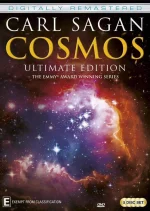
PHPBS - Cosmos (1980)
TV-PG | 13h | Documentary | TV Mini-Series (1980)
45 GB
45 GB
Information
Part 1: The Shores of the Cosmic OceanAstronomer Carl Sagan leads us on an engaging guided tour of the various elements and cosmological theories of the universe.
Part 2: One Voice in the Cosmic FugueCarl Sagan examines our planet's place in the universe by leading us on a journey from Earth to Deep Space.
Part 3: Harmony of the WorldsCarl Sagan examines the origin, development, and complexity of life on Earth and speculates on the possibility of life developing elsewhere in the universe.
Part 4: Heaven and HellAfter briefly looking at the pseudoscience of astrology, Carl Sagan examines the history of astronomy from ancient times through Ptolemy to Johannes Kepler.
Part 5: Blues for a Red PlanetCarl Sagan examines the nature of comets before turning to a close look at the planet Venus.
Part 6: Traveller's TalesCarl Sagan looks at the search for life on Mars from the speculations of Percival Lowell and H.G. Wells to the arrival of the Viking probes.
Part 7: The Backbone of NightCarl Sagan looks at the planets Jupiter and Saturn by examining the work of Galileo, Huygens, and the Voyager probes.
Part 8: Journeys in Space and TimeCarl Sagan looks at the work of ancient Greek scientists and astronomers including Thales, Anaximander, Democritus, and Pythagoras.
Part 9: The Lives of the StarsCarl Sagan explains scientific concepts like relativity and examines the possibility of time travel.
Part 10: The Edge of ForeverCarl Sagan examines the life cycle of stars from their creation to their deaths.
Part 11: The Persistence of MemoryCarl Sagan focuses on the origin of the universe by discussing the Big Bang, Galaxies, Dimensions, and the expansion of the universe.
Part 12: Encyclopaedia GalacticaCarl Sagan examines life on earth discussing genes, DNA, the brain, and human social development.
Part 13: Who Speaks for Earth?Carl Sagan examines the possible extraterrestrial life and discusses his skepticism about UFOs.
Carl Sagan considers the significance of science and discusses the importance of human survival in the nuclear age.
Link:
You do not have permission to view the full content of this post.
Log in or register now.